A monk settled on the shores of Lake Onega back in the 14th century. His name was Lazarus. In 1352, he received a charter for the land and founded a monastery. The first temple in it was a small wooden church, which the monk cut down himself. Tradition says that Lazarus lived a long and righteous life (he died at 105 years old), and when he died, he was buried behind the altar. In 1811, a chapel was erected over that place.
The church is small, so in later centuries it was used for worship only once a year, on Lazarus Saturday. And for daily services, other churches were built: the Nativity of John the Baptist, the Dormition of the Virgin Mary.
The tiny Church of the Resurrection of Lazarus eventually ended up behind the monastery fence and stood there until it was dismantled and transported to Kizhi (1959).
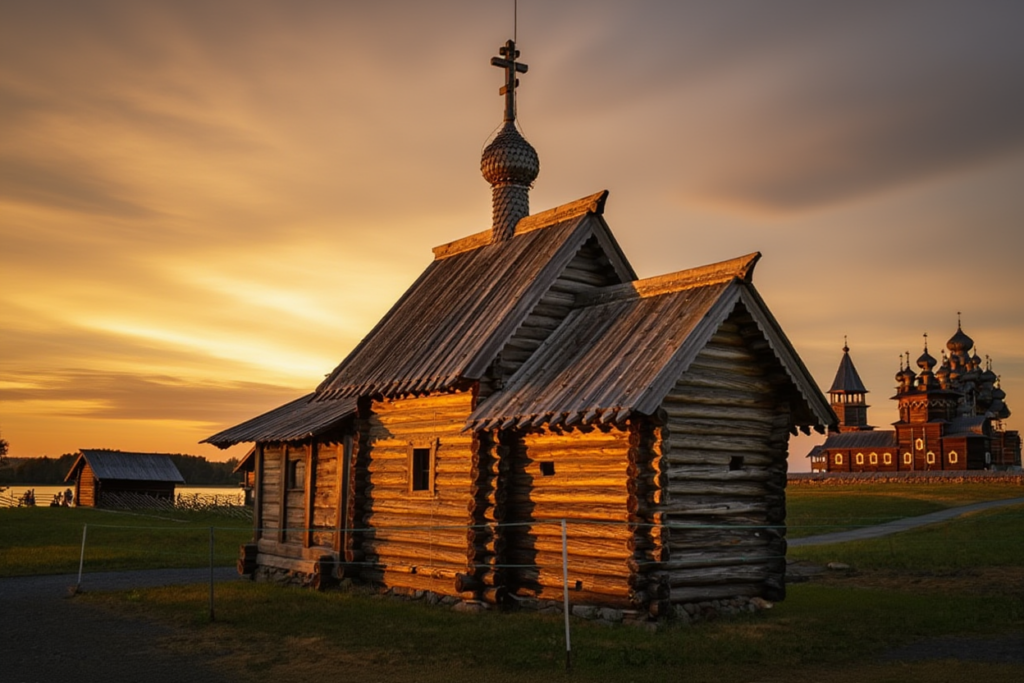
The peculiarity of the Murom Church is that it represents the initial stage of wooden architecture, shows how Russian wooden architecture developed.
The building has no foundation. It was placed on large boulders. The floors are made of huge blocks. There is not a ceiling everywhere, for example, it is absent in the entryway and the altar.
The first restoration was carried out in 1960. In 1975, the logs were treated with a chemical compound for preservation. The last restoration was completed in 2006, by which time the church had become dilapidated, especially the roof. The roof was replaced, a new chapter was installed, and the old one was transferred for storage to the storerooms of the Kizhi Museum. Nails, a lock and a key were forged according to ancient samples. Contrary to
popular opinion, not all buildings were built in Karelia without nails. They were also used in the original church.
Internal restoration of the temple is yet to come.
Charitable Foundation Holy Land
Temples and Monasteries of Russia