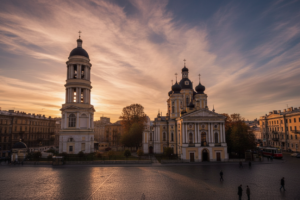
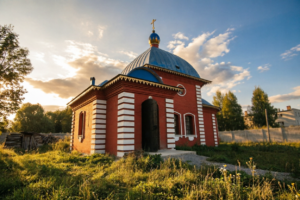
Even if you don’t remember the name, you’ve heard of the monastery. At school, when they studied “The Word about Igor’s regiment”. It was in the local library that the only copy of this work of ancient Russian literature was found.
The monastery was founded by Prince Konstantin Vsevolodovich, in the 12th century. The monastery was the center of the spiritual and cultural life of the city, as well as part of the complex of city fortifications. He opened the first spiritual school in the region. The library was amazingly diverse. Dozens.
The monks were engaged in rewriting books.
Unlike the Yaroslavl Kremlin, the walls of the monastery were stone. When, in the 18th century, the Kremlin wooden walls were dismantled, the monastery was mistakenly called the Kremlin. His sight was formidable and impregnable. Its walls helped to withstand a month-long siege of Polish troops during the Time of Troubles. It was from here that the troops of Minin and Pozharsky went on a liberation campaign.
Here, on the way to Moscow, came the new Russian tsar Mikhail Romanov. Here he officially agreed to ascend the throne.
The main temple of the monastery is the Transfiguration Cathedral. Built in the 12th century. It was completely destroyed in a fire in 1501, and a new one was built in its place, which has survived to this day. This monastery loved to visit Ivan the Terrible. He gave the monastery lands and rich gifts. The new cathedral had a rich iconostasis. Moscow and Yaroslavl icon painters took part in its creation. The frescoes of the temple are the oldest preserved wall painting.
In the 16th century, the belfry, refectory and Christmas church were added to the monastery complex.
In the 18th century stone towers appeared in the monastery. One of them, Ugly, has survived to this day. At the same time, a seminary was opened at the monastery. It worked until the late 19th century. In 1787 the bishop’s see was moved here and the monastery became the bishop’s house.
In the 19th century, a church of Yaroslavl wonderworkers David, Constantine and Fedor was erected next to the cathedral, a belfry was built.
In 1918 the monastery was closed. The buildings were used as housing, agricultural equipment. In the 50s, restoration was carried out and the Yaroslavl State Historical, Architectural and Art Museum Reserve was organized on the basis of monastic buildings.
Charitable Foundation Holy Land
Russian Temples and Monasteries