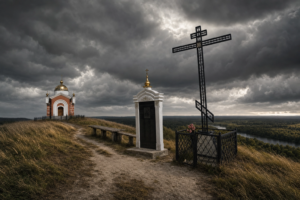
A thousand years is almost unthinkable for a Russian church, but that is how long the history of this place measures. Prince Vladimir had not yet completed the baptism of all his lands, but on the high bank, surrounded by impassable thickets, the first cage had already been cut down. The tenth century, its very end. A tiny church made of ship pines, consecrated in the name of St. Nicholas the Pleasant, became the core of the future city of Alexandrov. Then the tract was called simply — Nikolsky churchyard, and the ringing of its simple bell was drowned in the noise of the centuries-old forest.
Christianity spread throughout Zalesye slowly, and soon another log house rose to the east of the churchyard — this time Rozhdestvensky. The two wooden shrines stood side by side, like two wings, until the hurricane of Troubles burned the area to the ground. Scribe books from 1627–1630 record a dry fact: the settlement is empty, the land is devastated, but both churches are intact. We resisted. It was this point on the map that, half a century later, the co-ruler brothers John and Peter chose to stop. The arrival of royalty in 1687 breathed new life into the old walls. Pyotr Alekseevich, then still young and passionate, ordered the dilapidation to be erased: nine years later, in 1696, a stone was laid on the ashes of two wooden predecessors. This is how the Church of the Nativity of Christ with the St. Nicholas Chapel arose — the memory of the ancient graveyard moved inside the new walls.
The stone skeleton stood for more than a century, until the Alexander merchant family took up the matter. In 1829, Fyodor Baranov added a belfry, removing the last wooden part of the ensemble. His son, Ivan, in 1847 expanded the refectory so much that almost the entire district population could fit within the walls. The chapel of Archangel Michael had already been erected by that time — a year earlier than Nikolsky. Yakov Nikiforov, the provincial architect, maintains lines in a strict Empire style: heavy plasticity, the absence of elaborate stucco, the play of light on the surface of the whitewashed facades. The result was a temple-ship, powerful and at the same time ascetic.
And then the turning point of 1920 happened. Crosses were knocked off the domes, and opera arias began to sound in the naves. For seventy long years the building served as anything — a theater, a bakery, a club, an exhibition hall — but not as a place of liturgy. Sacred space was desecrated not by destruction, but by everyday life. The heat of the stove ate away the remains of the frescoes, and the footsteps of spectators erased the floor slabs. Only in 1991 did they begin to remove the skeleton. The first service was served in the bitter cold of Christmas Eve 1992 in the St. Michael’s Chapel. Archbishop Eulogius consecrated the throne a year later, and by the beginning of the two thousandth the dome with the cross again pierced the sky of Alexandrov. Today, prosphora is baked here in its own bakery, children learn the Law of God, and in the baptismal room, babies cry again, just like centuries ago.
Charity FoundationHoly Land
Temples and Monasteries of Russia