St. Isaac’s Cathedral, by this name everyone knows this temple, was built 4 times. In 1707, the foundation of the church was laid in honor of the birthday of Peter the Great. It was the day of Isaac of Dalmatia, so the temple was dedicated to him. But the life of a wooden church in a marshy area is short-lived, so in 1717 Peter ordered the wooden walls to be replaced with stone ones. When the work
was completed, it became clear that the new building was a replica of the Peter and Paul Cathedral. All techniques, lines, even chimes were repeated one after another. In 1735, the building was struck by lightning and was severely damaged by a fire. They did not restore it.
Catherine II ordered the cathedral to be restored, but in a new place, behind the monument to Peter. However, things had barely moved forward when the empress died. The new Tsar, Paul, ordered the temple to be completed. But even here there were problems. In 1816, during a service, a huge layer of
plaster collapsed from the ceiling. There were no casualties, but visiting the cathedral became dangerous.

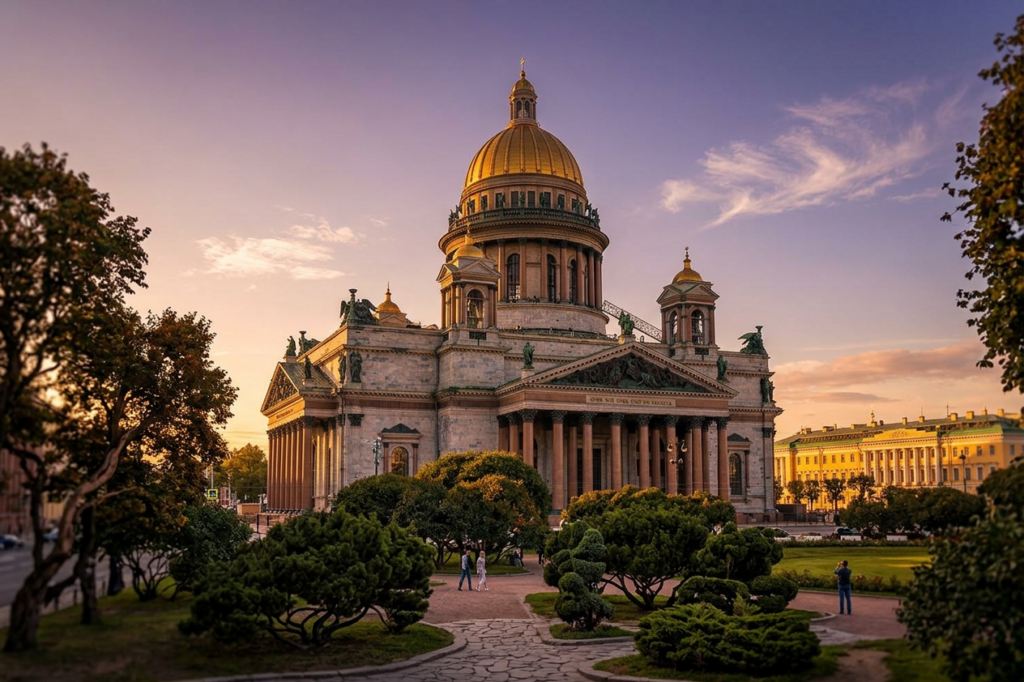
The next emperor, Alexander I, ordered the cathedral not to be repaired, but to be rebuilt. A competition was announced for the best architectural project. Auguste Montferrand won the show jumping competition. It is his brainchild that we still admire.
The building took 40 years to build, during which time 3 emperors changed the throne. Not only did each of them make their own wishes, but the area itself was a poorly drained swamp. 11 thousand piles were driven into the ground, and granite blocks were laid on them. For the porticoes alone, 48 monolithic blocks had to be delivered, each weighing 114 tons.
In an unusual construction decision, Montferrand installed the columns before the walls were built. The first was installed in 1822, with a huge crowd of people, in the presence of the royal family. The turn to the last one came only after 8 years.

Only in the forties, when the walls were erected, a huge dome with a diameter of 25.8 meters rose above the cathedral. The copper lining of the dome was poured with molten gold on top. This took 100 kg of gold. At the same time, mercury was used, so the work was deadly in
all senses.
The project did not have a bell tower, but the architect preserved the tradition of the five-domed church, installing 4 towers with domes along the edges.
Finally, in 1848, construction was officially completed. The next 10 years were spent finishing the interior. The illumination of the cathedral took place in 1858.
They spent on the interior decoration:
400 kg of gold
16 tons of malachite
1000 kg of bronze
500 kg lapis lazuli
Now, St. Isaac’s Cathedral is a museum-monument, open to the public, but services are held there and the Sacraments are performed.
Charitable Foundation Holy Land
Temples and Monasteries of Russia