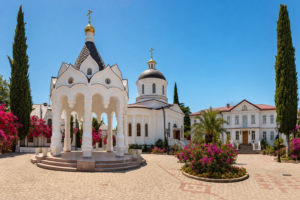
In ancient Russia temples were often built similar to fortresses. In the case of raids, it was possible to hide there, or even organize a defense. This feature of ancient churches was used by Prince Grigory Gagarin when he designed the Holy Ascension Cathedral in a small village (now it is a city) Alagir. Times were turbulent. In the Caucasus, one military clash followed another. And the location of the temple made you think about defense. The church was built at the same time as the silver factory. They were completed simultaneously, in 1853. Those who want to be rich in silver, smelted in the shops of Alagir, too, was enough.
The powerful stone walls of the cathedral and 5 watchtowers cooled the riotous heads, and the parishioners were served as soothing. The height of the fence is more than 2 meters, and the towers are 8 m. They have survived to our days.
The temple was built from local tufa, but there are reports that Greek masters participated in the construction. The cathedral raised its slap-like head by 24 meters. The style of the cathedral is neo-Byzantine. The temple is cross-domed, with three apses, three porches and three entrances. Inside it was painted 2 times, during construction and 40 years later, during restoration. Then replaced the roof, updated the interior.

A little later than the temple itself, the bell tower was built (1867). It had 2 large bells, several small bells and a clock with a fight.
In 1927, the cathedral was closed, the bells were melted down, and the bell tower itself was destroyed. The building of the church was preserved only because a local history museum was organized there. What the Soviet government failed to do was almost succeeded by the fascists. During the war, the cathedral was badly damaged by artillery shelling. There were no windows left, the walls were destroyed, the painting was spoiled.
In the late 50s, a large-scale restoration was carried out. They strengthened the walls, cleared the rubble, and most importantly, restored the painting of the cathedral, which was made by the famous artist Costa Khetagurov in the late 19th century. But by the end of the 80s, the building again dilapidated, the colors faded, the plaster crumbled.
In 1989, the cathedral was returned to the church, at the expense of parishioners and with the support of local authorities began its reconstruction. It was fully completed by 2000, but the cathedral was consecrated, and it began to operate in 1989. In 2002, a new bell tower was built.
Charitable Foundation Holy Land
Russian Temples and Monasteries