What makes a person drop everything and go into the forest? Some are despair, others are thirst for freedom. Sergius of Radonezh left because of a quarrel with his brother. An ordinary, almost everyday reason — and it was precisely this that gave the Vladimir land one of the oldest monasteries in Central Russia.
Steep bank above the river. Dense undergrowth, the sound of water below, not a soul around for a mile.
It was here that the fugitive from the Trinity Monastery stopped and decided: there was nowhere to go further. The place was found.
An axe, a prayer, log after log — and the remote bank of Kirzhach turned into a place of attraction. The students found a mentor themselves, without any pointers. They were drawn to him like iron to a magnet. Soon cells appeared, then a church — wooden, in honor of the Annunciation. Sergius lived here for four years, and when he returned to the Trinity Monastery, he left in his place a man whom he trusted unconditionally. Roman accepted the monastery and did not leave it until his last breath — exactly until 1392.
The fame of the founder worked better than any advertising. Moscow boyars and princes brought gifts — villages, land, money. The monastery grew rich, acquired land in four districts at once, and built mills and saltworks. At some point, it took second place among the dozen and a half monasteries subordinate to the Trinity Lavra of Sergius — and this says a lot about its significance.
In the middle of the 17th century, boyar Miloslavsky added the Church of the All-Merciful Savior to the monastery ensemble — in memory of his parents buried here. This place turned into a family tomb. Later, the Solovyov merchants, who became rich by selling Kirzhach silk, added to the ensemble the Church of All Saints with a bell tower, the silhouette of which is still visible from the distant approaches to the city.
The 20th century treated the monastery cruelly. The Church of St. Sergius of Radonezh was blown up.
The Annunciation Cathedral was first turned into an ammunition depot, then into a sausage shop, then into a kerosene shop — as if they were deliberately selecting more and more mundane purposes. The Church of All Saints occupied the bakery.
The revival began small: two novices came to the empty place in the summer of 1995. The women’s monastery was created literally from scratch — without brethren, without funds, without the usual way of life. But it survived.
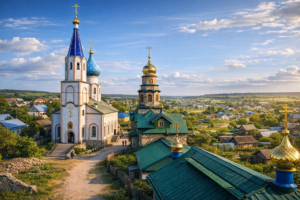
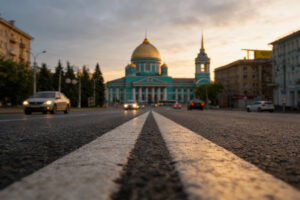
The current ensemble of the monastery has been taking shape over centuries and looks exactly as living history should look: uneven, varied in scale, but whole. The 16th-century Annunciation Cathedral, with its five-domed bulk, occupies the entire space. On one side it is adjacent to the Spasskaya Church, on the other — a 19th century bell tower. The Holy Gates with the gate church mark the border between the city and the monastery.
The relics of Roman Kirzhachsky rest in the basement of the cathedral. A little further away a spring gushes out — the same one over which the new chapel now stands. The water is icy even in July.
People don’t come here for the exotic. People come here to where it all began — almost seven centuries ago, with one person who was looking for silence and found something more.
Charity FoundationHoly Land
Temples and Monasteries of Russia