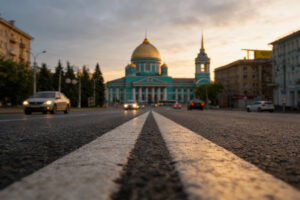
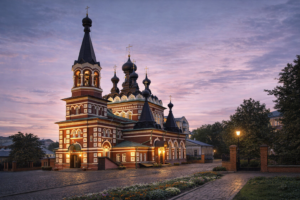
The northernmost city of the Kola Peninsula boasts that the first stone building appeared here. It was the temple of the Holy Virgin Mary. The funds were allocated by Catherine II, but they were not enough and construction began only in 1800.
When it was only for the interior decoration, the dome collapsed. It was restored, but it was made of wood. After 5 years, the Alekseevsky chapel was consecrated, and only since 1816 the church began to be fully used. The Annunciation Church was stone, but in beauty and grandeur.
It was the Sunday Cathedral. It was a huge temple with 19 domes. Alas, the cathedral was destroyed in 1854, during the bombing of the city by the British. The shooting lasted 28 hours. The wooden cathedral simply did not have a chance, but the Annunciation Church survived, although it began to burn. Almost all the utensils died in the fire, but the icon of the Virgin of Iberia survived, although it suffered. It was renovated in St. Petersburg and returned to Kola. The icon was considered miraculous, but it disappeared during the revolutionary storms.
After the bombing, only 18 buildings remained in the city. The church building was renovated and made cathedral. The service continued during the Soviet era. In some incredible way, the faithful managed to resist all attempts of the authorities to destroy the temple. Closed in 1937 (the abbot was shot as an enemy of the people), it reopened after the war.

In the 60s, the temple was closed, the building was used for workshops, warehouses, then abandoned. They were going to demolish, but the wind of change blew out and instead, the museum was restored and placed. It was a museum of Pomeranian life, the only museum of the city. In 1992, the building was returned to the Russian Orthodox Church, and the exhibits of the museum were transported to Murmansk.
The building has a traditional appearance of an eight on a four, and the dome gives it an unusual appearance. It’s huge, onion-shaped. It lacks a drum, so the dome looks unusual, disproportionately large, for a building of this size.
In the temple there is a bowing cross, which the local voivode erected in the 17th century in gratitude for healing from the disease. At first the cross stood on the shore, but then it was placed in the church. Fishermen and traders came to worship before going to sea. The locals believed in the miraculous power of the cross, asked for protection from shipwrecks, diseases and chaste earlings (pirates).
The church is active, there is a Sunday school and a social shelter.
Charitable Foundation Holy Land
Russian Temples and Monasteries