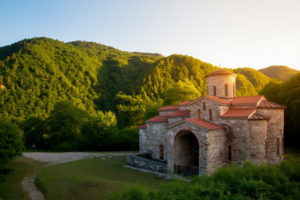
Forty-four versts from Kargopol, on the quiet Churyuga River, among fields and wild forests, stands a monastery that survived fires, looting and decades of oblivion. Alexandro-Oshevensk monastery is one of the oldest in the Russian North, and its history is read on the white-stone walls, which stubbornly hold for the fourth century.
Reverend Alexander
The founder of the monastery was born on March 17, 1427 in the family of a wealthy peasant Nikifor Oshevnya. The young man went to the Kirillo-Belozersky monastery, took tonsure with the name Alexander and about 1452 received a blessing to create a new monastery. The father had moved closer to Kargopol and called his son. Alexander came to Churyuga, raised a cross and vowed to stay here until the end of his life. The first wooden St. Nicholas Church was built by Nicephorus himself.
The monk introduced a strict social rule: silence in the temple and at the meal, constant prayer, manual labor. He warned the brethren, Do not be afraid of the labors and tribulations of the desert. May there be mutual love and humility within you.” Alexander died on April 20, 1479, fifty-two years old. After his death, the monastery was empty, leaving only five elderly monks. Revival began in 1488 under Abbot Maxim.
From lightning to white stone
Wooden temples were destroyed twice in the fire, in 1540 and 1706. The last fire began from a lightning strike on May 6: the entire monastery burned down, only the hegumen’s cell survived. It was after this catastrophe in 1707 that a stone two-storey building was laid.Dormition Cathedral— the oldest stone building of a vast region between Kargopol and Solovki. The cathedral is made of white limestone with brick parts; the lower floor blocks are larger and more carefully crafted. From the outside, it seems to be a five-headed pillarless temple, from the inside — a traditional four-pillar. The three-tier bell tower adjoins the western facade without a refectory — reception is extremely rare.
It was built in 1834.door-to-door NicholasIt is the place in which worship is now performed. And in 1900 in the center of the monastery put a wooden tent Pokrovskaya church — it stood until 1990, when its tent collapsed.
Devastation and quiet return
In 1928, the relics of St. Alexander were opened in the presence of local residents and representatives of the Soviets. The cathedral was looted, the monastery was closed. By the middle of the XX century, the Assumption Church turned into ruins, a school was located in the fraternal building.
The revival began in 2001, when Bishop Tikhon blessed the re-establishment of the community. Since 2008, restoration work has been underway: the roof of the St. Nicholas Church has been repaired, an iconostasis has been installed, the bell tower has been strengthened, and bells have been purchased. On October 30, 2025, the Holy Synod officially opened the monastery, appointing Theodosius (Kuritsyn) as abbot.
The Assumption Cathedral remains in ruins — walls without vaults, windows without glasses. But the white-stone arches, framed by grass and sky, have a special beauty — one that does not require restoration to touch the heart.
Charitable FoundationHoly Land
Temples and Monasteries of Russia