|
TRAIN DESCRIPTION (Travel description and all dates are conditional) |
TIME OF TRIES | Orientation cost of the trip. Clarify. |
|---|---|---|
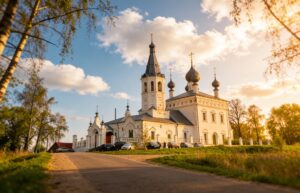
The journey covers three contrasting locations: a new church with a gray shrine, an outpost from the time of Dmitry Donskoy and a grandiose embodiment of the evangelical landscape on Istra. The story of the route is built around spiritual content, not tourist logistics.
The Church of Prince Alexander Nevsky appeared in the settlement of Prince Lake on private donations of the developer and future parishioners. The project of the nineteenth century in a pseudo-Russian key was developed by the architect S.V. Borisov. Nine chapters crowned the building in the autumn of 2009. At the same time, the fate of the ancient image of the Virgin “Odigetria” – the Guide, who passed through the centuries from Ephesus and Korsuni to Polotsk and Toropets. The Ministry of Culture responded to the request of the head of the church, and the relic left the halls of the Russian Museum. The interior is subordinated vertically: the five-tier altar barrier rises almost twenty meters, repeating the composition of the Smolensk Assumption Cathedral. The floor is lined with natural stone with ornament, made by Italian carvers.
Next, the pilgrims keep their way to Mount Watchmen near Zvenigorod. Here, at the end of the fourteenth century, the monk Savva, the tonsured son of Sergius of Radonezh himself, dug a cave and cut down the first wooden church of the Nativity of the Mother of God. The funds were allocated by Prince Yuri Dmitrievich. Over time, a small desert overgrown with stone fortresses and turned into a royal praying place. John the Terrible came here with his wife Anastasia. Later, Tsar Alexei Mikhailovich arranged in the monastery an exit residence with chambers for the queen. Today, residents pray at the founder’s crayfish, and guests draw water from an ancient well.
The final point is the Resurrection Monastery on the Istra River, conceived by Patriarch Nikon in 1656 as a living icon of the Holy Land. Architecture and toponymy repeat Jerusalem: the architects recreated the outlines of the Church of the Holy Sepulchre, the nearby stream was called Cedron, and the groves and heights around – Gethsemane Garden and Tabor. The twentieth century brought the monastery closure and museum status, and then undermining by retreating invaders in the winter of 1941. Revival began in 1994 with the return of the church. Fourteen years later, the board of trustees was headed by the head of state and the patriarch. The scaffolding was removed in 2015, and in May 2016 Patriarch Kirill consecrated the cathedral with a great rank. Those who come can venerate the tomb of the Lord in Kuvuklia, the tomb of Patriarch Nikon and the ark with the right hand of the martyr Tatiana.
The Holy Land Charitable Foundation
Soul investment!