Mount Athos (Greek: Άθως), in Greek sources officially called the Holy Mountain, Greek: Άγιον Όρος, "Ayon Oros" is the name of a mountain (altitude 2033 m) and a peninsula in Greek Macedonia in northern Eastern Greece. In the system of administrative regions of Greece, it is called the “Autonomous Monastic State of the Holy Mountain” (Greek: Αυτόνομη Μοναστική Πολιτεία Αγίου Όρους – “Aphthonomies of Monastic Politics of Ayu Orus”). This self-governing community of 20 Orthodox monasteries under the direct ecclesiastical jurisdiction of the Patriarch of Constantinople (since 1312) is the world’s largest concentration of Orthodox monasticism. The sovereignty of Greece over the peninsula is enshrined in the Treaty of Lausanne of 1923; the self-government regime is initially based on the provisions of the first Statute of the Holy Mount Athos ("Tragos"), approved by Chrysobulus Emperor John Tzimischios in 972. Unlike most of the Patriarchate of Constantinople, Mount Athos uses only the Julian calendar, including administrative documents. In 2001, the population of Athos was 2,262. For comparison, in 1903 the population of Mount Athos was approximately 7,432, and in 1917 it was about 10,500. For the Orthodox all over the world, it is one of the main holy places, revered as the earthly lot of the Virgin. UNESCO World Heritage Site. One of the most famous customs of Mount Athos is the ban on women and female animals.

Athos is one of the most mysterious places on earth. Nowadays, more and more people are eager to get to this Greek peninsula, covered with many legends.
According to legend, the Most Holy Theotokos herself preached faith in Christ here and received this land from God in her inheritance. Therefore, the peninsula is called the Allotment or Garden of the Most Holy Mother of God. For many centuries, monks – people who have left the fuss of the world for the sake of communion with God – make incessant prayers here. And every person who gets here feels the great power of the special fertile atmosphere reigning on this piece of land. This piece of land is small, but its importance in the fate of the whole world is great. This is where apocalyptic prophecies will begin to come true at the end of time. One of the signs of the end of the world will be the departure from the Holy Mountain of the Iverian icon of the Most Holy Mother of God, which is called the Gatekeeper. Twelve Athonite elders, as tradition says, will serve in the time of the Antichrist the last Divine Liturgy on earth. It is well known that everything that is most important and significant in the fate of mankind is usually done in secret, and only then becomes known. So the most important thing is that prayer, which is still worth the world, is performed by unknown selfless ascetics who come before God with tears for all of us. “You are the light of the world. The city that stands on the top of the mountain cannot be sheltered (Matthew 5:14). These Gospel words seem to be said about Athos and his ascetics. The world from which the monks took refuge here now glorifies many of them as saints and feeds on the spiritual fruits of their labors. And the secret life in God continues on this holy place from age to age, and now, in our difficult time, as Elder Silouan of Athos wrote: “Today there are still many ascetics whom the Lord has hidden by the fact that they do not work obvious miracles, but marvelous miracles are performed in their souls every day, only people do not know how to see them.” Every pilgrim returns from here to another. He has a spiritual experience that cannot be obtained anywhere else on earth. The grace of the Holy Spirit, prayers and advice of ascetics help a person to look at many things in a new way, change for the better, gain strength for good changes in his life, which will undoubtedly make the world around us brighter.
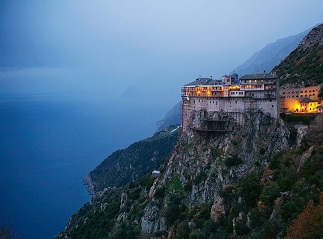
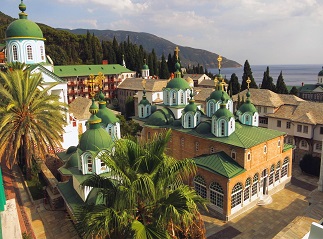
Athos is a name of pre-Christian origin. It is believed that this was the name of one of the pagan gods. In any case, the pagans lived in these places until, according to the Providence of God, these places were visited by the Most Holy Mother of God. According to legend, the ship on which the Blessed Virgin and the Apostle John the Theologian followed to Cyprus, the storm carried and nailed to the Athos shores. It was they who brought the news of Christ here. Mention of the first ascetics belong to the IV century. In the VII century, the Byzantine emperor Constantine IV Pogonat issued a decree that the peninsula was given to monastics who by that time lived here in cells and small monasteries. In 681 St. Peter settled in one of the caves – one of the most famous saints of St. Petersburg, who lived on Athos for 53 years. In the second half of the X century, after the foundation of St. Athanasius the Great Lavra, the rapid flowering of St. Agora monasticism began. By the middle of the XI century, one hundred and eighty monasteries were founded here. In the following centuries, the peninsula suffered greatly from both the Turks and the Latins. Some monasteries died, others were created.
Climate
Athos is one of the tips of the Greek peninsula of Halkidiki, or rather, its eastern part is 70 kilometers long and about 12 kilometers wide. It consists of mountains covered with dense forests, the highest peak reaches 2033 meters above sea level. The climate on Athos is Mediterranean subtropical with hot summers and rainy winters. The high humidity makes the winter very cold, despite the fact that the temperature here rarely falls below zero. In winter it often rains and sometimes snow.
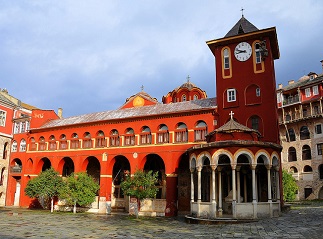
There are now twenty monasteries on the Holy Mountain, and, according to the existing law, it is prohibited both the abolition of existing and the creation of new monasteries. Each monastery has its place in the Athos hierarchy. In hierarchical order, monasteries are arranged as follows:
1. The Great Lavra is the oldest and largest of the monasteries.
2. Vatopedi (Bατοπέδι or βατοπαίδι) – the keeper of the honest Belt of the Most Holy Mother of God and seven miraculous icons;
3. Iversky (Iβήρων) – keeper of the legendary Iverian icon – Portaitissa (Gatekeeper);
4. Hilandar (Chilandari) – Serbian monastery, keeper of the icon of the Most Holy Theotokos of the Trinity;
5. Dionisiate (Διονυσίου) - the guardian of the honest right hand of St. John the Forerunner;
6. Kutlumush (Kουτλουμούσι) is a monastery of the X century, keeping the icon of the All-Merciful Intercessor and part of the foot of righteous Anna - the Mother of the Most Holy Mother of God;
7. Pantocrator (Παντοκράτορος) is the monastery of the Almighty, in which the oldest iconostasis on Mount Athos is preserved;
8. Xyropotamus (Xiropotamou), founded in the middle of the X century, stores the world's largest particle of the Life-giving Cross of the Lord with a hole from one of the nails;
9. Zograf (Zographou) – Bulgarian monastery in honor of the Great Martyr George the Victorious;
10. Dohiar (Δοχειαρίου) – the keeper of the icon of the Most Holy Theotokos “Gorgoipisus”, one of the most beloved and revered on Athos;
11. Caracal (καρακάλλου) – mentioned in documents as early as 1018, the honest head of the Apostle Bartholomew is kept here;
12. Philotheus (Philotheou) - a monastery known since the IV century, deeply revered by many Byzantine emperors;
13. Simonopetra (Σιμωνόπετρα) - a monastery of the XIII century, built on the edge of a sheer rock;
14. St. Paul (Aγίου Παύλου) – a Christian community on this site existed even under Constantine the Great;
15. Stavronikita (Σταυρονικήτα) is the smallest monastery on Mount Athos, the keeper of a rare mosaic image of St. John. Nicholas the Wonderworker;
16. Xenophon (Xenophontos) - on the site of this monastery in the year 520 a temple dedicated to St. Dmitry of Thessalun was erected;
17. Grigoriate (Oσίου Γρηγορίου), founded in the XIV century by Gregory Sinaitus and his disciples;
18. Esphigmenus (Eσφιγμένου) – Saints Anastasius, Patriarch of Constantinople, and Gregory Palamas lived in the monastery, as well as the founder of Russian monasticism, St. Anthony of Kiev-Pechersk;
19. Panteleimonov (Αγίου Παντελεήμονος, or Rossikon) is a Russian monastery on Mount Athos, the keeper of the head of the Great Martyr and healer Panteleimon;
20. Constamonite (Kωνσταμονίτου) is the keeper of the miraculous icon of St. Stephen of the VIII century and two miraculous icons of the Most Holy Mother of God.
Who is Athos subject to?
It is an autonomous monastic republic within the state of Greece. It is governed by the Holy Kinot, which unites representatives of all twenty monasteries elected for one year. The state of Greece has a governor on the Holy Mountain, who is under the authority of the Ministry of Foreign Affairs. The order is monitored by the Greek police.
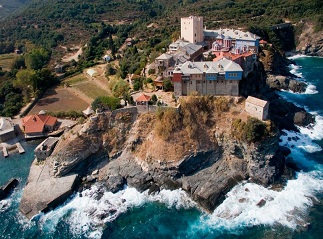
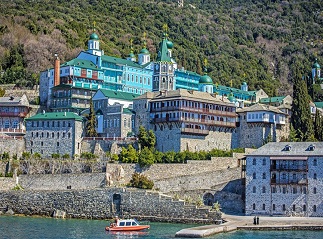
Pilgrimage to Athos
The Holy Mount Athos is the center of Orthodoxy, the lot of the Virgin. According to legend, it was here that a storm nailed the ship on which the Mother of God and the Apostle John were going to Cyprus. Since then, this place has attracted believers. Athos is an Orthodox republic within Greece. It is governed by the general council of all monasteries. There are now 20 on Athos. The opening of new and closing of existing monasteries is prohibited. It is forbidden for women to visit the Holy Mountain.
Getting to Athos isn’t easy. You need a special permit — diamonitirion. The number of pilgrims is limited.
The first Russian settlement here dates back to 1016, the «presbyter and abbot of the monastery of Rosov», the monk Gerasim signed that year under an important agreement. During the Tatar-Mongol yoke, the monastery lost its way, novices from Russia did not arrive, there were no offerings. After liberation from the yoke, the monastery on Athos was remembered. Prince Vasily 3 took the Panteleimon Monastery under his hand. But wars, political conflicts did not contribute to the flourishing of the monastery. Only in the 19th century, thanks to the patronage of the imperial family and the donations of large patrons, the monastery began to expand. Now it is one of the largest.
How many shrines in all of Athos is hard to imagine. Each of the monasteries was overshadowed by the blessing of the Queen of Heaven, many miracles occurred in temples and hermitages, at miraculous icons.
Incredible grace descends on Athos on those who came for spiritual rebirth. The Mother of God blesses the pure in heart who, in sincere prayer, falls to her feet.
The Holy Land Charitable Foundation thanks everyone for donations to God-pleasing cause. You can also purchase a trip for yourself and your family.
The Holy Land Charitable Foundation
Soul investment!