On the southern outskirts of the Moscow region, where the land is almost Ryazan, stands the village of Silver Ponds. The name sounds festive, but life here has always been simple: peasants, the bazaar, the road to Ryazan. And the church is one for the whole village, old, wooden, cramped. Until Count Sheremetev appeared.
Count and architect
At the end of the XIX century, these lands were owned by Count Sergey Dmitrievich Sheremetev — a man of an ancient family, historian, collector, philanthropist. He came to his Silver Ponds, saw the crowded St. Nicholas Church, from which people went out on Easter, because they did not fit inside, and decided: we need a new one. Big one. Warm. Stone.
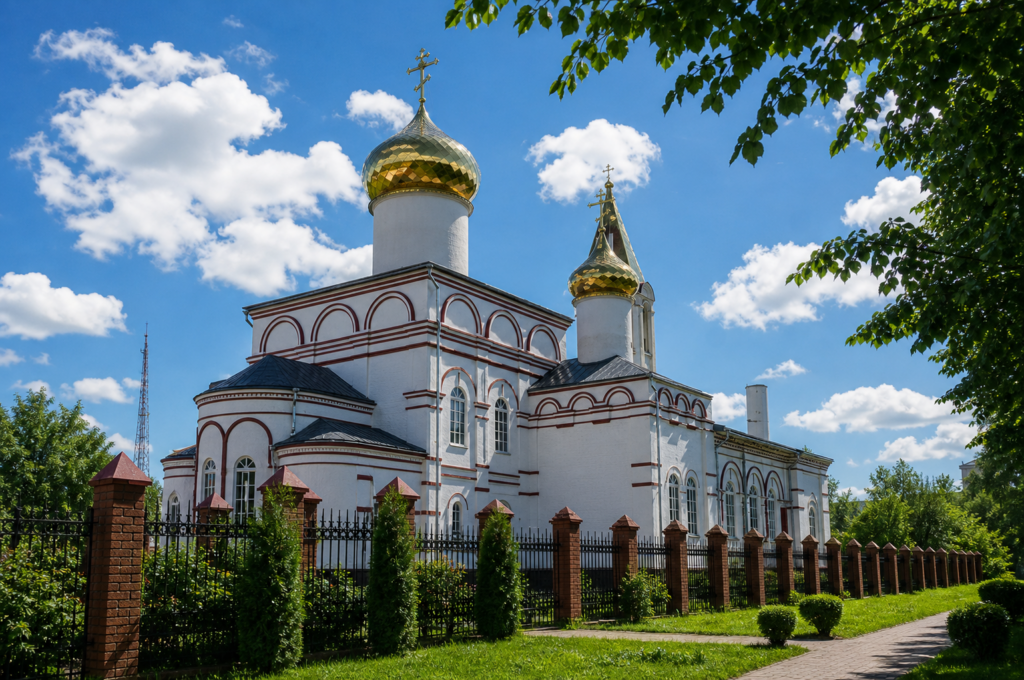
In 1901, the count set aside four tithes of land for construction — chose the most prominent place, next to the market square. The project was entrusted to Nikolai Vladimirovich Sultanov, an architect, art historian, restorer, a man who restored monuments of ancient Russian architecture and knew them like his five fingers. Sultanov conceived the temple in a pseudo-Russian style — with patterns, kokoshniks, tiles, in the spirit of the Moscow tsarist architecture of the XVII century. It counted on one thousand five hundred people. Warm — to serve in winter, which for these places was not a matter of comfort, but survival.
The thirtieth of August 1905 laid the first stone. And then the trouble started. The Russo-Japanese War. The revolution of 1905. Village unrest. Sultanov died in 1908 without seeing the temple finished. The First World War has begun. Construction’s creeping. Bricks were brought from Sheremetevsky factories — Serebryano-Prudsky and Dudinsky. Workers were, or were not: men were taken into the army. And yet in 1914 the temple was completed and consecrated.
The main throne is in the name of the icon of the Mother of God “The Sign”. Two side aisles were conceived to dedicate to the holy princes Boris and Gleb and the Great Martyr Catherine. But they did not have time to fully equip them — again the war prevented, and then 1917 came.
The building turned out to be impressive: a double-light four, a three-apse altar, a spacious refectory. The bell tower, however, made wooden — Sultanov wanted a tent stone, but either there was not enough money, or time. Wooden didn’t last long.
Warehouse, club, kindergarten
In 1929, the temple was closed. The bell tower was destroyed — either blown up or dismantled, in any case, only a trace remained of it. The building was given for economic needs. What else was there: a rural club, a library, a nursery, a kindergarten, a people’s home. Then there is the regional House of Culture. Walls were painted, redrawn, broke new doors, walled up old ones. The iconostasis is gone. Paintings, if they were, painted over. Domes demolished — why domes to the House of Culture?
In the early 1980s, a new building of the House of Culture was built in the village — a real one, with a large stage and foyer. The old temple is no longer needed. He got dumped. The roof flows, the brick crumbles, birch trees grow on the vaults — you can see them from the road, they stick out of the roof, like from a flower bed. The building was slowly dying.
Clearance
In 1995, the temple was transferred to the Orthodox community. Experts who inspected the building shrugged: there is nothing to restore, it is easier to demolish and build again. But the parishioners did not listen to the experts. They came with shovels, axes and buckets. Removed the roof, which over the years of desolation grew trees — uprooted them by hand, with roots. Cleared the trash. Built holes in the walls.
In 1999, new vaults were filled, floors were laid, water and electricity were supplied. On Christmas Day 2001, it was the first liturgy in more than seventy years. There were so many people that they stood on the street, as in the old St. Nicholas Church. In September 2002, domes with crosses were raised on the temple. A few years later, according to the project of the architect A.N. Maltsev, a new stone bell tower was erected — this time not wooden.
In 2008, icon painters Sergey and Tamara Zhilyaev painted the walls and vaults with frescoes. In the Borisoglebsky aisle, the main theme was the Baptism of Russia — Prince Vladimir, the people of Kiev in the waters of the Dnieper, a white temple over the river. In the second aisle — the priest Agafangel, Metropolitan of Yaroslavl — the new martyrs and confessors of Russia: those who passed through prisons and camps and did not renounce. For this temple, the theme is not abstract: it went through warehouses and clubs, through roof trees and painted walls.
On the seventeenth of August 2019, Metropolitan Juvenal of Krutitsky and Kolomna performed the great consecration of the temple. The temple was completely restored.
Coincidence
There is one coincidence in the history of this temple, which is hardly accidental. The feast day of the icon of the Mother of God “The Sign” falls on December 10. On the same day, December 10, Silver Ponds celebrate the Day of the liberation of the village from the German occupiers. So in winter, on the shortest day of the year, the soldiers-liberators are remembered here, and the feast is celebrated — the two holidays merged into one.
Today.
The temple is active, the main one in the Silver-Prude delicacy. There are children’s and adult Sunday schools and a library of Orthodox literature. It stands on Pervomaiskaya Street, house 5, a stone’s throw from the place where once there was a market square, chosen by Count Sheremetev. The square is long gone, so is the bazaar. The temple stands.
Charity FundHoly Land.
Russian Temples and Monasteries