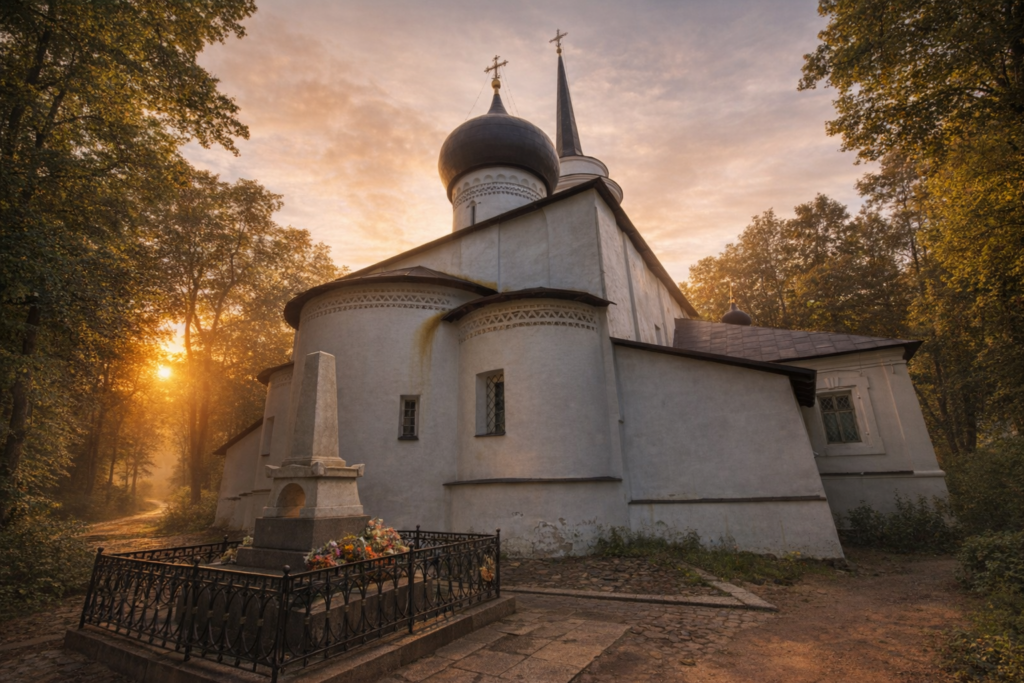
The central place in the monastery complex is occupied by the Assumption Cathedral. It was built by Pskov masters, in 1569, according to the canons of Russian religious architecture. The basis of the building is a «four» — a quadrangle of powerful walls of one and a half meters. To Quad.
2 chapels were added, the last in 1776.
The main shrine of the temple is the icon of the Mother of God Odigitria. This icon miraculously appeared to the shepherd Timothy. But in his native town he was considered a fool, a simpleton, and did not believe his story about the miraculous appearance of the icon of the Mother of God. I was most outraged by the “fairy tales”
local priest. Until his illness twisted him and he himself had a vision confirming the words of Timothy. The priest gathered the people and with the procession went to Sinichya Mountain, where everyone saw the icon on the pine. Miracles began to take place immediately. When the icon was removed from the tree, no one succeeded. After several unsuccessful attempts, Timothy was asked to try it, and the icon was immediately in his hands. After that, Timothy went to the cities and villages, telling everyone about the miraculous appearance of the icon. And she found shelter in the Assumption Cathedral, which arose on this site of the monastery. Not only the locals came to worship her, but also worshippers from distant places.
In addition, pilgrims are attracted to the pottery. There are collected particles of relics of 60 Russian saints.
The monastery itself is surrounded by a stone fence. You can get inside through the Saints (Fridays) and Anastasiavo Gate.
Another gate, Nikolsky, is inside the monastery. They connect the Holy and Merchant Courts.
Since the 18th century, the monastery has become an important part of the life of the Pushkin family. Here is their family tomb. First, the Hannibals were buried there, and later the Pushkins.
Despite the fact that by the 19th century the monastery had become a third-class one, a large library has been preserved in it since the old days. Her materials were used by Alexander Sergeevich when he wrote Boris Godunov.
On the territory of the monastery twice a year there were well-known fairs throughout the district. The poet loved to visit them, to watch people. It is known that it is heard at the fairs.
Proverbs were included in his tragedy “Boris Godunov”.
It was here that Pushkin’s body was brought in February 1837. Here he was buried, placing a modest cross with the inscription “Pushkin”. The monument on the grave was erected in 1841.
In 1924 the monastery was closed. The buildings were used for a club, bakery, printing house. During the Great Patriotic War, the monastery was mined, but miraculously not blown up. Fortunately,
After the war, the monastery buildings were restored and made a museum. In 1992, the monastery returned to the fold of the Orthodox Church. In 2005, a monastery was opened in the village of Stolbushino.
There are now 25 monks living there. The monastery receives Orthodox pilgrims.
Charitable Foundation Holy Land
Russian Temples and Monasteries