On the high bank, where the waters of Big and Small Civil merge, stands a monastery born of a miracle. The Tikhvin Theogoroditsky Monastery did not appear according to the princely decree and not according to the plan of the architects — it was erected by grateful citizens who survived the mortal danger and received heavenly intercession.
It all began in the autumn of 1671. Stepan Razin’s troops approached Civilsk. The forces of the defenders melted, the city was ready to fall. And then, as the legend says, the pious citizen Juliana Vasilyeva appeared in a dream the Virgin. She pointed to the Tikhvin image from the Trinity Cathedral and ordered not to be afraid: the enemy will retreat, and after deliverance, a monastery should stand here in her honor. In the morning the attackers suddenly became blind, massacre broke out in their camp, and the civilians, having opened the gates, drove the enemy away by a procession.
Four years later, the streltsman Stefan Ryazanov cut down the wooden Ascension Church with the Tikhvin chapel at the place indicated by the Mother of God. The monks settled nearby — so a male monastery arose. However, spring floods year after year undermined buildings. By the middle of the XIX century, the monastery was almost empty, and the Kazan Archbishop Anthony even ordered its abolition. But the residents of Civilsk did not allow this to happen. They begged the hierarchy to preserve the holy place, and in 1871 the monastery was revived as a female one.
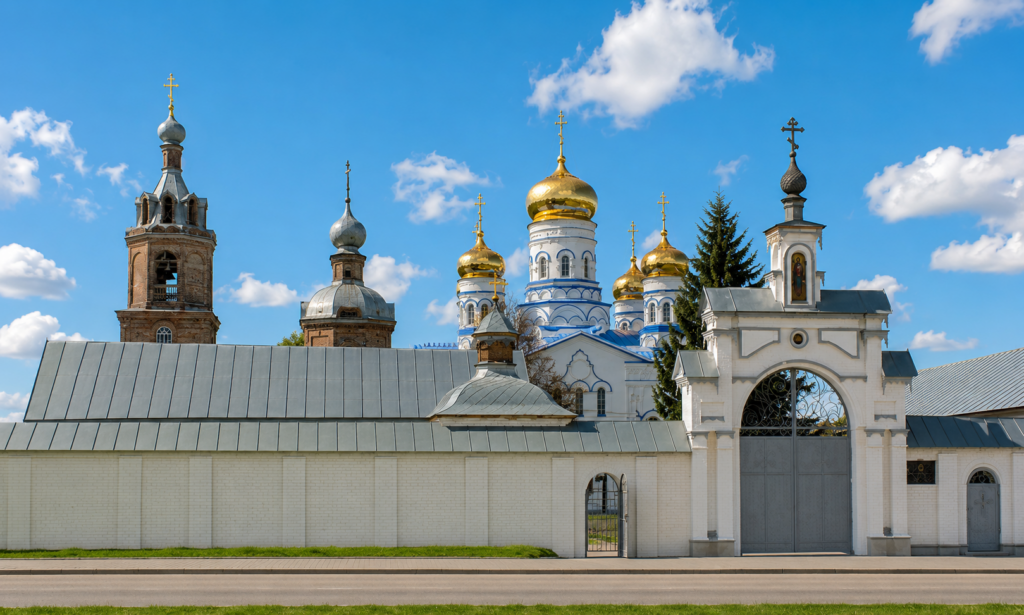
The real transformation is associated with the name of the abbess Cherubima and the Kazan merchant Vasily Nikitin with his wife Daria. On their donations in 1880, a stone three-chaired cathedral was laid. Six years later, he was consecrated: the main altar took the image of the Tikhvin Mother of God, the side dedicated to the Ascension and All Saints. Eclectic in spirit, with massive apses and five-domed over a cubic volume, the temple absorbed features of the Russian-Byzantine style and echoes of classicism. Nearby rose an elegant hegumen’s corps in the spirit of Moscow Baroque — with a mezzanine, porebriks and town belts. The complex also includes the wooden Kharalampi Church, a brick fence with towers and the Holy Gate leading directly to the western portal of the cathedral.
The Soviet era left deep wounds. In 1925, the monastery was closed. Crosses were knocked down from the domes, the bell tower was dismantled, and in the cathedral rebuilt beyond recognition, an orphanage, a hospital and a vocational school were placed alternately. Only in 1998 the Holy Synod decided to revive the monastery. Abbot Agnes with a handful of sisters took the ruins and began a painstaking restoration. The winter church of the Hieromartyr Charalampius was rebuilt again, according to old drawings, returning the tent bell tower to him. And in 2009, the golden domes shone again at the Tikhvin Cathedral.
Today the monastery breathes full life. There is a Sunday school and a shelter of mercy, and the main shrine is the very miraculous list of the Tikhvin image, written in 1675. Swirls of pilgrims also come to venerate the Vladimir and Tolga icons, the myrrhaging face of the Archangel Michael, the arks with particles of the relics of Patriarch Tikhon and Matrona of Moscow. Every year, on October 30, a crowded procession moves through the city streets — the memory of the miraculous deliverance from the Razins. And every evening, the sisters make the Virgin procession around the monastery walls, as if embracing the monastery with prayer.
This place is not to be confused with any other. Here faith flows through every stone, and history does not sound like a museum echo, but a living testimony that the intercession once revealed remains forever.
Charity FundHoly Land.
Russian Temples and Monasteries