On the eastern edge of Tula, where the century-old Shcheglovskaya zazaka once guarded the approaches to the city, time flows differently. Here the air is saturated not just with history, but with a sense of a quiet miracle. Among the walls, remembering both the imperial scope and the years of desolation, is a place that has no analogues on the map of Russia. This is the only monastery in the world dedicated to the rarest image — the icon of the Mother of God «Mammal».
The birth of monastic life in this corner of Tula began not with loud decrees, but with personal feat. At the beginning of the XIX century, a country house for the bishop was built here, and later the providence of God brought together several people, without whom the monastery would not have taken place. Moscow merchant Vasily Makarukhin, once bowing to the miraculous list of “Mammals” in the first throne, caught fire with an idea that turned his life upside down. He decided to use his entire fortune to create a monastery. In his assistants were talented architects — father and son Bocharnikova. His son, Alexander, the architect of the Imperial Academy of Arts, created the project, and his father, Gabriel, supervised the construction.
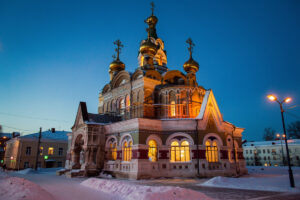
Work was boiling fast. Already in 1860, the main cathedral was laid, and four years later it appeared before the Tula in all its grandeur. The temple turned out to be two-storey, roomy, and was consecrated in honor of the icon that became the heart of the monastery. Around as if cell buildings grew out of the ground, a high bell tower stood at the entrance, and the walls with towers turned the future monastery into a real fortress of spirit.
But the major miracles were ahead. The builder of the temple Alexander Bocharnikov took tonsure with the name Herman and went to Athos. He returned from there not with empty hands, but with priceless gifts: a particle of the Tree of the Life-giving Cross, a stone from the Holy Sepulcher, and the relics of the Great Martyr Panteleimon. These shrines forever determined the fate of the monastery, making it a place of attraction for pilgrims. The founder himself, Vasily Makarukhin, completed his earthly path here, adopting a schema with the name Barsonofii.
The monastery lived an active life. Later, a warm temple was built here in honor of Nikandr Pskovsky, a school for poor children and a hospital were opened. But the most important treasure that the inhabitants carefully kept was not only in buildings, but also in people. Hundreds of suffering people came here to see Elder Dometian. It is said that after the service he walked from temple to cell for several hours because he could not pass by people sitting under trees waiting for advice and consolation. He bequeathed his will to bury himself under the porch, so that people, entering the temple, trampled his grave with their feet — so the humble elder asked to pray for the forgiveness of his sins.
The revolution swept this idyll. In 1921, the monastery was closed, the monks dispersed, and the land was nationalized. For almost eight decades there was desolation. The shrines seemed lost forever, and only dilapidated walls resembled the former greatness.
Revival began at the turn of the 1990s, as if by the covenant of the elders. In 2007, the Divine Liturgy was performed for the first time after a long silence. Today, the monastery found its voice again. On the site of the ancient well, dug by the monks themselves at the direction of the schemist Varsonofius, stands the chapel of the Archangel Michael. The shrines are collected by bits: an ark with its relics is inserted into the icon of the healer Panteleimon, and the icon of Nicholas the Wonderworker with a particle of relics appeared in the temple.
The great miracle of today is the return of prayer. Before the two old lists of the icon «Mammal», who survived in the fever, again ask for help. The monastery has a chronicle of healings, proving that the Queen of Heaven does not leave her only abode. Looking at the restored walls and hearing the quiet ringing of bells, you understand: despite all the storms of the twentieth century, the spiritual connection of times has not been interrupted. And this corner of the Tula land is still a place where the heavenly meets the earthly.
Charity FundHoly Land.
Russian Temples and Monasteries