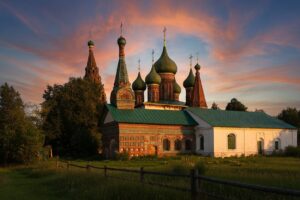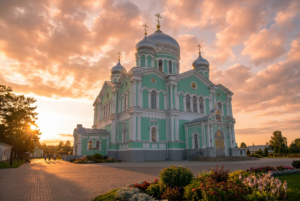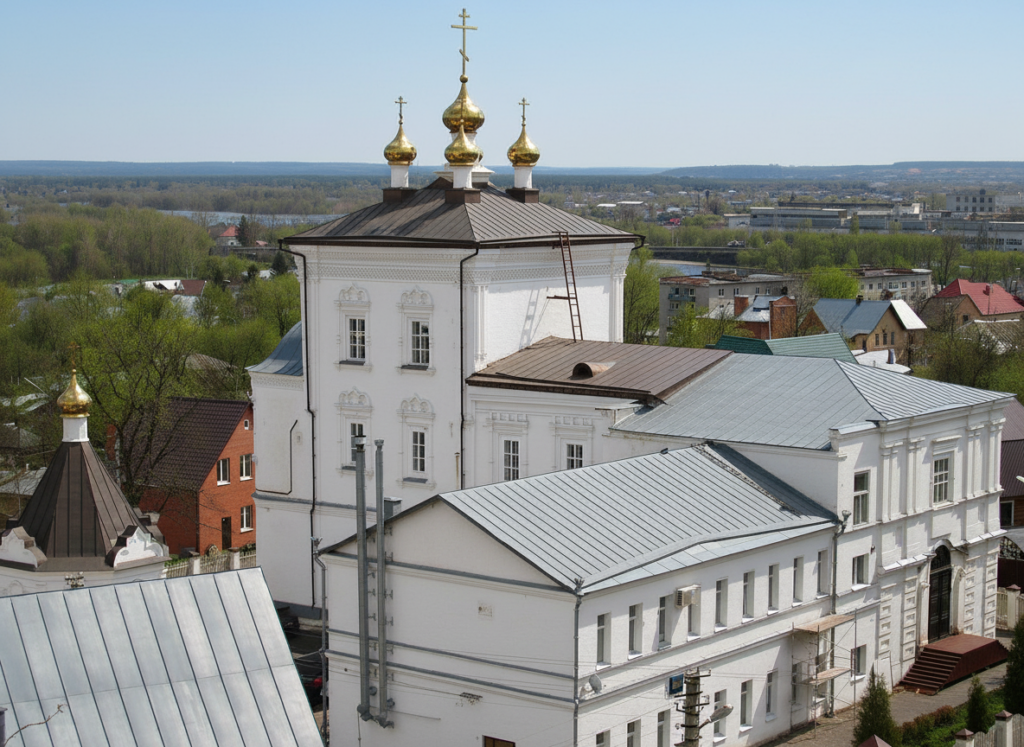
Walking around Penza, it is difficult not to notice the building, whose walls are still remembered by the royal decrees of Peter and Sophia. Five onion heads, aimed at the sky, and restrained, but expressive brick ligature of casings is the Transfiguration Church, the same age as the rapid formation of the city. If you freeze at its foot in the evening twilight, it seems that time itself rings here with a thin string, linking the era of Strelets patrols with the modern rhythm of the regional center. This is not just Penza’s oldest stone building, it is its petrified prayer, which has survived fire, desolation and oblivion.
The starting point was the turn of 1688-1689, when a man’s monastery was laid at the slope of the mountain, directly under the protection of a new fortress. The diploma on behalf of the young kings John and Peter Alekseevich gave a start to life, which at first huddled in wooden log cabins. However, the real monument to faith was erected by Abbot Nikon Volosky. From 1735 to 1750, a two-storey stone giant grew here, in the form of which the features of the late Russian Baroque are guessed. The architect thought practical: the lower floor, warm and cozy, was consecrated in honor of the Kazan Icon of the Mother of God, and the coolness of the upper one was given to the Transfiguration of the Lord, adding John the Forerunner and John Chrysostom to the refectory. The decoration of the facades is still admired today — semi-columns, carved keel-shaped frames of windows and a characteristic «finger» speak of the delicate taste of builders who did not strive for catchy luxury, but appreciated the noble play of brick.
However, urban planning does not tolerate statics. A century later, Catherine’s redevelopment led the monastic brethren far to the southeastern outskirts, and the Transfiguration Church became a modest parish. This saved her from demolition, which was subjected to the elegant gate Tikhvin Church. The temple continued to gather parishioners until a revolutionary whirlwind interrupted the ringing of the bells in 1931. The authorities, without ceremony, adapted the shrine to the hostel of a garment factory, and a little later — to the archive. The dampness of the cellars and the indifference of time ate up the unique wall painting, but the stone skeleton survived, waiting for life to return in 1993.
The new page began with careful restoration and resumption of worship. Today, crossing the threshold of the temple, you can touch the shrines, the true age of which makes the heart freeze. In the kyots there are particles of the relics of St. Innocent of Penza and confessor John Olenevsky, as well as a gift from the Patriarch of Jerusalem – a cross-powered man who keeps the incorruptible remains of ten ascetics of the Church. In 2010, the ancient shrine regained the status of the core of an independent male monastery.
But perhaps the most touching touch in the portrait of the revived monastery is the appearance of the chapel-tomb in 2013. Here the famous benefactors Alexander and Maria Kiselev found peace, as if returning from nothingness to guard the peace of the prayer land. Looking at the restored domes, you realize: before us is not a cold monument of antiquity, but a living colossus that managed to melt the tragedy of loss into the wisdom of repentance and the joy of a new day.
Shrines
- Cross-powered – a gift of the Patriarch of Jerusalem Meletios (1731-1737) Tikhvin Kerensky Monastery, with particles of the relics of 10 saints (Shmch. Charalampia of Magnesia and Ignatius the God-bearer, Vmch. Panteleimon, Theodore Tyrone, Theodore Stratilat and Eustathius Plakida, Mch. Julian, Vmtz. Catherine and Barbary, Mtrone).
- Ark with a particle of relics Pr. Pimen Ugreshsky
- St. Icons. Innocent of Penza, Spanish by John Olenevsky, smc. John of Riga with particles of relics
- The ancient icon of the Transfiguration of the Lord
- Icon mr.
Charity FundHoly Land.
Russian Temples and Monasteries