There are places that do not want to attract attention. St. John’s Church is one of them. It is hidden in the Zatmatsky district, far from the center, on the steep Volga coast. A casual passerby is unlikely to wander here, but the one who sails to Tver along the river will see it first: a white silhouette above the water, calm and confident.
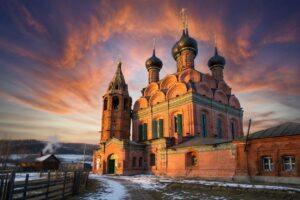
This temple is not like the others. In a city where architectural styles replaced each other like gloves, he retained a rare solution for these places — the eight Americas, put on a four, in the spirit of restrained early classicism. No pretentiousness. Only clear volumes, a five-sided apse on the side of the altar and a three-tiered bell tower, which the provincial architect Lviv designed separately from the main building, and did not lose: it fit perfectly into the ensemble.
It took a long time. The first stone was laid in 1784, and the main throne was consecrated only in 1809 — a quarter of a century later. The chapels took even longer to build. The money was collected by the parishioners themselves, although
The church stood in the city cemetery, where wealthy people were buried. A paradox characteristic of provincial Russia: the rich lay nearby, and those who were more victorious were leaning on construction.
Inside were kept three iconostasis with particles of relics – Prince Vladimir, the Monk Nile.
Stolobensky, the faithful Michael Tversky. The walls were painted. All this seemed unshakable until the doors closed in the thirties.
The fate of the temple is typical of its time and is no less sad. Warehouse. Then the incubator. Then workshops. The painting almost did not survive — it was painted over or simply scraped.
Restorers worked here in the 1970s, but only returned the church to the faithful in 1997.
Regular worship was resumed in 1998.
Today, the interior lives in two times at the same time: whitewashed walls coexist with fragments of ancient painting. The iconostasis is collected from images of different eras and formats – not according to the museum principle of unity, but according to the living parish. Above the royal gate is an icon in the salary,
Stylized under the sun: an unexpected and memorable image.
Among those whose fate is connected with this place is the deacon Nikolai Pavlinov. He served here in the 1920s, was arrested and shot. In 2001, the Church listed him as a priest martyr.
Now his name is inscribed in the history of the temple — quietly, but forever.
The John-Predecessionary Church does not seek to impress. It just exists.
on its shore, in its rhythm, with unhealed traces of the past and a living present. These are places that are remembered for a long time.
Charity FundHoly Land.
Russian Temples and Monasteries