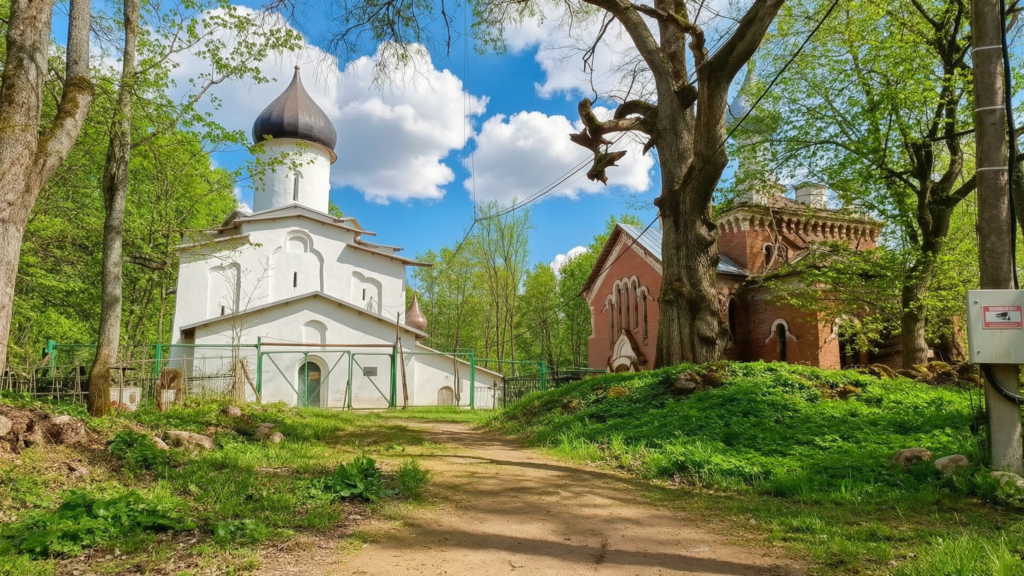
Fifty kilometers from Pskov to the east — and the asphalt ends. Then there is the primer, the fields, the overflows, and suddenly on the hill, at the very road, there is a stone church. Small, single-headed, gray from time to time. At first glance, you don’t know how remarkable it is. Unless it’s very old. But if you go inside — and it’s not easy to go in, the temple is almost always locked — you open something that takes your breath away. The walls are covered with frescoes of the XV century. Not the remains of frescoes, not individual fragments – whole compositions, which are nowhere else. Not in Russia, not in Greece, not on Athos. Only here, in the village of Meletovo, on the edge of the earth.
Pogost at the border
Meletovo is a parish, that is, a church with a cemetery and several courtyards of the parish. The first mention is 1341. The place was border: here the Pskov and Novgorod lands converged, and the church on the churchyard worked as a border pillar, only stone and with a cross. This is not a metaphor: in medieval Russia, a stone church meant the presence of the state far more reliably than any garrison.
In 1461, the Pskov chronicles recorded: the stone church of the Assumption of the Most Holy Theotokos was laid on Meletov. Construction was completed within a year. The customers were Pskov posadniki — Yakov Krotov, John Puchkov and Zinovy Mikhailovich. Their names are carved on the portal of the porch and in the drum — a rare case when the customers of a medieval temple are known by name. The masters who built the temple are unknown. But researchers have no doubt: Pskov. A year or two later, the same hands folded the church of Cosmas and Damian from Primosti in Pskov, which is now on the UNESCO list.
Building
The temple is small. Single-headed, four-pillars, with one semicircular apse and two rectangular altar protrusions on the sides. The facades are separated by wide shoulder blades and are tightened by two-fold bladed arches — a technique characteristic of the middle of the XV century, not earlier and not later. The windows of the drum are decorated with semicircular «brows» — a detail that in later Pskov temples acquired a forceps shape, and here it is still ancient, simple, clean. The church is made of local limestone slab — not brick. The porch is brick, but it’s later.
At the end of the XVI century, a warm chapel of Nicholas the Wonderworker was built on the south side. In 1778, the porch was expanded to the west and a brick bell tower was erected — five bells, the largest sixty-two poods. In 1790, an iconostasis was installed inside. Ancient frescoes, probably at the same time whitewashed – a common practice: the old painting was not appreciated, considered rude, dark, interfering with the new splendor.
Painting
In 1465, three years after the completion of construction, the temple was painted. One summer, as was customary. Artel of Pskov masters: artists familiar with monumental painting, icon painting, and book miniature. A significant part of the painting was made in the technique of secco — on dry leukas, which allowed to work slowly, to prescribe details.
To this day, about forty percent of author’s painting has survived — about a hundred subjects. Forty percent is a lot for six hundred years. Not much if you know what happened.
It’s not even about quantity. The thing is, there’s nowhere else. A number of Meletov’s compositions have no analogues in either Old Russian or Byzantine art. Some of the scenes are taken not from the Gospel, but from Pskov chronicles and ancient Christian literature – texts that were read in the XV century, but were not depicted in churches. The painting reflects the ideology of the Pskov Veche Republic: sovereignty, border protection, the fight against heresies, the expectation of the end of the world. This is not just an illustration of Scripture – it is a political painting, smeared with colors.
The most famous composition is “Ant-Skomorokh”. The Mother of God bows down over a jester who lost his arms and legs for laughing at her. The plot is based on a story from Limonis, a collection of stories about monks, and was probably inspired by the struggle against the Pskov-Novgorod heresies. Nowhere else in ancient Russian painting does such a scene occur.
Christ carries a wise robber on his shoulders to heaven. The rarest iconographic type. The bird is a symbol of impurity and death with spread wings. The unicorn is a sign of strength and purity. “Service of the Holy Fathers” is a liturgical composition that was written in other churches, but here it is unfolded with an unusual completeness. “Washing the Feet”, “Thoma’s Confidence”, “Place in the Sepulchre”, “The Burning Bubin”, “Transfer of the Ark of the Covenant”, “The Prophet Elijah and the Priests of Baal on Mount Carmel” – each composition is either unique or has unique features.
The master, who wrote “The Assurance of Thomas”, according to researchers, had a gift that no one of his contemporaries had. His faces are alive. Not conventional, not schematic, but written with such subtlety that it seems: now they will talk. Six hundred years, and they’re still watching.
When the frescoes were found
Meletov’s frescoes have been hidden under whitewash for centuries. When they were discovered is unknown, but by the middle of the XX century they were already recorded. In 1947, the temple received the status of a monument of republican significance. In 1959, architects M. I. Semenov and N. S. Rakhmanin developed a restoration project: later extensions were dismantled, the original shapes of the windows were returned, and the paving was restored. In 1963-1968, the restorer D. E. Bryagin cleaned and strengthened the frescoes — removed the lime whitewash and late oil recording. What was discovered surprised the researchers.
But before that, in the 1940s, there was a bakery in the temple. Smoke, soot, flour, soldiers. The frescoes, already whitewashed, suffered from dampness and temperature changes. Something came down. Something washed away. Something ruined forever. No one knows exactly how much is lost, because no one saw the temple before the whitewash.
«National Shame»
By the early 1990s, the condition of the monument had deteriorated again. The roof was flowing, the plaster was moving away from the walls in pieces, the colorful layer crumbled. In 2006, the temple was transferred to the Pskov Museum-Reserve. In 2016, a commission of the Ministry of Culture surveyed the church and recorded a phrase in the record, which was later circulated to newspapers: “A world masterpiece that is gradually turning into a national disgrace.”
Why did they say that? Because Meletov’s frescoes are not a regional monument, not an ordinary painting. This is world-class painting. And it collapsed, slowly but inevitably. Moisture was rising from the foundation. Temperature swings ripped the leukas. The paint came off the wall and fell to the floor with dust.
In 2017, the Pskov Museum-Reserve organized an exhibition of copies of Meletov’s frescoes – those that were filmed by Alexander Krylov, professor of the St. Petersburg Academy of Arts, back in the 1980s. Copies hung in the hall, under the light, in the warmth. And the originals are in a damp temple without heating, in a village where there is no road.
In 2019, emergency work began. In 2022, the temple was opened for two months from mid-July to mid-September to organized groups. People were transported by bus, according to the record, no more than eleven people at a time. In February 2025, in the Order Chamber of the Pskov Kremlin, an exhibition “Images of Meletov’s Wall Painting” was opened – to the 560th anniversary of the painting. Copies again. Again, the original remained in the village.
Why there is no UNESCO
In 2019, ten monuments of the Pskov architectural school were included in the UNESCO World Heritage List. The Assumption Church in Meletovo did not enter. According to experts, it deserves it. But: emergency condition, unfinished restoration, lack of infrastructure, bad road, emergency neighboring Trinity Church of the XIX century, which threatens to collapse. UNESCO does not accept objects that cannot be preserved. Meletovo can’t yet.
Director of the Pskov Museum-Reserve Svetlana Melnikova said this directly: “If Meletovo is the best we can imagine, then I have a question.” There were no road signs. No sign. No normal road. The world masterpiece stood in the field, and the field slowly ate it.
Charity FundHoly Land.
Russian Temples and Monasteries