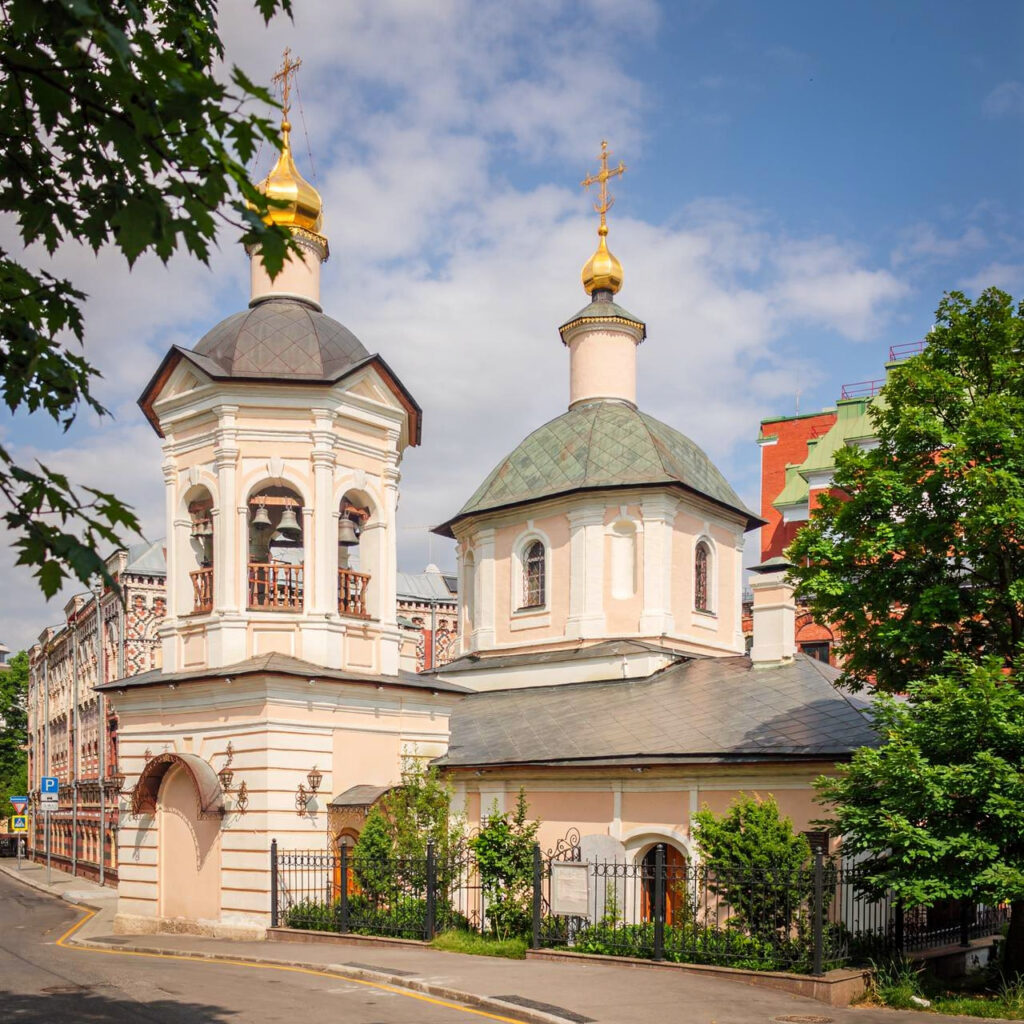
In Moscow, there are alleyways in which you enter by chance and leave with the feeling that you hit the wrong place. Krapivensky is one of those. Quiet, short, rests on the high fence of the Vysoko-Petrovsky monastery. Transportation is not buzzing, people are not in a hurry. And in the middle of this rest is a small temple, which for more than three hundred years has changed so many shapes that you do not immediately understand what you are looking at. The columnless four of the XVII century, the baroque second tier of the XVIIIth, the refectory with chapels, the bell tower, the courtyard buildings — everything is knit together, as in a house that was built by three generations of one family, each with its own taste. It is.
Why Hives?
No one knows exactly where the name came from. According to one version, nettle grew here — the place was empty, unkempt, and the weed reached the waist. According to another, the lane is named after someone from the local owners: in 1752, the collegiate assessor Alexei Krapivin lived here, and perhaps his name stuck to the place stronger than nettles to clothes.
The temple had other names. «In Old Silver» — because there lived silversmiths, masters of the Mint, who minted and melted silver. «At the Pipe» — because nearby Pipe Square, and the pipe, through which Neglinnaya went underground, was a landmark local detail. «In the Watchmen» — because there were Strelets guards here. The three names of one temple are like three lives, but they were all lived in one place.
Wood, stone, fire.
The first mention of a church on this site dates back to 1591. Documentary confirmation — «Peter’s drawing» of 1597, which depicts a small one-headed temple on the descent from the Vysoko-Petrovsky monastery to Neglinnaya. In 1625, the documents already listed a wooden church. A tree is a tree; it burned in 1677.
In 1678-1679, a stone quaternary was placed on the ashes. Here is this small, columnless, with smooth walls — it still stands, forms the oldest core of the temple. Who built it is unknown. But the walls hold the load of the second tier, which was built almost seventy years later, and do not crack.
In 1701-1702, a refectory with a southern chapel was added to the main volume in the name of the Beheading of the Head of John the Forerunner. The chapel was combined with the refectory — a reception characteristic of parish churches of that time: closely, but functionally. The refectory became a place where parishioners not only prayed, but also ate, and gathered, and discussed affairs. In modern Moscow, only the Liturgy remains, but the walls remember something else.
Baroque and Ukhtom
In 1749-1750 the temple underwent the most significant reconstruction. Above the old four of the XVII century, a second tier was built — higher, lighter, with baroque details. They built a new bell tower. The northern chapel was added in the name of St. Nicholas the Wonderworker. The temple became taller, more elegant, more noticeable. It was then that he found baroque features — stucco casings, linings, curved cornices.
There is an assumption that the restructuring was carried out according to the project of the master from the school of Dmitry Ukhtomsky, the chief architect of Moscow in the middle of the XVIII century. Ukhtomsky and his students created the appearance of post-Petrine Moscow: the Baroque of Elizabeth, festive, lush, but not heavy. The temple in the Krypivniki is not a masterpiece of Ukhtomsky, but perhaps the work of his pupil, who knew how to put the Baroque tier on the pre-Petrine four so that one did not crush the other. It worked.
The Compound of the Patriarchate of Constantinople
In 1883, Emperor Alexander III signed a decree: the land and the temple pass to the Patriarchate of Constantinople for the construction of the farmstead. It was a political decision: Russia supported the Church of Constantinople, and the compound in Moscow was a sign of friendship. In 1887-1892, according to the project of architect Sergei Rodionov, the building was built in a style combining Byzantine and Russian motifs. It turned out a whole complex: a temple, housing for pilgrims, an office, a refectory. The church ceased to be just a parish church and became the representation of the Ecumenical Patriarch on Moscow land.
Rodionov is an architect-restorer, a connoisseur of ancient Russian architecture. He did not try to rebuild the temple in a single style — he preserved the layers: the XVII century, the XVIII century, his annexes. This is a rare approach for a time when many architects were “fixing” old temples under one facade. Rodionov left every century in sight. Thanks to this, the temple today is like a section of the earth: you can see who added his layer and when.
Skates and withdrawals
In 1920, church values were removed from the temple. Gold, silver, utensils — took out, took away, melted down. In 1938, the temple was finally closed, the compound ceased to exist. In the late 1930s, the bell tower and the drum over the main volume were dismantled — why the bell tower if there are no bells and there will not be?
Inside, they staged a handicraft production for sharpening skates. Nearby was the Dynamo rink — one of the main Moscow skating rinks, and the skates dulled quickly. A small temple with three hundred years of history became a workshop where blades were sharpened. The altar is a workbench, the iconostasis is a shelf for the tool, the dome is the ceiling under which the grinding stone hummed. If the walls could breathe, they would sigh.
Return
On the thirtieth of August 1991, Patriarch Alexy II consecrated the throne, and divine services resumed in the church. Seventy years without prayer, the first liturgy. Then came the restoration. In 2001, the bell tower was restored — reassembled what was dismantled in the 1930s. In 2010, the altar was consecrated in the aisle of All Saints, who shone in the Russian land. In 2013, the painting of the altar in the aisle of St. Seraphim of Sarov was completed – the artist Irina Zaron painted the frescoes, and they turned out to be light, light, not heavy, as happens in the newsletter, but breathing.
In 1993, the Lyceum of Spiritual Culture was opened at the temple in the name of St. Seraphim of Sarov. Children have studied—and seem to continue to learn—not only God’s law, but also history, literature, and music. The temple where skates were sharpened became a place where children study. Four centuries – four lives: the parish church, the courtyard, the workshop, the school and again the temple.
Ki-cross
The main shrine is the Ki cross, made by order of Patriarch Nikon in the XVII century. This is an exact copy of the Cross of the Lord, which contains particles of the relics of more than four hundred saints and stones from biblical places. Nikon ordered a cross for the Kii Monastery on the White Sea, but the cross went a long way and in August 1991 was transferred here to the Rivets. In the same days when Patriarch Alexy II consecrated the throne. The two dates coincided — or did not coincide, but merged.
In the temple there is the Theodorovsk Icon of the Mother of God of the XVIII century and the image of St. Sergius of Radonezh of the XVII century with a particle of relics. In pre-revolutionary Moscow, this temple was the only one in the city center, the main throne of which was consecrated in honor of Sergius of Radonezh. Here was baptized Vladimir Fedorovich Odoevsky — writer, philosopher, musicologist, one of the last romantics of Russian literature. In the XVI-XVIII centuries, the Ukhtomsky princes were buried at the temple — those whose family gave Moscow the chief architect of the middle of the XVIII century.
Charity FundHoly Land.
Russian Temples and Monasteries