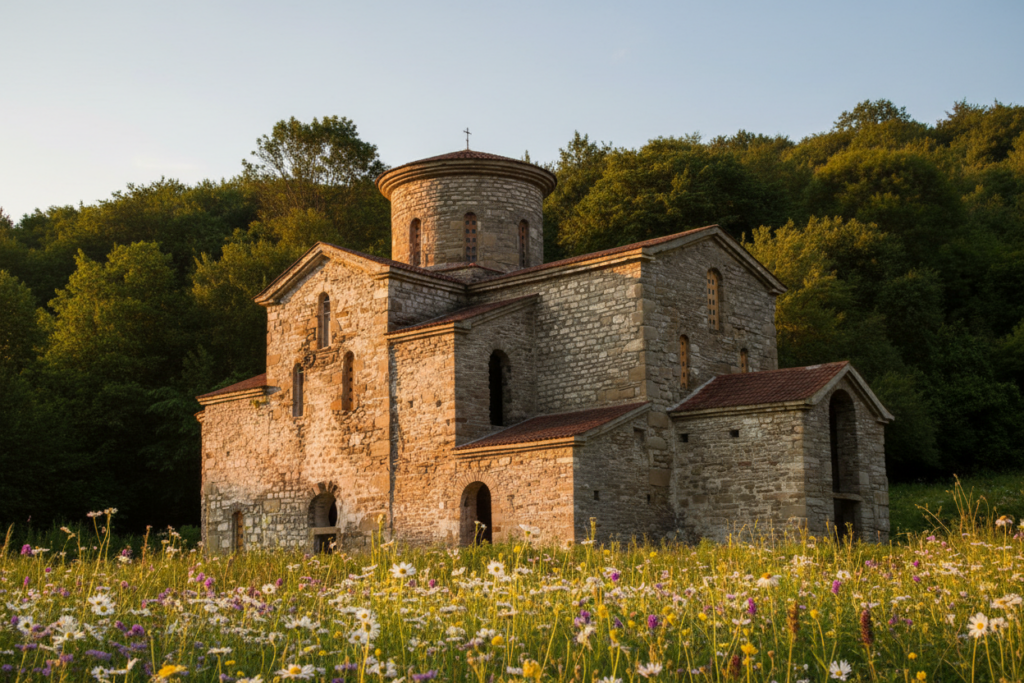
In the mountain silence of the gorge of Big Zelenchuk, where the air seems to insist on eternity, there are three stone witnesses to the disappeared kingdom. Back in the X-XII centuries, a crowded settlement with the residence of the Alan metropolitan, merchant caravans and temples rose to the sky above the narrow streets. Today, only ruins and three churches are reminiscent of the former grandeur, which scholars among themselves call the North, Middle and South. They are older than the famous Tithe Church in Kiev – a living reminder that the light of the Christian faith lit on these slopes earlier than in many parts of Russia.
If you freeze on the path leading from the settlement in the direction of the wooded highlands, the first will open the most majestic of the three — the Northern temple. He was deliberately placed outside the city walls, as if a guard was on the threshold of another world. Inside, you can still guess the scale: this is the largest preserved church building of the entire Alan state. According to one version, it was built in 914-916 and dedicated to Nicholas the Wonderworker. Once the walls were covered with exquisite fresco painting – it was performed by the Byzantine master, because Alans did not have their icon painters of this level at that time. Alas, the paintings did not survive, but a lucky chance gives us the opportunity to present them. At the end of the XIX century, the artist and archaeologist Dmitry Strukov made watercolor sketches of fragments. Looking at its sheets, and today you feel strict faces, the luxury of ornaments and a deep sapphire background — the breath of Constantinople among the Caucasian steeples. And here is preserved the only in the whole North Caucasus ancient stone baptism. Step down the erased steps into her cup and you literally touch the moment when a whole nation embraced a new faith.
Going down to the heart of the settlement, you meet the Middle Temple. Many scientists believe that it was here that the pulpit of Metropolitan Alanya was located — here for centuries the word that united mountain villages sounded. The architecture gives its special status: a powerful dome, a clear cross in plan, altar apses looking to the east. After centuries of desolation in 1897, the monks of the revived Alexander Nevsky monastery came here. They restored the walls, blocked the roof and consecrated the temple in honor of the Trinity. It now stands bright and austere, and if you go inside at noon, you can see the sunlight piercing the space from the dome to the stone slabs of the floor — as if an invisible liturgy is still being performed.
The third temple, the South, is the smallest and most alive. Built according to the Byzantine canons of hewn stone, it is only 20 by 25 Greek feet — almost a family chapel. Researchers believe that it was built on the site of an even more ancient church, and it was owned by a noble Alan family, making the home temple of the prophet Elijah. At the end of the XIX century, he was reborn under the name of Alexander Nevsky, and in 1991 he was consecrated again as Ilyinsky. The miracle is that today it is the only functioning Christian Alan temple on the territory of Karachay-Cherkessia. On Sundays, prayers are heard within its walls, candles are lit, and the same echoing bell ringing through the gorge is heard as it was a thousand years ago.
Standing between these three temples, the skin feels the pulsation of time. The North is a fixed memory, the Middle is a restored dignity, the South is an inextinguishable lamp. The Great Silk Road has gone down in history, the kingdom of Alans has sunk into oblivion, and stones still hold the sky, reminding that true faith does not know oblivion.
Charity FundHoly Land.
Russian Temples and Monasteries