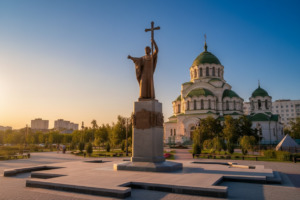
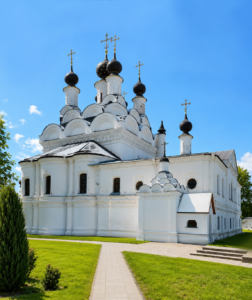
Snow-white temples of the Savior-Ethymius Monastery in Suzdal are included in the UNESCO World Heritage List. It is impossible to take your eyes off the snow-white walls, colorful onions, from majestic arches and intricate decorations. It is part of the Vladimir-Suzdal Museum-Reserve.
The Spassky Monastery was built in 1352, at the behest of the Suzdal Prince Boris. The first abbot was Euthymius of Suzdal. He served in the monastery for 55 years and died at the age of 89.
He was buried at the monastery. When, 100 years later, the tomb was discovered during the construction of a new cathedral, they saw that the decay did not touch the body of Euthymius. He was listed as a saint, and the monastery began to be called Spaso-Euphimius.
The monastery was constantly expanded and renewed. Its wooden walls have not survived, but the stone walls are able to withstand any siege. The territory of the monastery is clearly visible from the walls and Suzdal appears in all its glory.
The monastery complex includes:
1. Holy Transfiguration Cathedral
A small church was built over the tomb of Saint Euthymius. Later, a magnificent white stone temple was erected next to it. The roof of the cathedral is 5 drums with poppies. Inside, the cathedral was painted in the 18th century by the famous masters Sila Savin da Guri Nikitin. The painting is preserved and pleasing to the eye.
At the eastern wall of the cathedral is the grave of Prince Dmitry Pozharsky – the organizer of the people’s militia, which liberated the Russian land from the Polish invaders.
2.The Assumption Church
This building combines a small church and a refectory, economic part. On the first floor there was a bakery, the kitchen on the second — a dining room.
3. Caller.
It consists of 3 spans, which were built in the 16-17 centuries. Bells for belfry were presented by Vasily III, the father of Ivan the Terrible. Ancient bells have not survived, and 17 modern bells ring 5 times a day.
4. St. Nicholas Church and hospital building Church modest, with one head. Built for sick monks. Later, prisoners of the monastery prison prayed in it.
5.Brotherhood
The cell building is strict, with few decorations. Narrow windows are punched in thick walls. The building was built in the 17th century. It’s 100 meters long.
6.Annunciation Church
She served as a gatekeeper, but later found herself inside the monastery walls. One of the oldest buildings of the monastery. It was founded in the 16th, rebuilt in the 17th century.
7.Archimandrite Corps
Two-storey building with a covered gallery. Built in the 17th century. Since the end of the 18th century, the archimandrite of the monastery lived there.
8.Prison castle
By order of Catherine the Great, a prison was opened on the territory of the monastery. At first, the prisoners were placed in the hospital building, but there were not enough places and a special building was built, which was surrounded by a high wall. Here they were mainly placed Old Believers and sectarians, whose activity the Holy Synod recognized as heretical.
9.Walls and towers
High brick walls appeared at the monastery in the 17th century. They have a clear defensive purpose. The walls on the river side are lower, on the city side — higher. Powerful towers are equipped with loopholes. There are 12 of them and each is adapted for defense.
Interestingly, after the construction of these fortifications, the monastery was never under siege or attack.
Soviet period
The monastery was closed in 1922. The buildings were used as a political prison during the war as a filtration camp. After the war there was a children’s colony.
In 1968, the territory of the monastery was transferred to the museum-reserve. At the same time, restoration work was carried out, which was resumed several times. Now in most temples there are services on Sundays and holidays.
Expositions
In almost every building of the former monastery there are thematic museums
exhibits.
1.In one of the defensive towers there is a small museum of torture. The eerie exhibits give an idea of how they received “truthful testimony” with the help of a rack, whips and chains.
2.In the Annunciation Church there is a museum of Prince Dmitry Pozharsky, the leader of the people’s militia, which liberated Moscow from the Poles.
3.In St. Nicholas Church there is a Golden pantry. The dishes, decorations, icons collected here are very ancient, some exhibits are more than 1000 years old.
4.In the prison building there is a museum «Suzdal Bastille». In terrible conditions, schismatics, sectarians, and after the uprising of 1825 and the Decembrists were kept here.
5.The complex itself, primarily the Transfiguration Cathedral, is one large monument of Russian history, architecture and military glory.
Charitable Foundation Holy Land
Russian Temples and Monasteries