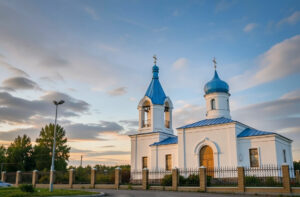
In 1674, at the height of the reforms of Patriarch Nikon, which split the church into 2 camps, on the banks of the river.
Varzuga built a temple. The builders expressed their disagreement with the innovations in the architecture of the building. Patriarch Nikon ordered to build churches strictly «about five tops», and tented, single-domed, banned, but this was built in Varzuga.
All the classical techniques of northern Russian architecture were embodied by the architect: the church with a tent – a narrowing pyramid with 8 faces upwards, built without a single nail, decorated with a wall.
Many decorative elements. Hidden architecture is very common in the north — its shape reduces the load of a thick layer of snow. The foundation of the church is quadrangular, to him with
All sides are joined by pipes, forming a cross. On this basis there is an eight-walled log house, the neck of the dome and the dome itself with a cross, which reaches a height of 34 m. There is a temple on the high bank of the river. You can see him from afar, as if he were looking up. The iconostasis of the church included 84 icons. Some of them remained from the old, unpreserved church, others were worked on by icon painters of the Solovetsky and Antoniyevo-Siisky monasteries. It was updated in 1860.
Some icons were replaced and new salaries were added.
In 1894 the building was renovated. Outside added a new skin, changed the spire, repaired the chapter. The list of works of the master of the artel of carpenters listed on a wooden board. He also mentioned the number of employees and the payment. This board, as a report for posterity, left in the crown of the church. And then nobody cared about the church for 100 years. Repairs would undoubtedly have been carried out, but the revolution and the “fight against obscurantism” intervened. During this struggle, the church was left without its bells. In 1939, it was removed, sawed, and laid on the bank of the river. The water in the river rose and, falling, carried the bells. So they remained under a thick layer of bottom silt.
The church building was dilapidated, and most importantly, the icons were badly damaged. Some of them were transferred to the State Hermitage for restoration, some disappeared without a trace, and some simply rotted.
At the state level, they did not try to preserve the monument of wooden architecture, but specialists were always interested in it. Murmansk architect N.P. Bystryakov even created an exact model of the church, which is now exhibited in the local history museum.
In 1990, the parish community of the village of Varzugi was registered, services began to be held in the temple. In 1999, the building was officially transferred to the Russian Orthodox Church. Restoration began almost immediately. While the work was carried out outside, the temple was still held.
service. In 2004, the interior decoration began and now the church is almost always closed.
The beauty, some soulfulness of this small temple, undoubtedly attract pilgrims.
Getting to the temple is not easy. From the nearest city, Kandalaksha, more than 100 km along a dirt, difficult road. Perhaps, therefore, about the temple of the Dormition of the Most Holy Mother of God, so ancient and beautiful, few people know. No sign of civilization touched him, and he
It still amazes with the skill of Russian architects and its discreet northern beauty.
Charitable Foundation Holy Land
Russian Temples and Monasteries