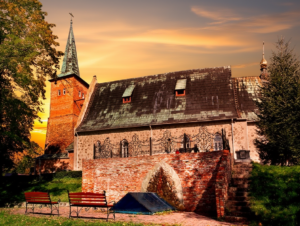
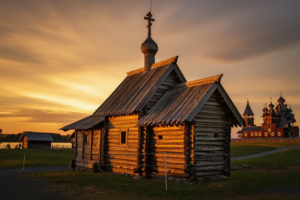
The brick giant stands in the middle of the Volga plain, like a guest from another dimension. The road to it winds past village houses, overgrown ponds and endless fields, and when the eight-man with a tent suddenly grows before his eyes — breathtaking. The village bears the name of Abashevo, although natives of Penza lands, who settled here in 1776, called it Penzino. The memory of a small homeland was absorbed in names and fates, and centuries later dissolved in the steppe wind.
What stands today above the surrounding beams is the third chapter of the local church chronicle. At first there was a modest wooden building with the money of the prince-general. Then — a new one, which the landlord Melgunova ordered to move to a more successful site. And only in the mid-1860s, Count Vasily Pustoshkin launched a truly ambitious construction project. His father bequeathed him to replace the dilapidated building with something solid, and his son approached the matter on a grand scale, choosing the Peter and Paul Cathedral in Luban as a model. Today, the cathedral does not exist, as does its Samara twin. The Abashev temple remained the only one – a living cast of the Russian-Byzantine fantasy, which has survived to our days.
Look at the proportions: a massive eight, as if inhaling, lifts the second, lighter, and he is crowned with a tent with a cupboard. On the sides of a strict symmetry attached altar and porch. But the main surprise is waiting at the bottom — the basement hides a full-fledged winter chapel of Alexander Nevsky, consecrated in 1875. Thick walls store heat, and even in the fierce cold here you can serve without fear of frozen corners. The upper tier was dedicated to Sofia with her daughters – Faith, Hope, Love – and consecrated two years later.
The decline came with a hammering inevitability. The thirties of the twentieth century knocked out the temple, turning it into an architectural ghost. They say that when the nineties building was returned to the faithful, the wind walked inside, and the last frescoes crumbled with dampness. It wasn’t just repairing hands that were needed—it needed someone willing to take on that burden for a long time. They became Archpriest Oleg Rebishung. For more than fifteen years he has been a shepherd, a carpenter, and a mason. The iconostasis in the lower temple is assembled from simple plywood, and there is a special dignity in this restraint. Gold carvings would look alien here, and a modest tree breathes authenticity.
The refectory is growing right now — the father brings out the masonry, from time to time summoning friends to help with weights. The bell tower came to life in 2009 — five Ural bells. And four years later, the Samara doctor Branchevsky paid for a complete replacement of the roof and new cupolas to replace those that had become thin for decades of neglect. There are still forests around, some holding restorers, others bent inside, reminding them of how much more needs to be done.
There is an amazing feeling in this place: the temple is not a museum exhibit, it breathes. In the evening, the brick is poured with a thick scarlet, as if the walls absorb the sunset to shine them in the dark hours. And the bell floating over Abashevo carries the news: there is no point here, here the story continues – brick by brick, prayer, human indifference.
Charity FundHoly Land.
Russian Temples and Monasteries