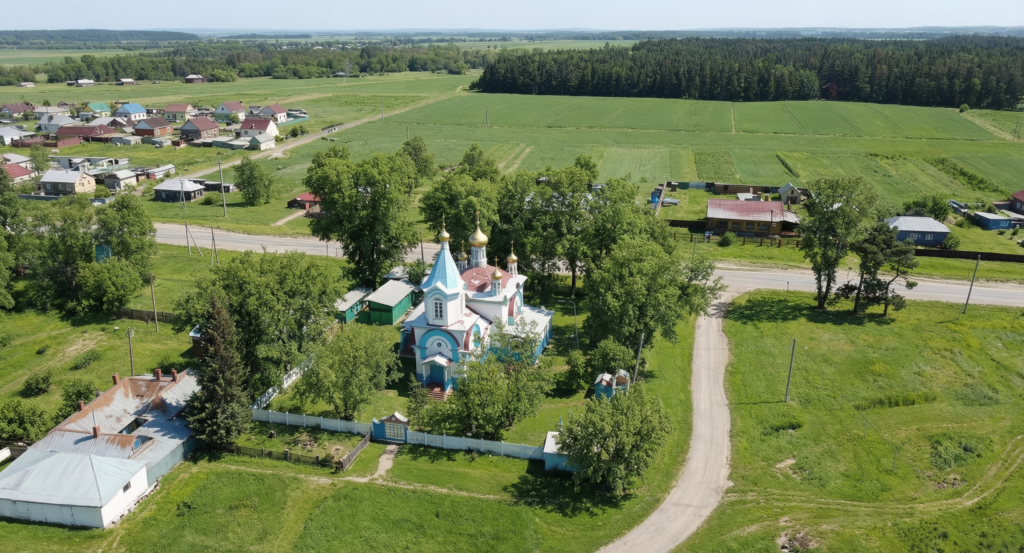
Turning from the noisy Astrakhan tract into the silence of the village of Vyazovoy, the traveler almost immediately rests his eyes on the snow-white wooden lace, crowned with matte-gold domes. This temple, consecrated in honor of John the Forerunner, does not suppress monumentality — it meets the warmth of a carved tower, as if descended from the pages of Russian fairy tales. It is enough to cross the threshold to feel the thick aroma of aged pine and wax, mixed for a century and a half with a quiet but surprisingly persistent prayer. The five-headed four under a four-sided roof, with a light refectory and elegant tent bell tower, appeared here in 1867 through the efforts of ordinary peasants who never knew serfdom, but were firmly enslaved by love of God.
The history of this place is a fusion of fervent faith and severe frontal stubbornness. The inhabitants of the village, whose thatched roofs surrounded the busy transshipment route, collected scant pennies for the temple. The building turned out well, and although initially it was attributed to the Intercession Church in Chikarevka, the soul of the Vyazov shrine from birth was independent. The walls remember the ice grinding of the revolutionary years: the local priest, Father Matthew, hid the future Marshal Zhukov, whose squadron fought here with the Antonovs. It is said that the bullet of that battle was forever stuck in the body of the bell, becoming a silent witness of the era. For sheltering, the father was not spared — Solovetsky exile cut off his life on takeoff, and the temple in 1933 was stabbed to death, letting the laminated logger under grain and military needs. However, the unique structure survived as if conspiratorial, and in April 1946 the doors opened again — and since then it has not closed.
The architecture of the temple is an ode to the Russian ingenuity and golden hands of unknown architects. Built from selected, “not junk” pine, the log is despite the time almost fresh. The recent clearing of the iconostasis turned into a sensation: under the layers of late paint, the gold leaf of the XIX century appeared, shining as if the masters only left the forests yesterday. The inner space breathes authentic antiquity. Here, in the soft twilight, miraculously preserved pre-revolutionary icons and frescoes darkened from soot live, and under the dome, surrounded by angelic faces, a touching image of the Most Holy Trinity unfolds.
The surrounding land deserves special worship. In the tract Korytino beats the «Open well» — the John-Predechensky spring, whose cold waters have long given pilgrims physical and mental peace. Next to him, life flows in a special way, as if recalling the strict rules introduced here by Hieromonk John Mokashov, a former Pochaev monk who gathered around the church a strong monastic community. It was he who climbed the bell tower during his leisure hours and painted icons, several of which are still carefully stored in the altar.
Today, the parish not only preserves the past, but also cultivates the new. The local Sunday school rings with children’s voices studying the Law of God and the basics of gardening, and in the refectory, arranged in a classic five-wall with an oven, whitewashed walls and a red corner, it smells of pies and incense. The temple in the Elm is a living proof that faith, like a good tree, from time to time becomes only harder and more beautiful.
Shrines
- A special value of the temple is a small image of the holy prophet John the Baptist with a particle of his relics. This shrine is a gift from the monastery of St. Seraphim of Sarov, which is near Voronezh.
- Near the village in the Korytino tract is the John-Predechensky spring, revered as a saint.
Charity FundHoly Land.
Russian Temples and Monasteries