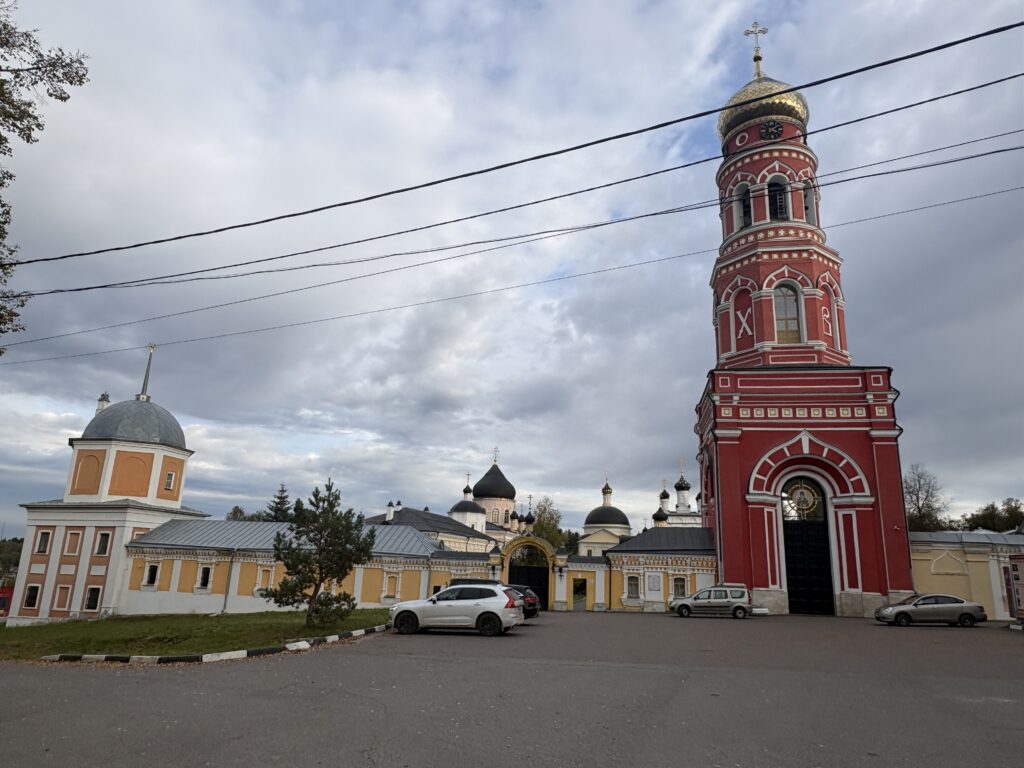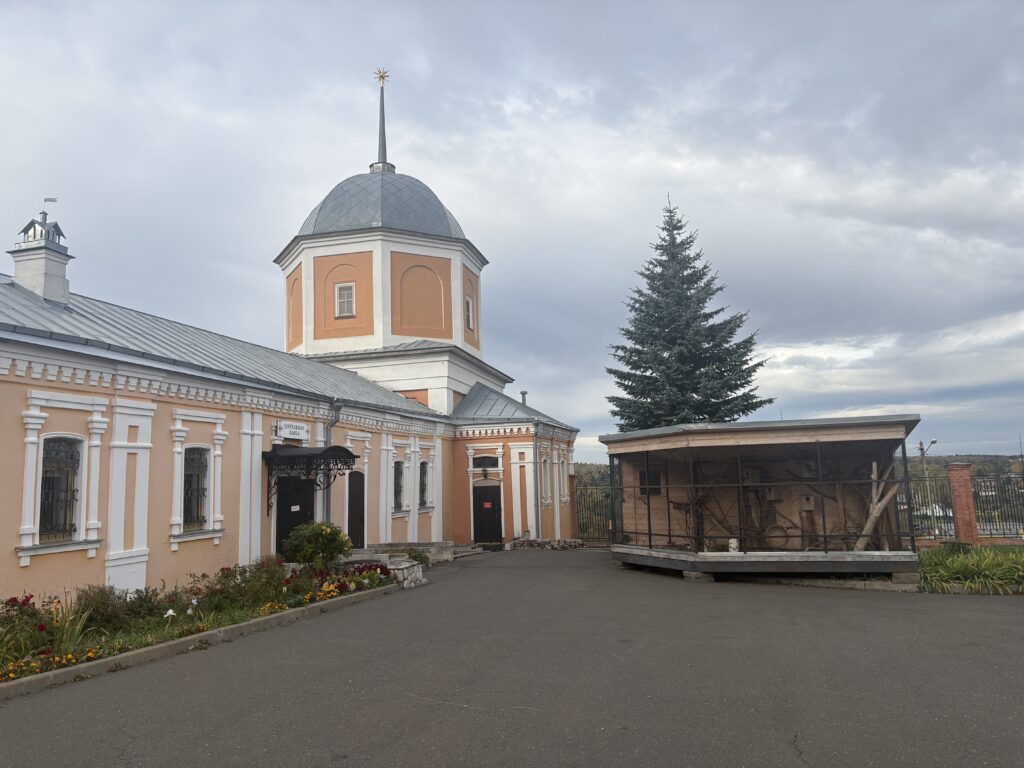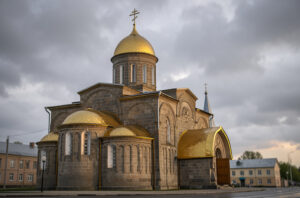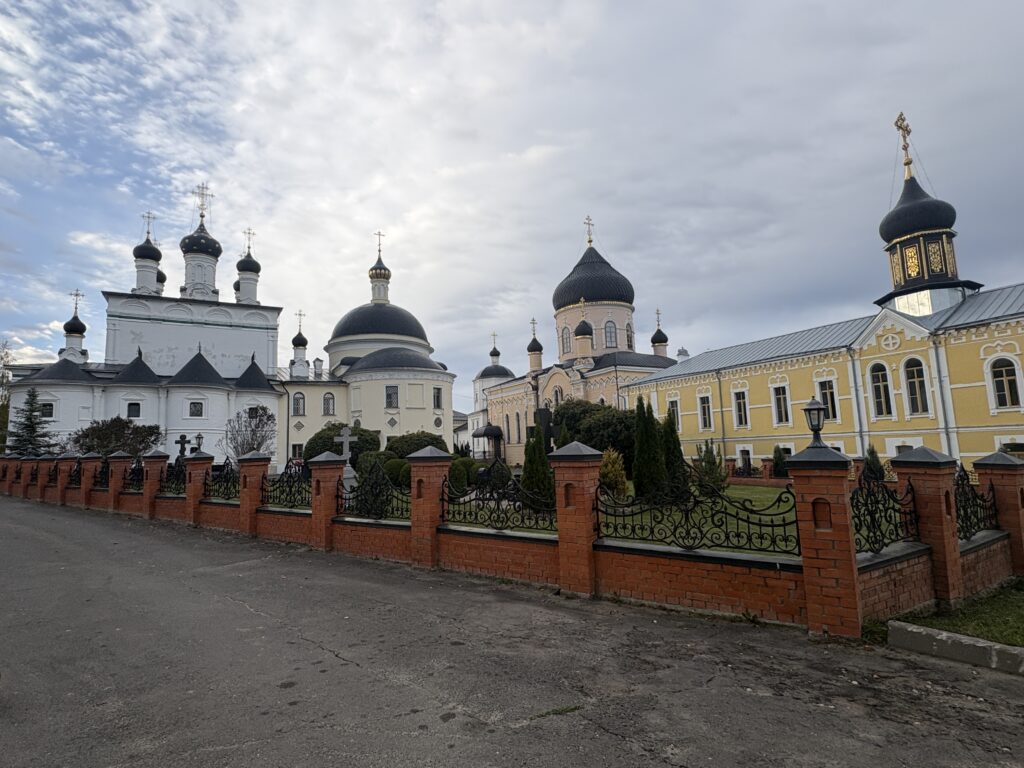
The Ascension David Desert is a male monastery half an hour from Chekhov, on the shore of Lopasny. It was founded a hundred years before the accession of the Romanovs, not the most famous of the monasteries near Moscow, but one of those where history is not fenced off with window glass from today. Liturgy is served in the temple, which began to build under Ivan the Terrible, the procession bypasses the same walls as four hundred years ago.
Reverend David and the Beginning of the Monastery
In the summer of 1515 hegumen David with two monks and two novices came to the shore of Lopasni. He brought the icon of the Mother of God with him. In an unfamiliar place he set up cells, gathered the brethren — so the monastery was born.
The first churches were wooden. The main was the temple of the Ascension of the Lord with the chapel of the Assumption of the Virgin, and next to it is the refectory and small Nikolsky temple. The building set is modest, but the spiritual program of the monastery was determined immediately: Ascension, Theotokos, St. Nicholas. This triad runs through the history of the desert today.
The Monk David lived in the monastery for over forty years. He was not just a founder, but a spiritual mentor for both the brethren and the surrounding residents. He died in 1529, September 19 in the old style. His memory is now celebrated on October 2. The veneration began almost immediately: already the synodik of 1602 calls him the Reverend, and the documents of the XVII century – the miracle worker.
The main shrine of the monastery is the holy relics of the Heavenly Patron of our monastery, the Venerable Father of our David, the Abbot of the Ascension, the Serpukhov Wonderworker (October 2 and May 23 – the acquisition of relics), now rest in cancer in the Znamensky desert temple. To this day, there is a queue of pilgrims.
The cathedral that was built for a hundred years
Stone Ascension Cathedral is the main architectural event of the desert. It was laid presumably under Ivan the Terrible, in the XVI century, but the original plan for a long time remained unfinished. Work continued by decree of Patriarch Joachim in 1676, and in 1682 the temple received an antimins – a consecrated fee necessary for the celebration of the liturgy. From the laying of the first stone to full functioning, two reigns took place.
Externally, the cathedral is a two-tiered four, crowned with five chapters. The main volume is adjacent to the three-part apse, fragments of galleries and the Assumption chapel are preserved. The decor is characteristic of Moscow architecture of the second half of the XVII century: stone frames of windows, corner semi-columns, kokoshniks, tiled frieze. The building is both strict and elegant — without the heavyness of early samples, but also without the frivolous stucco of later eras.
Interesting vault design. The central part of the ceiling is held by four spring arches, resting on internal pillars. For the Russian temple architecture of that time, this is a non-standard solution. Usually it was not built this way — and it is this feature that makes the cathedral not just a functioning temple, but also a noticeable monument of building thought.
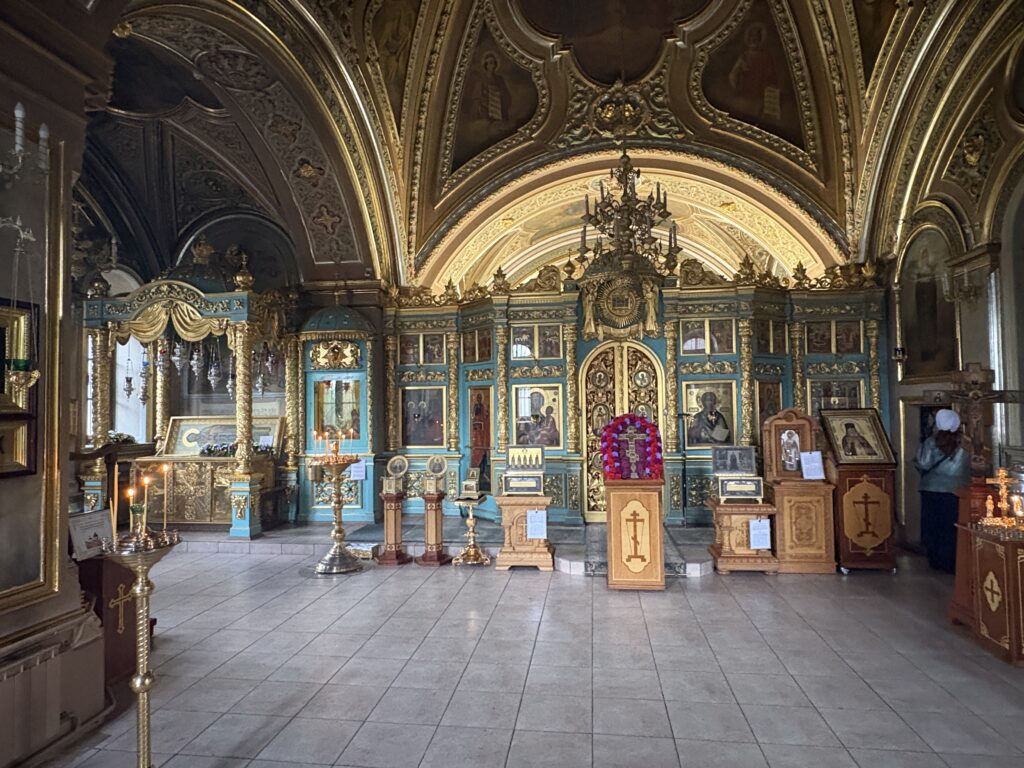
In the XIX century, the cathedral was updated more than once: new iconostases were put up, paintings were updated, floors and chapters were changed. By the beginning of the XX century there was a five-tiered iconostasis, richly decorated with icons. Then revolution, closure, years of desolation. The revival of the cathedral, like the entire monastery, began in the 1990s.
Temples: not an architectural series, but a prayerful whole
The temple ensemble of the desert was formed not simultaneously, but for centuries, and each temple took its place in the general memory of the monastery.
The temple is the most personal of all. Here is a crayfish with the relics of St. David, here are stored particles of the relics of many saints. For a pilgrim, visiting this temple is a natural continuation of acquaintance with the founder of the monastery: you can approach cancer, pray, stand in silence.
Nikolsky temple returns to the earliest tradition of the monastery. St. Nicholas is one of the first patrons of monastic life, his memory was laid by St. David. The Nicholas throne is one of the main celebrations of the desert.
The Assumption, Savior’s temples and the Church of All Saints complement the ensemble, revealing every facet of church memory: the Assumption of the Virgin, the All-Merciful Savior, the conciliar veneration of all saints. Together, the temples form not just an architectural series, but a single space in which the worship circle of the monastery is performed continuously.
Shrines
The monastery has one of the largest collections of shrines in the Moscow region — more than two hundred particles of the relics of saints. Among them: particles of the relics of St. Nicholas the Wonderworker, St. Sergius of Radonezh, St. John the Forerunner, the Apostle Andrew the First-Called, the Great Martyrs Panteleimon and Barbara, the Martyr Tatiana, the Kiev-Pechersk Saints, the Monk Moses Ugrin and many others. For a pilgrim who comes to pray, this is one of the main reasons for the trip.
Monastic calendar
The main feast day is the Ascension of the Lord, on the fortieth day after Easter. This day is associated with the name of the monastery and its cathedral temple. On this day the Liturgy is celebrated solemnly, after the procession around the churches.
In autumn, October 2, the desert celebrates the day of remembrance of the Monk David. On the eve of the Nikolsk temple, an all-night vigil is performed with the akathist to the monk. On the holiday itself, two liturgies are held — in the Znamensky Church and the Savior Cathedral, after which the clergy and parishioners by procession bypass the monastery. Another memorable day is May 23, the acquisition of the relics of the monk.
Other holy days: the Assumption of the Virgin (August 28), the celebration of the icon “The Sign” (10 December), the days of memory of St. Nicholas (May 22, August 11, December 19), the Day of All Saints (the first Sunday after the Trinity), the All-Merciful Savior (August 14).
Monastery life is not limited to holidays. Liturgy is celebrated here every day, the schedule includes confession, morning and evening services. Those who come on a weekday will see the monastery without elegant fuss — and, perhaps, will understand it better.
Excursions and pilgrimage
The desert receives both individual pilgrims and groups. The tour of the monastery lasts about an hour and fifteen minutes. During this time, guests are told the history of the monastery, show the temples and shrines, explain why the Ascension Cathedral was built in several stages and how the monastery ensemble changed. The tour is not a lecture on architecture, but a conversation about why the monastery was built and why it lives now.
In addition to excursions, the monastery hosts Sunday school classes, pilgrimage meetings, memorable events. Photography and video on excursions — only with the blessing of the abbot. It is better to check the current schedule of services and events on the monastery website before traveling.
Talezh: source and temple
The desert compound in the village of Talezh is a place to go after the monastery itself. Here is the source of the Monk David. The territory is surrounded by a fence, inside — a chapel in honor of the icon «Life-giving Source», the chapel of St. David, a belfry, a male and female font. The source is open from 8:00 to 21:00, Monday is a sanitary day.
In the eastern part of Talezh stands the Church of the Nativity of the Most Holy Mother of God. Its history goes back to the XVII century, a stone building was built at the end of XVIII. In 1939, the temple was closed, and for several decades it stood abandoned. In 2006, it was transferred to the David Desert, and on September 9, 2014, after the restoration, the Great Consecration took place. Now in the temple is the central throne of the Nativity of the Virgin and the aisles of Archistratig Michael and Holy Prince Vladimir. Services are held on Saturdays, Sundays and public holidays.
Instead of inference
The desert of David is not revealed at first sight. First you see the walls and domes, then you enter the cathedral and realize that it was built for a hundred years, then you go to the cancer of St. David and hear about the shrines, then you go to Talezh — and all this adds up to one road. Not an excursion route, but a road.
The value of the monastery is that the temples here did not become decorations. They pray, serve the liturgy, by the procession of the cross bypass the walls, receive people both in joy and in sorrow. Past and present meet not in an exhibition window, but in a live service — and it seems that the Monk David, who in 1515 put up cells on the banks of Lopasni, would not be at all surprised to enter the monastery today.
Charity FundHoly Land.
Russian Temples and Monasteries