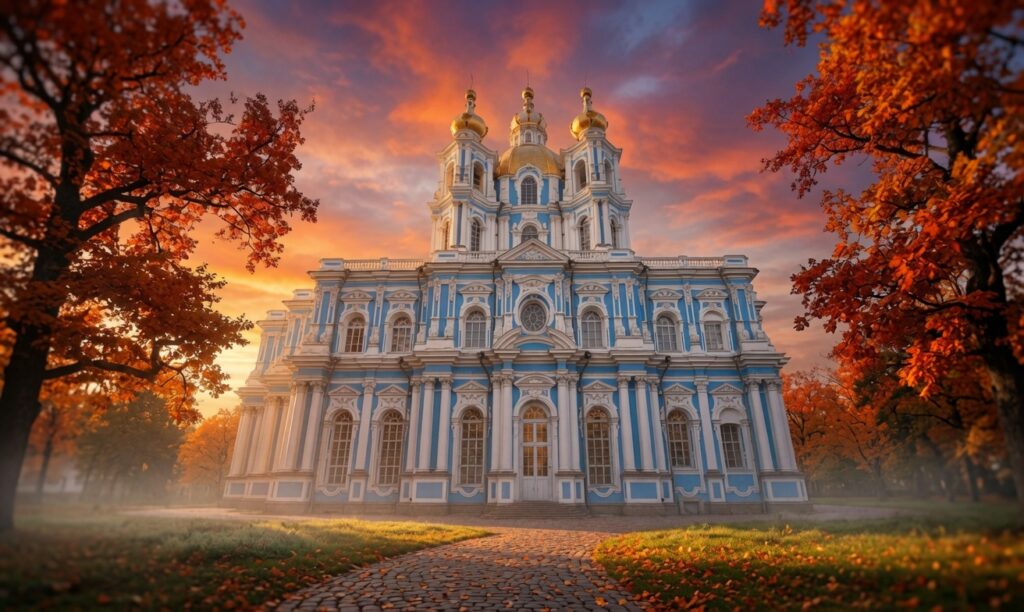
If you sit on the granite parapet of the Neva embankment and raise your eyes, you can see how the city bustle retreats before the emerald and turquoise grandeur soaring above the left bank. It’s not just a temple. It is a frozen dream of the Empress, an architectural challenge and a silent witness to the upbringing of several generations of Russian noblewomen. The Smolny Cathedral meets the traveler not with cold monumentality, but with an amazing flight, like a huge ship that forever raised sails over St. Petersburg.
It all started with an audacious desire. The daughter of Peter the Great, Empress Elizabeth, dreamed of silence. According to legend, she planned to end her days in the monastery, choosing a picturesque corner for this, where ship tar was cooked as a child. In 1748 she laid the first stone. And to implement this daring plan undertook Francesco Bartolomeo Rastrelli — an architect who did not know how to build boring.
The architect conceived a grandiose ensemble in the style of Elizabethan Baroque, where the main temple was to become only a “flower” in the center of the architectural cross. Initially, Rastrelli planned to build next to the cathedral the highest bell tower in Russia — more than 140 meters, above the spire of the Peter and Paul Cathedral. But fate ordered otherwise. The death of the master in 1771 and the subsequent decades of completion turned his idea into a legend. The bell tower remained in the drawings, but this gave us the unique silhouette composition that we admire today: five chapters, as if fused into a single monolith, dominate the space, creating the illusion of eternal movement upwards.
The interior for a long time remained «silent» — only at the beginning of the XIX century, Vasily Stasov took up the business. He did not argue with the baroque luxury of the facades, but created a space of solemn simplicity inside. When in 1835 Metropolitan Seraphim consecrated a building capable of accommodating up to six thousand people, the church gained a special status. Nicholas I ordered to consider it a cathedral of all educational institutions, dedicating it to the memory of his mother, Empress Maria Feodorovna.
Time was different here. On the day of St. Mary Magdalene, the royal family came here, and the walls heard the rustling of dresses of pupils of the Smolny Institute — the first Russian higher female educational institution, arranged in the monastery buildings in 1764. After the revolution came an era of oblivion. In 1922, the cathedral was closed, valuables were seized, and the requests of believers went unanswered. For almost 90 years, the magnificent building has lost its original sound.
Today, life has returned to those walls. In 2009, a prayer service was performed here for the first time in decades, and seven years later, in 2016, the church was officially transferred to the Russian Orthodox Church. Again, as two centuries ago, it became a center of spiritual enlightenment.
Looking at this architectural masterpiece, it is hard to believe that it was built for 87 years. Rastrelli designed the building so that even those who do not like the Baroque can not pass by. It is said that the strict classicist Giacomo Quarenghi, known for his intransigence to the work of Rastrelli, every time passing by, took off his hat and exclaimed: “This is a temple!”
Now the silence of the square is broken only by the measured hum of a ten-ton bell cast in Voronezh. On its lower part are engraved the names of the main universities of the city — a symbolic connection of times, a reminder that the cathedral is still the spiritual mentor of students.
The building seems to breathe history. In its blue walls, decorated with white-stone molding, the prayers of Elizabeth, and the sighs of the institutes, and the strict conciseness of the Stasov interior mixed. The Smolny Cathedral is not just the dominant of the left bank of the Neva. It is a triumph of human will and a rare example of how long years of construction and the change of epochs did not destroy the original harmony, but only gave it a true, precious perfection.
Charity FundHoly Land.
Russian Temples and Monasteries