The peasant son who became the head of the Russian Orthodox Church, Patriarch Nikon, as no one was sure that there were no barriers to dreams. And his dream was to transfer a part of Palestine to Russia.
In 1656 he conceived a grandiose construction on the banks of the Istra River. According to his plan, a monastery was founded there, which was to repeat the main monuments of the Holy Land. With the light hand of Tsar Alexei Mikhailovich, the Resurrection Monastery became known as the New Jerusalem.
The Patriarch took the matter seriously. Large-scale landscape works were carried out on the lands of the monastery. Cut down the forest, poured out the hill, cleared large areas for construction. Even the name in the area was changed to Palestinian. The mountains of Eleon and Zion appeared, and Istra became
Jordan. Peasants from near and far villages worked on the construction site, and masters were collected throughout Russia.
When Patriarch Nikon fell into disgrace, he retired to the Resurrection Monastery and brought his huge library there. There were manuscripts from Athos and ancient Russian scrolls, the first printed books, works of foreign authors. Later, some of the books went to the patriarchal treasury, and all
manuscripts to the Synodal Library. They are now kept in a historical museum.
When Nikon was defrocked and deported to the north, work on the construction of the New Jerusalem froze. The workers were transferred to the decoration of the Faceted Chamber of the Kremlin. But the monastery continued to exist, and under Fedor Alekseevich, and flourished.
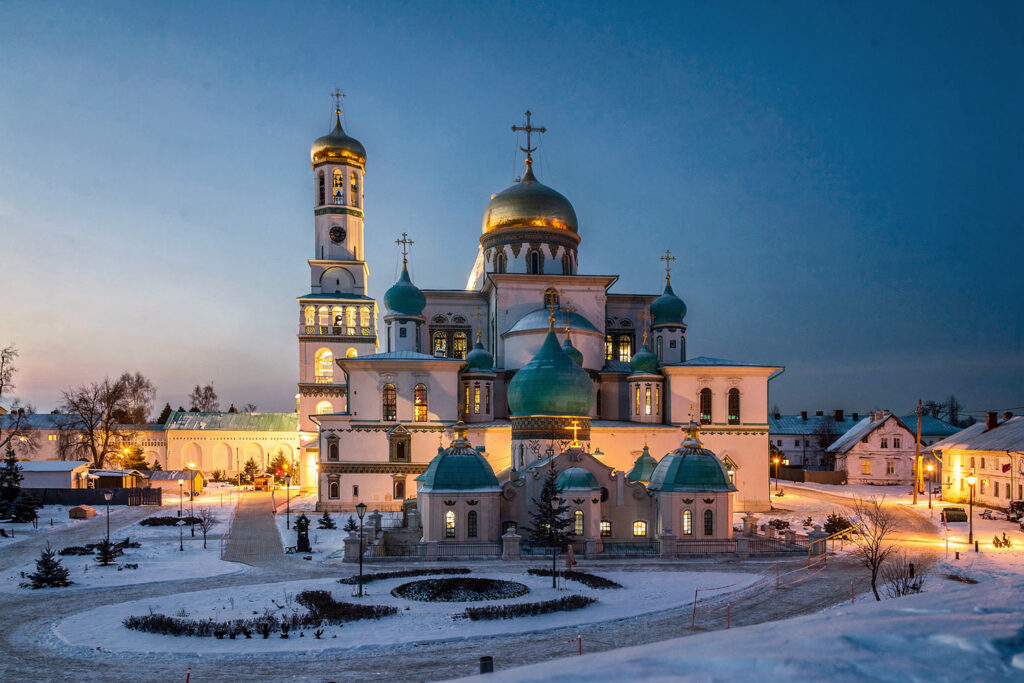
The main cathedral of the monastery, Resurrection, was built according to the drawings of the Church of the Holy Sepulcher in Jerusalem. His wooden model was brought to Russia by Patriarch Paisios of Constantinople.
The cathedral is connected to the underground church of Constantine and Helena. Under Nikon, it was simple, but in the 18th century it was updated in the lush Baroque style.
By the end of the 17th century, the monastery was surrounded by a stone fence 9 meters high. And their thickness in other places reaches 3 meters. It is, without a doubt, a defensive structure with battle towers and narrow loopholes. Above the Holy Gate was built the Church of the Entrance to Jerusalem.
The 18th century was generous with fires. The cathedral burned several times. As a result, the roof collapsed, the walls cracked. Queen Elizabeth Petrovna was so saddened that she sent her beloved architect Rastrelli to rebuild the church. Rebuilt in the mid-18th century cathedral
It existed in this form until its destruction in 1941.
Catherine II also followed the activities of the monastery, allocated money for its expansion and repair. The royal family paid attention to the monastery and donated for new construction until the 1917 revolution.
In the 19th century, the monastery became a center of pilgrimage. For pilgrims built a strange house, several hotels. At the same time, scientific work began to study the history and library of the monastery.
In 1919, the monastery was closed, but not looted, but turned into a museum. What the communists did not do, the fascists did. In 1941, they blew up the cathedral. Priceless historical materials have been lost.
Already in 1942, the design of the restoration of the cathedral began. The work lasted more than 10 years and in 1959 the museum was reopened. And in 1994, at the request of Patriarch Alexy II, the monastery was returned to the churches. The museum moved, residents appeared in the monastery, services began. Since 2011, with the blessing of Patriarch Kirill, the Great Sanctification of Water is held in New Jerusalem, the same as in the real Jordan. And on the feast of the Exaltation of the Cross of the Lord, they hold the rank of the life-giving cross. These events and shrines of the monastery, its unusual history and similarity to Palestinian places of worship attract many pilgrims.
Charitable Foundation Holy Land
Russian Temples and Monasteries