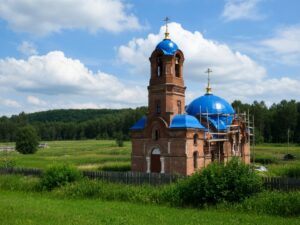
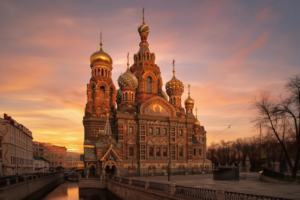
In the middle of the 16th century, on the cape, located between two rivers with colorful names Pesya Money, the monk Feodosius settled. He came from the Prilutsk monastery in Vologda.
He was looking for solitude, and soon other brothers began to settle nearby. In 1554 the monastery was opened. Under the leadership of Saint Theodosius, who received the nickname of Totem, the monastery flourished. But during the attack of the Polish-Lithuanian army, the monastery was destroyed, the buildings burned.
The monks again settled in the ashes. Gradually rebuilt the chapel, the brotherly building. In 1689, the first stone temple in Totma was consecrated. They dedicated him to the Transfiguration of God.
After 200 years, the temple was rebuilt: added a chapel, a porch, increased the height of the vaults.
The monastery was repeatedly visited by Peter the Great, and the founder of the Russian settlement in California, Ivan Kuskov, is buried here.
The second stone temple was the Ascension Cathedral. It was built on the site of an old wooden church in 1825. And at the end of the 19th century, the walls were painted by Vologda artist Platon Tyurin.
The stone bell tower, built in the middle of the 19th century, has not survived. There’s no information left on her. But the fraternal corps survived. Now in one of them there is a hotel for pilgrims, and in the other there is an exposition of the historical museum of Totma.
The monastery was closed immediately after the revolution. The buildings were used for economic needs. For a long time in the building for the monks was a forest technical school. There studied the famous Russian poet Nikolai Rubtsov.
The ROC Monastery was returned only in 2014. The buildings had completely collapsed by this time. Rehabilitation work is currently underway in the area.
Charitable Foundation Holy Land
Russian Temples and Monasteries