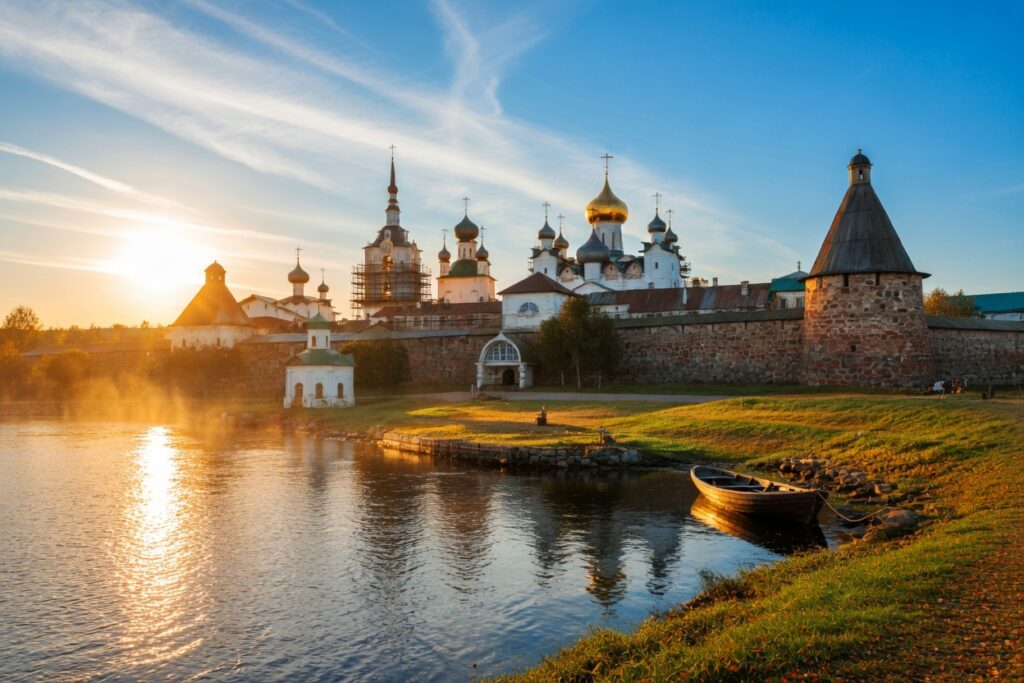
At 165 km south of the Arctic Circle, in the center of the Solovetsky archipelago, is the Spaso-Preobrazhensky monastery, better known as Solovetsky. The first inhabitants of Solovetsky Island were the monks Savvatius and Herman, and then Zosima. They arrived in the early 15th century in search of complete solitude. They had nothing but faith in God. They cut down the first wooden temple. Thus began the construction of God’s house on the Holy Island. Later, three monks were listed as saints. Their remains rested in the monastery until 1939, when they were taken to the mainland. In 1992, the relics of the saints were returned to Solovki. August 21, 1992 became the main holiday of the monastery.
The heyday of the monastery began under Abbot Philip, in the 16th century. On the site of wooden churches put stone temples. The most famous are the Cathedral of the Transfiguration of the Lord, the Cathedral of the Assumption of the Virgin and the Church of Nicholas the Wonderworker.
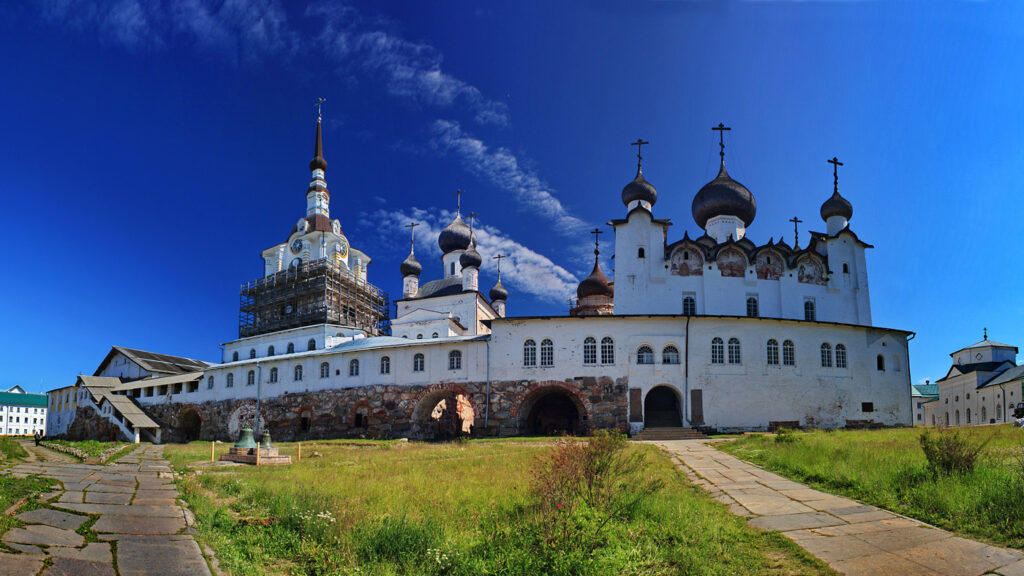
But it was not only the temples that were built by Solovka. They dug numerous canals, connected the lakes of the archipelago, built mills on them. Many times increased the number of salt cookers. From huge boulders up to 2 meters in size and weighing from 7 to 11 tons, a stone wall was built. In the 17th century, the Solovetsky Monastery with its incredible engineering wall was the northern outpost of Russia.
Interestingly, many innovative ideas in the Russian North were embodied in the lands of the monastery. The first weapons factory was built here in the 17th century, and a biological station in the 19th century. The monastery had its own geophysical laboratory and weather station.
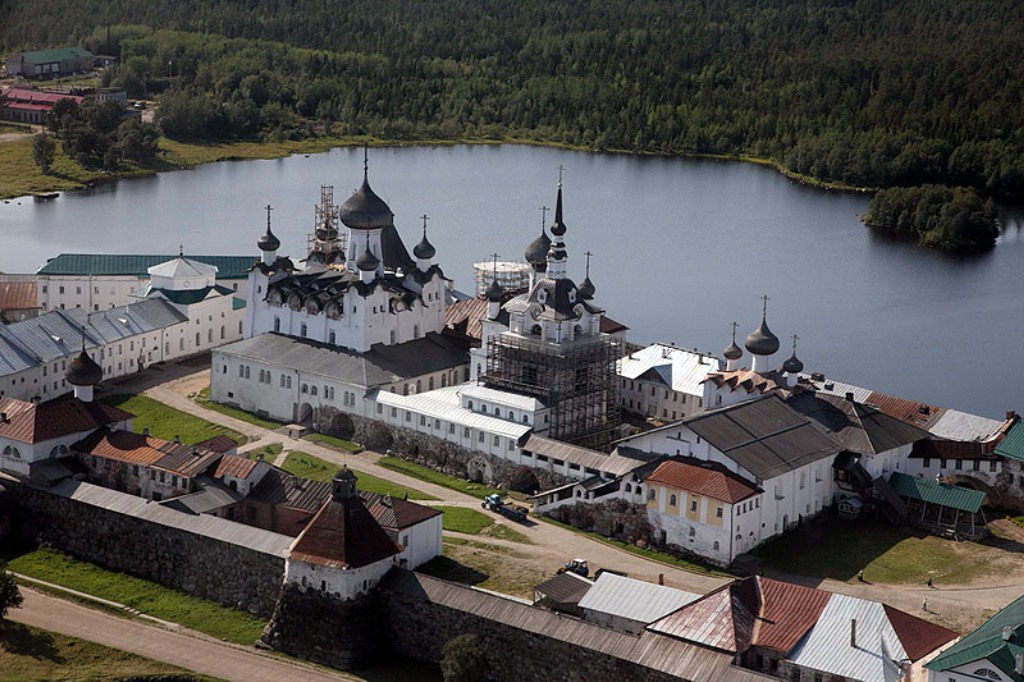
Over time, biological and meteorological stations and even an observatory will be built on Solovki. The library was of great value. Before it moved to Kazan in 1854, it kept unique collections of handwritten and old printed books.
Currently, in addition to the cathedrals, churches and chapels of the monastery itself, there are 6 hermitages, 3 deserts and several farmsteads around it. Most of them were built on places of memorable events and miracles.
Away from the main monastery, there was a cell of the abbot Philip, where he retreated. To this day, there is a stone that he put under his head.
It was there that Christ appeared to him as an omen of the martyric end awaiting the future Metropolitan of Moscow. His relics rested on the territory of the monastery until 1652, then some of the relics were transported to the Assumption Cathedral in Moscow.
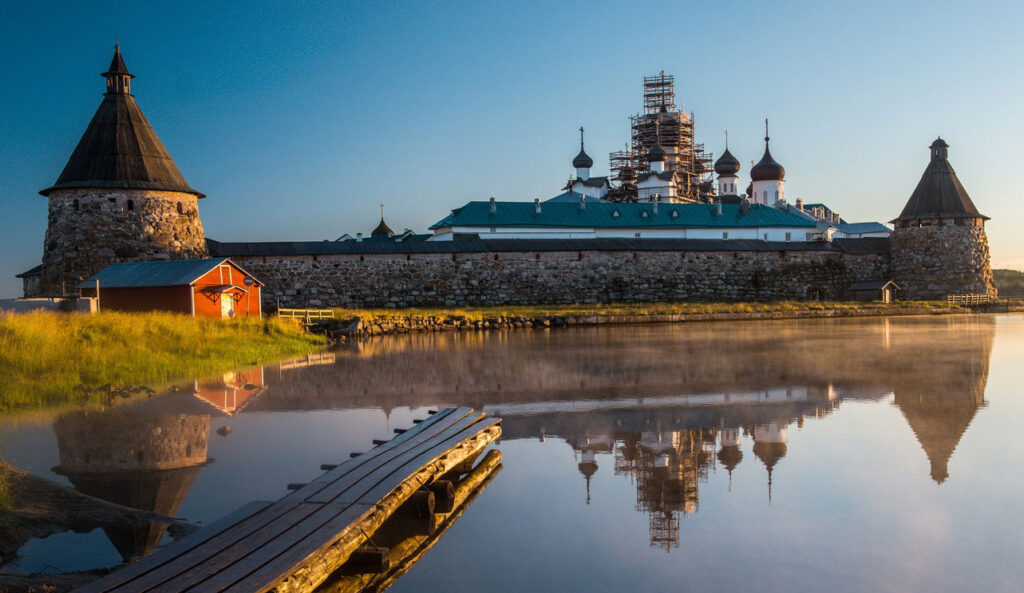
In the 17th century, the monastery was the most impregnable fortress in northern Europe, with a spirit of mercy and prayer. But if necessary, the monks took up arms. The monastery remembers a heavy siege during the Schism associated with the reforms of Patriarch Nikon. The Solovetsk confrontation, called the “Solovets seat” lasted 8 years. Only the betrayal of one of the monks allowed the fortress to fall. The irony of the story is that Nikon was tonsured as a monk in Solovetsk obitnli.
In the 19th century, its stone walls stood under a hail of English cores.
It was on Solovki, in St. Andrew’s Skete that Tsar Peter I consecrated the Symbol of the Russian Navy, the St. Andrew’s Flag. Before the revolution on the territory of the monastery worked wax and brick factories, icon painting workshop.
In the 18th century, the Monk Job of Anzer appeared during prayers the Mother of God and told him to put a temple on the mountain in honor of the crucifixion of Christ. This place was called the second Calvary. A bitter prophecy predicted the death of many people in this place.

In the 20-30 years of the 20th century, the prophecy of the Mother of God came true. Solovetsk monastery in 1920 was closed, and Solovki became the place of death. The Soviet government established a special prison on the island. Shootings and murders were common on Solovki. These were times not only of suffering, but of great devotion to God. Among the prisoners of Calvary were many priests and even bishops.
Only in 1990 began the restoration of the monastery and the renewal
monastic life.
Solovetsky Monastery has a unique religious, historical, cultural and natural significance. It is listed as a UNESCO World Heritage Site.
The monks say that this is a place where you can learn to breathe the sky before you go to heaven.
Charitable Foundation Holy Land
Russian Temples and Monasteries