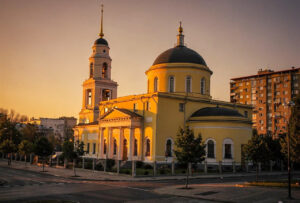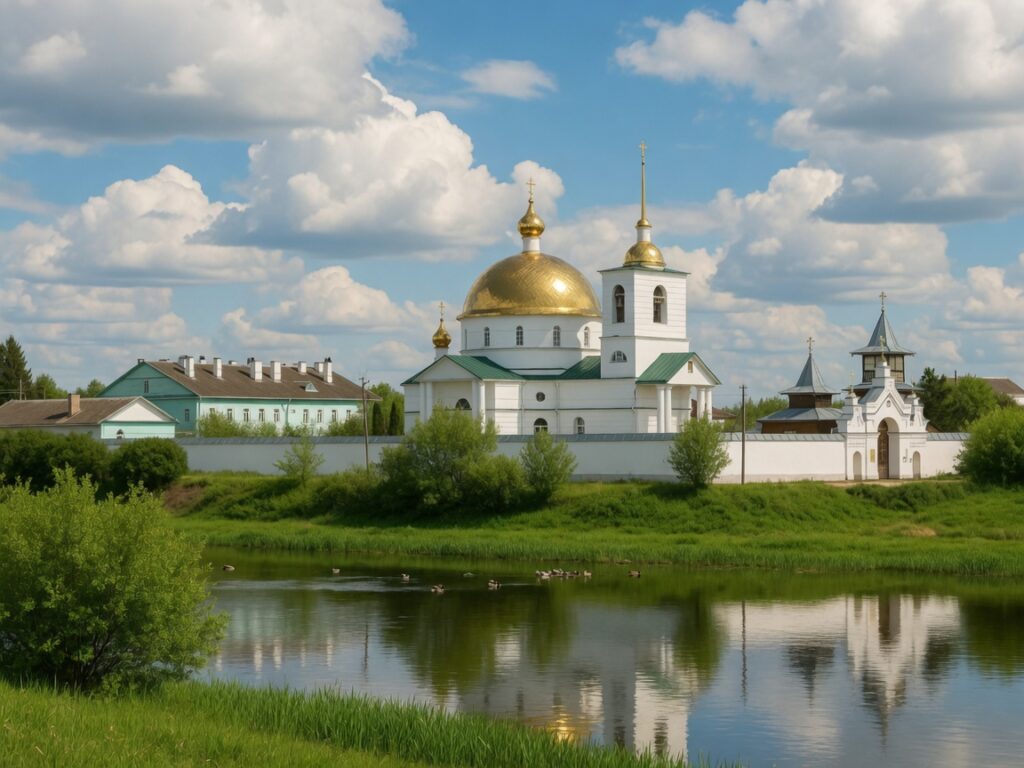
In the small town of Ostrov in the Pskov region, where the Great River cuts the land on two banks, there is a monastery, which could not be. It is not founded by the prince, not built by royal decree, does not stand on the site of an ancient miracle. It grew out of the estate of one Russian family — a family that gave Russia a patriarch, and this town — a monastery that survived ruin, oblivion and return.
Simanian
It all began with the Ekaterinsky estate. In 1845, Vladimir Alexandrovich Simansky, the great-grandfather of the future Patriarch Alexy I, built a stone church in his estate in the name of the Savior of the Unmade Image. The temple turned out elegant: colonnades, a park around, mansions in the neighborhood. According to the memoirs of the Patriarch himself, who came here as a boy, the estate resembled a small paradise — well-groomed, inhabited, warm.
But the estate was not just a manor. The Simansky family was ancient, noble, and at the same time deeply church. The brother of the patriarch’s grandfather, Pavel Vladimirovich Simansky, took the sacred rank and even during his lifetime planned to turn his native nest into a monastery. It is not a place of worship, but a place of worship. So that the temple, the park, the houses — everything went not for sale and not for division between the heirs, but for service to God and people.
In 1896, Pavel Simansky issued a donation: the land, the temple of the Savior of the Unmade Image, some buildings and fifteen thousand rubles of initial capital. The father of the future patriarch, also Vladimir Alexandrovich, but another, the son of the one who built the church, contributed his share. So the family decision became a business.
Consecration with John of Kronstadt
On the seventeenth of August 1897, the monastery in the name of the Kazan Icon of the Mother of God was solemnly consecrated. The ceremony was attended by righteous John of Kronstadt, one of the most revered pastors of Russia at the end of the XIX century, the spiritual mentor of Pavel Simansky. His presence gave the event a special weight: not every monastery was consecrated by a well-known saint.
At first it was a community — not a full-fledged monastery, but a sisterhood. In 1907 it was transformed into the Savior-Kazan Convent. The sisters lived according to the rules, prayed, worked. At the monastery, a parish school and a school of needlework for girls were opened — local peasant women learned to sew, knit, embroidery. A homeopathic hospital worked: it was treated for free, there were almost no medicines in the villages. The sobriety society was active — by 1902 it consisted of one hundred and thirty people. For those places and those times it was a serious figure: drunkenness was a scourge of the village, and society gave people an alternative — at least for a while, at least within the walls of the monastery.
At the beginning of the XX century, they began to build a cathedral in honor of the Kazan Icon of the Mother of God — a large one, with two chapels. But we didn’t have time to finish. 1917 came and everything stopped.
Ruin.
After the revolution, the monastery was closed. The buildings were dismantled on brick — the necessary, scarce material. In the destroyed temples set up a dump. What was built with the money of one generation and protected by others was destroyed in a few years.
There was a short, strange pause. In 1942-1943, under the German occupation, the closed church was restored and consecrated. Around him again gathered sisters — those who survived, who lived, who did not lose faith. But after the liberation of the Island, Soviet power returned, and the monastery was liquidated a second time. Now it is finally — so it seemed.
Return
Revival began in 2003 — eighty years after the closure and sixty years after the last attempt. On the thirteenth of October, Archbishop Eusebius of Pskov blessed the creation of the parish of the church of the Kazan Icon of the Mother of God. In February 2004, he commissioned nun Markella, a woman who undertook a task unthinkable by the standards of ordinary life: to restore what was left of walls and memory.
On the second of January 2005, the first service took place in the new wooden church of John of Kronstadt — the same saint that consecrated the monastery in 1897. The circle is closed. On the fourteenth of June 2005 the community was reorganized into the Savior-Kazan convent.
The monastery has since been rebuilt. The temple of the Savior of the Image Not Made by Hands was restored — the first festive service was held on November 4, 2010. There were monastery walls, sister and working buildings, refectory, library, singing class, sacristy, outbuildings. They dug a pond. The museum of Patriarch Alexy I was opened — the same one who came to Catherine as a boy and remembered the park, colonnades and mansions.
The monastery has a compound in the village of Tonkovidovo. There restored the temple of Archangel Michael XV century — the oldest in the Ostrovsky district. Five hundred years of the stone, and he hears prayer again.
Kazan icon
A special shrine of the monastery is one of the miraculous lists of the Kazan Icon of the Mother of God. According to legend, the image was found on the banks of the Great River — the same one that flows through the Island. The Simansky family especially revered this icon, and when Paul Simansky conceived the monastery, he chose the name of Kazan not by chance. The icon became the heart of the monastery – for what the sisters returned, for what they built anew, for what people came.
Today.
The monastery is located on Malaya Pioneerskaya Street, 80, in Ostrov. Open daily from eight in the morning to eight in the evening. The abbot is Abbot Markella, the same one who in 2004 received the obedience to gather the sisters. She still collects them.
The place where the Simansky estate once stood now bears little resemblance to the park with mansions and colonnades described by Patriarch Alexy. But something remained: the stone temple of the Savior of the Image Not Made with Hands, built in 1845, is the one from which it all began. It stands as it stood under Vladimir Alexandrovich, under Pavel Vladimirovich, under John of Kronstadt.
Charity FundHoly Land.
Russian Temples and Monasteries