The Ladoga winds preserve the memory of a place where time flows according to special laws. Here, among the harsh northern landscapes, for nine centuries stands the monastery, the birth of which is shrouded in a fog of legends. The Assumption Monastery in Old Ladoga is in no hurry to reveal all its secrets, allowing only to guess who exactly laid the beginning of its history.
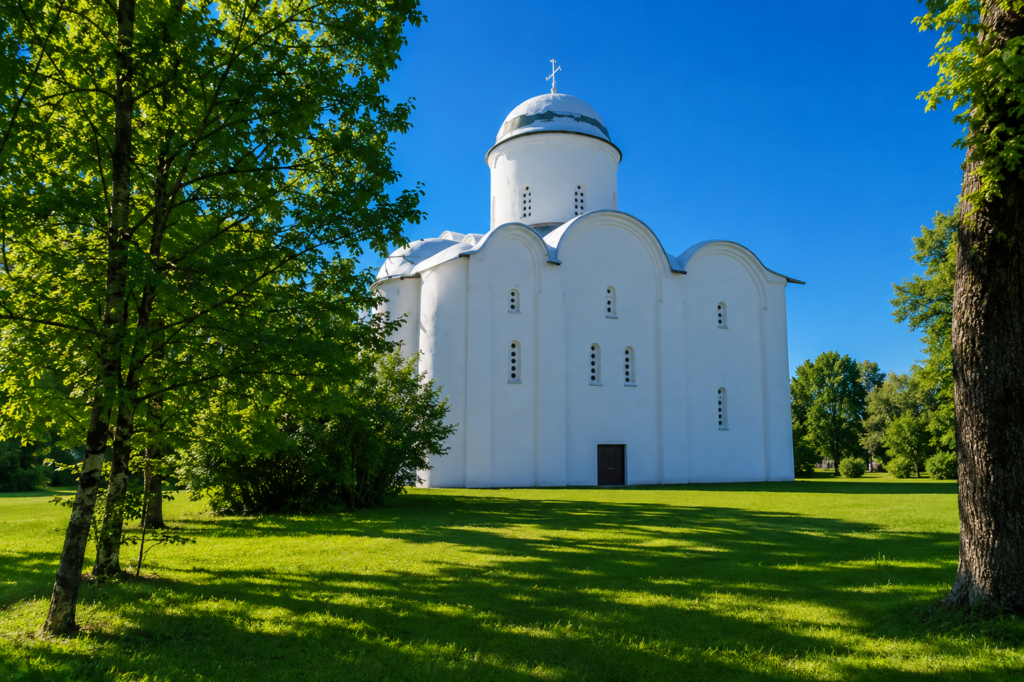
Scientists argue, naming different dates of foundation — from the middle of the eleventh century to the second decade of the twelfth. The stone heart of the monastery, the cathedral church of the Assumption of the Most Holy Mother of God, was built approximately in 1114-1116. This makes the temple the most northern architectural gem of the pre-Mongol era. Imagine: a harsh land piercing the wind from the Volkhov, and Novgorod masters erect an elegant cathedral-tomb. In its walls, arcosol niches are still guessed, and on the arch’s vault mysteriously appears the “sign of Rurikovich”.
The appearance of the white stone temple is inextricably linked with the names of those who ruled these lands. The laconic and majestic architecture of the cathedral gives rise to a feeling of strict detachment from the worldly bustle. Fortress masonry of walls, monumentality of forms — everything here breathes the era of the birth of Russian statehood. The centuries have left their mark, but the spirit of antiquity has not weathered, it has frozen in every stone.
Who was at the beginning of the monastery? One hypothesis sends us to the figure of the Swedish Princess Christina, the wife of Prince Mstislav the Great. Perhaps it was she who consecrated the construction of the Ladoga stronghold, founded a maiden monastery here. There is a bolder assumption that goes back to the eleventh century. According to him, the wooden monastery could appear through the efforts of Ingigerda — the daughter of King Olaf of Sweden, who became the wife of Yaroslav the Wise. Having received the Ladoga lands in a dowry, this extraordinary woman, in the baptism of Irene, and in the night Anna, could well lay here a holy monastery.
The history of the monastery is a series of extinctions and miraculous revivals. The terrible pogrom of the Swedish invasion in the early seventeenth century almost wiped it off the face of the earth. It seemed that life here was frozen forever. But after the pacification of 1617, Elder Aquilina, like a candle in the darkness, gathered scattered sisters and breathed life into the desecrated walls. In the same year, the main temple was re-consecrated, restoring hope to the depopulated land.
The walls of the monastery saw not only ascetics of the spirit, but also royal prisoners. Since 1718, here, in mournful silence, spent seven years the first wife of Peter the Great – Queen Evdokia Lopukhina. Forced into a nun named Helena, she dutifully waited for her release, which came only with the death of the emperor. Later, the monastery shone the names of ascetics of piety — schiagumenia Eupraxia and gifted poetess Elizabeth Shakhova, who took tonsure as schemamonachina Maria. Here Saint John of Kronstadt visited and prayed, drawing from the sisters of the monastery abbot wisdom for the new monasteries.
The nineteenth century transformed the architectural ensemble. The architects of Gornostaev, Nikonov and Brant left their handwriting here, supplementing the harsh antiquity with noble features of late eclecticism. After closing in 1919, the monastery endured decades of neglect, serving as an orphanage and school. It was only in 2004 that buildings recognized as federal monuments finally returned to the Church.
Today, the bell rings again over the Volkhov. In the Church of the Exaltation of the Cross are buried particles of the relics of the Great Martyr Barbara and St. Anna of Kashin. It was as if the invisible threads of holiness from all over Russia were drawn here: here they pray before the arks with the relics of Seraphim of Sarov, Arseny Konevsky, Diveevsky’s blessed and saints of Valaam. The ancient monastery did not become a museum exhibit. It continues to live, washed by the waves of history, remaining a quiet beacon for souls seeking salvation at the source of the Russian faith.
Charity FundHoly Land.
Russian Temples and Monasteries