Peter the Great created St. Petersburg for access to the sea. It is not surprising that there was a whole sea settlement in the city, because many people worked in the shipyards of the Admiralty so that the newly appeared Russian fleet would expand and strengthen. But for a long time the only place for services and prayers was only a small Nikolskaya chapel, and then a wooden church, a little larger. Only in 1752 it was decided to build a stone temple. The size of the building was dictated by the fact that it was built on a hill to avoid flooding during frequent floods.
For St. Petersburg, the church was unusual, five-domed, and not one-spyle, like Peter and Paul Cathedral. The building itself is conceived in 2 floors, with vaults, which were given the shape of a cross.
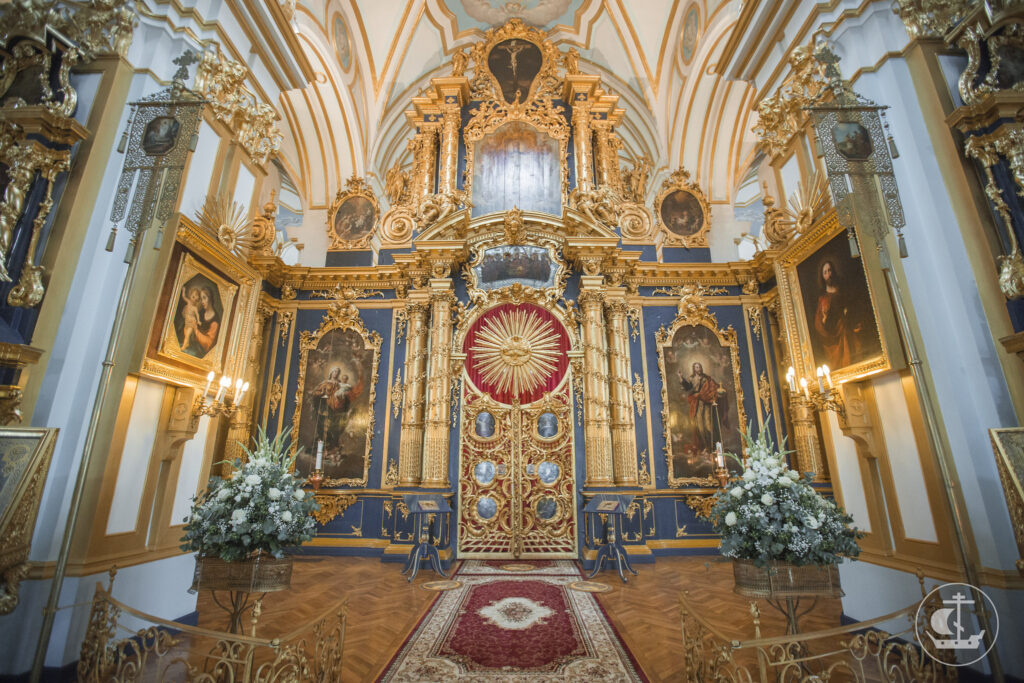
The interior was strikingly luxurious. The panicadilo came from Germany. It was decorated with figures of Jesus, the Baptist and the Evangelists. Icons were painted on a tree, but in a typical 18th century mix of church and secular styles.
The decoration and architecture of the temple underwent minor changes: the old gate was replaced by new ones, but the same ones, and the stone stairs were replaced by wooden ones.
A little later a bell tower was built nearby. It was decorated with clock-curantes, and the bell ringing provided 13 bells.

The temple was laid under Elizabeth, but consecrated under Catherine II. It was she who commanded him to be called the sea. That’s what happened. Since that time, all the victories of the Russian fleet were celebrated with celebrations in the Nikolo-Bogoyavlensky Maritime Cathedral.
In honor of every glorious battle during her reign, Catherine donated an icon in a golden robe. There were 10 such icons, each dedicated to the saint on the day of which the battle took place.
This tradition was followed by naval officers, crews of warships, employees of the Admiralty. The iconostasis of the temple is a living history of the Russian fleet.
But it is not only the victories that the Russian sailors wanted to remember. In the park of the temple, a monument to the participants of the Tsushima battle was erected on public money. Yes, we lost the battle, but how many heroes did this battle bring? Alas, the monument came into dilapidation and part of the boards with the names of the sailors was lost. When it was restored in 1973, it was not possible to find all the names. Listing ends
It says «etc.» Their memory is kept by naval officers and sailors who serve in the Navy now.
With the arrival of the Bolsheviks, persecution began. First, church values were seized. Some of them were bought, but most of them were taken by the authorities. Then the church was given to the so-called “renovationists”, Orthodox priests who supported the new government.
The priests who defended the true faith were exiled. Thus, the future Patriarch Alexy I was sent to Kazakhstan. But by 1924, the temple returned to the bosom of the ROC. Alas, in the 30s, the bells were removed from the bell tower and continued to take away church utensils.
During the war, parishioners regularly collected funds to send to the front. There was an air defense squad at the church. The entire blockade in the temple did not stop services. The building suffered from artillery shelling, but immediately after the end of the war, restoration work began and by the mid-50s the cathedral was completely reconstructed.
The temple is open, open daily. On church holidays in the cathedral, which seats up to 5,000 people, the apple has nowhere to fall.
There is a Sunday school, a library of ancient literature, and a Youth Union.
The main shrine of the cathedral is the icon of St. Nicholas. It also contains many other revered icons, particles of the ark of Nicholas the Wonderworker and the Life-Creating Cross.
Charitable Foundation Holy Land
Russian Temples and Monasteries