Imagine a narrow strip of land sandwiched between the harsh waters of Lake Onega and the quiet surface of Lake Murom. Around for hundreds of kilometers — only taiga, silence and ancient boulders overgrown with moss. Here, at the very edge of inhabited earth, time flows differently. Here for more than six centuries there is the Murom Uspensky Monastery — a place where history is not rewritten, but slowly, like resin on the bark, accumulates over centuries.
The monastery was born out of a feat of loneliness. According to legend, at the end of the XIV century, the monk Lazarus, obedient to the will of his spiritual mentor, went to the “north side, to the sea” to find the very island of Much. He came here when there was only wildlife and icy wind around. Having built a chapel and a cell, he did not know that he was laying the first stone in the history of one of the oldest communal monasteries of the Russian North.
The main architectural drama of the monastery revolved around the tiny wooden church of the Resurrection of Lazarus, cut down in 1390. She stood alone in the cemetery, outside the main monastery walls, and seemed doomed to oblivion. In the XIX century, in order to protect the dilapidated shrine, the northern masters came up with a unique move: they built a huge temple around it — «case». It seemed that the ancient building had eternal protection.
However, the twentieth century decreed otherwise. In 1959, when prayers had not been heard on the territory of the monastery for a long time, and the commune named after Trotsky, the house of the disabled, the church of Lazarus were dismantled on a log. She was transported on a raft to the famous Kizhi. Today, this log without a single nail is the pearl of the museum collection and the oldest monument of wooden architecture. In the monastery itself, an exact copy of the lost shrine is being erected today, restoring historical justice.
Today’s life here is a feat accessible only to a select few. The brethren of the monastery are few in number: only a few monks and novices under the command of the abbot Elijah. Communication with the «big land» is through the village of Gakugsu, from where you can reach the holy walls by river and lake. Only one old, swampy road leads to the monastery, and it preserves the memory of the tragic death of the inhabitant of Father Neil in December 2013.
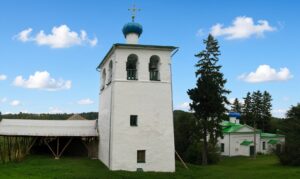
Despite the harshness of the terrain and the lack of usual benefits, the walls are being revived. The fraternal building with the winter St. Nicholas Church has been restored, the Church of All Saints has been rebuilt, the coastline is being strengthened, which is constantly being undermined by Lake Onega. Monks live in conditions of strict solitude, remaining cut off from the outside world for months, but it is here that you feel the very silence for which in ancient times they went to the desert.
When the monastery boat adjoins the pier, and you go ashore, it seems that behind the back is not only the water surface, but the whole noisy, bustling world. Murom Monastery does not wait for tourists — it receives pilgrims. It is a place where a person is left alone with history, nature and his own soul, and where among the age-old pine trees and white-stone walls time really stops.
Charity FundHoly Land.
Russian Temples and Monasteries