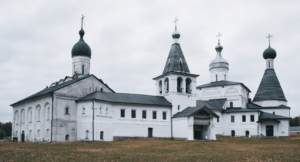
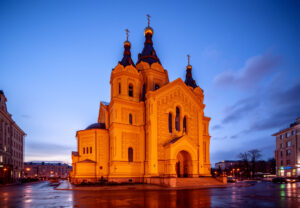
At the eastern border, Mikhailov Land makes a sharp bend, rising above the surrounding expanses of the Black Mountain. If you climb here on a quiet morning, when the fog still clings to the slopes, you can hear a subtle chime floating in the clear air. Thus, the revived Intercession Monastery welcomes a new day — almost a century after it seemed to have disappeared from the face of the earth forever.
The roots of this women’s community do not go back to St. Michael’s land. Initially, the sisters settled near Lake Kutskoye, near Ryazan, calling their home the Pustynsky Pokrovsky nunnery. The surrounding people, however, called it much more sincerely — the Agrafena desert. The isolated corner offered prayerful solitude, but by the beginning of the 19th century something had gone wrong in this solitary existence. In the summer of 1819, a decree was issued on the transfer of nuns to the district Mikhailov, to a hill dominating the city. As soon as the snow melted in May of the following year, axes were already knocking on Black Mountain — cell log houses were being erected. And the soul of the new monastery compound was made up of the donated cemetery church dedicated to the Resurrection of Christ.
Further events in the biography of the monastery resemble a protracted test of strength. In the stormy year of 1919, Bolshevik detachments sealed the churches, and all the sisters’ property was sold under the hammer or simply disappeared into bottomless duffel bags. The sanctity of the place was trampled underfoot with cynical pragmatism: a pig farm grunted under the ancient arches. The final chord of destruction struck towards the end of the fifties, when an excavator razed the last monastery walls to the ground. A dead void formed, as if locusts had passed along the slope.
And yet the Black Mountain waited in the wings. At the turn of the millennium, in 1998, the residents of Mikhailov erected a small chapel-temple on an abandoned wasteland. They dedicated it to the touching image “Recovery of the Lost” — a symbol of last hope for the desperate. On the autumn day of October 10, 1999, Metropolitan Simon consecrated it, and the ice crust of many years of silence gave the first crack.
Today, at the foot of the hill, the desolation zone is no longer recognizable. The key event in modern chronicles was the foundation stone of the gigantic cathedral in July 2005 by Archbishop Paul in the name of the Intercession of the Most Holy Theotokos. A little later, in September 2007, the foundation stone of the gate temple, entrusted to the heavenly intercession of John the Theologian, was laid down nearby. The monastery walls are rising again, the fence outlines the boundaries, and the carefully planted orchard promises to rustle in the wind with ripe leaves in about five years.
Daily life here is built around service and work. Sowed gardens, chores in the barnyard and reading books in the library are drawn to a single center — daily prayer. The sisters keep a simple farmstead in order, lead excursions for curious pilgrims and teach children’s Sunday school. Visiting pilgrims are given overnight accommodation right in the residential building: there is no separate hotel yet, but fifteen people are ready to be warmed up here with a warm welcome and a hearty monastery lunch.
The Intercession Monastery now resembles a living fresco, which is being re-painted along a barely noticeable outline. Every year new lines appear: the skeleton of the bell tower, the dome over the cathedral, the path running along the cliff. But the main miracle is the people who come here for healing not of the body, but of the soul. And for any guest, the Black Mountain is open as widely as two centuries ago, when the first carts with icons and utensils drove to its top.
Charity FoundationHoly Land
Temples and Monasteries of Russia