White Lake is a monastic land. St. Sergius of Radonezh sent monks across the Russian land, realizing how important it is to maintain the light of Orthodoxy under the yoke of the Tatars. Prior to him, monasteries were mainly built in cities or under their walls. The Russian peasant was locked in a triangle of arable lands, the exit from which was only one – to the north. But going to impenetrable forests and swamps is not everyone will decide. So Sergius sent pioneers – monks. The first to the White Lake came Kirill, founded Kirillo Belozersky monastery. A year later, his associate Ferapont organized a monastery, which was later named in his honor. This happened in 1398.
He was small, unknown to anyone, until he passed by a busy trade route to Arkhangelsk and Solovki. The abode blossomed here. Numerous donations began to arrive, but most importantly, the monastery became the center of spiritual life. Rector Martinian strongly encourages book writing, spiritual research. It’s not just books.
They were copied, they were created. The elders of Belozersk were famous for their wisdom and spirituality. The monastery was getting better and richer. Temples, cells, strange houses were built.
No matter how rich and famous the monastery was, it was still in the northern, harsh, far from the central cities. It was not only a place of worship, but also a place of exile for the disobedient. The most famous prisoner was Patriarch Nikon. Here he spent 10 years in works not only spiritual, but also physical. Nikon laid out an island of boulders on the shoals, built a small wooden structure and put up a cross with the inscription “Nikon, Patriarch by the grace of God, put this cross of summer 7176 (1668) May 15 days.”
When a specially sent centurion asked for the purpose of the cross, he received the answer: so that people would not die in a storm. The locals believed that the cross guarded them.
After 10 years, Nikon was transferred to the Kirillov monastery, and then allowed to return to his brainchild — New Jerusalem, but on the way he died.
Nikon was not the only prisoner. Tsars and queens did not hesitate to send unwanted clergy here until the monastery was closed.
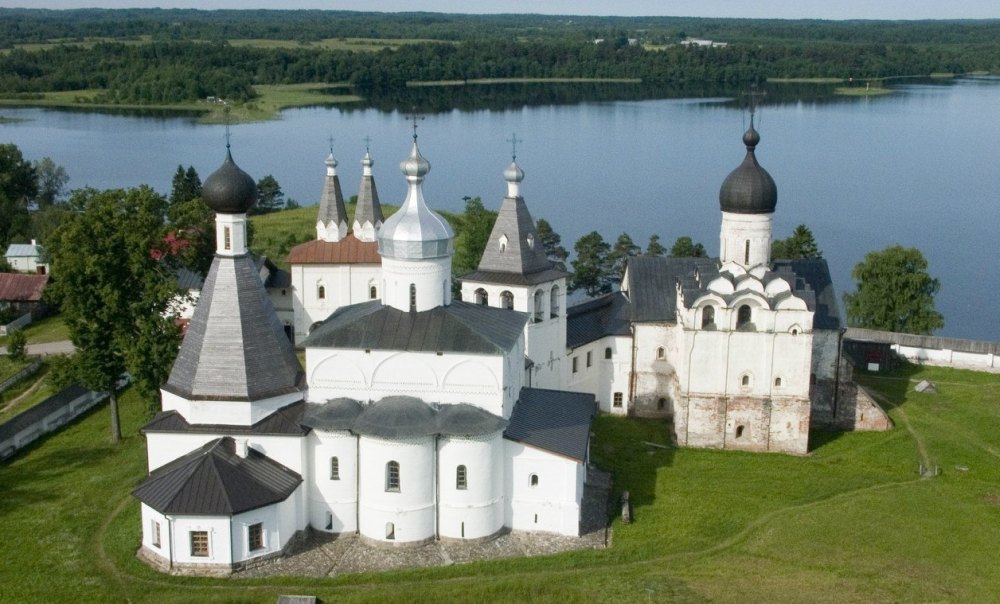
Ferapontov Monastery was badly damaged during the Polish invasion. He was robbed and set on fire several times. He could not recover and in 1798 it was closed. Temples became parish churches.
The remoteness of the monastery played a role or prayers of the elders, but the buildings did not suffer much damage. Miraculously preserved the Church of the Nativity of the Virgin, but frescoes in it, painted in the very beginning of the 16th century.
In 1904, the monastery was rebuilt as a female monastery. A large-scale restoration was carried out. Although it was closed again in 1924, it was not destroyed or disassembled into a brick.
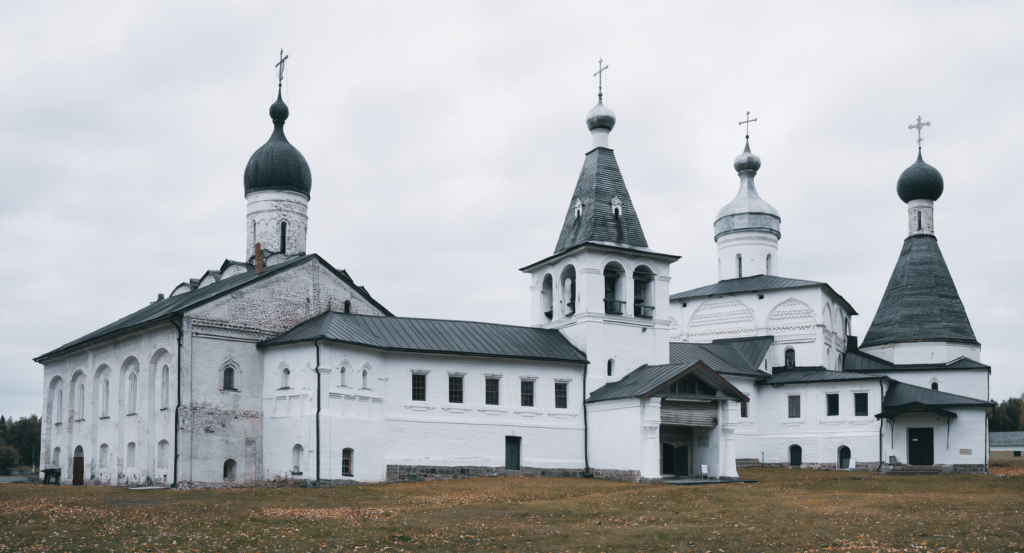
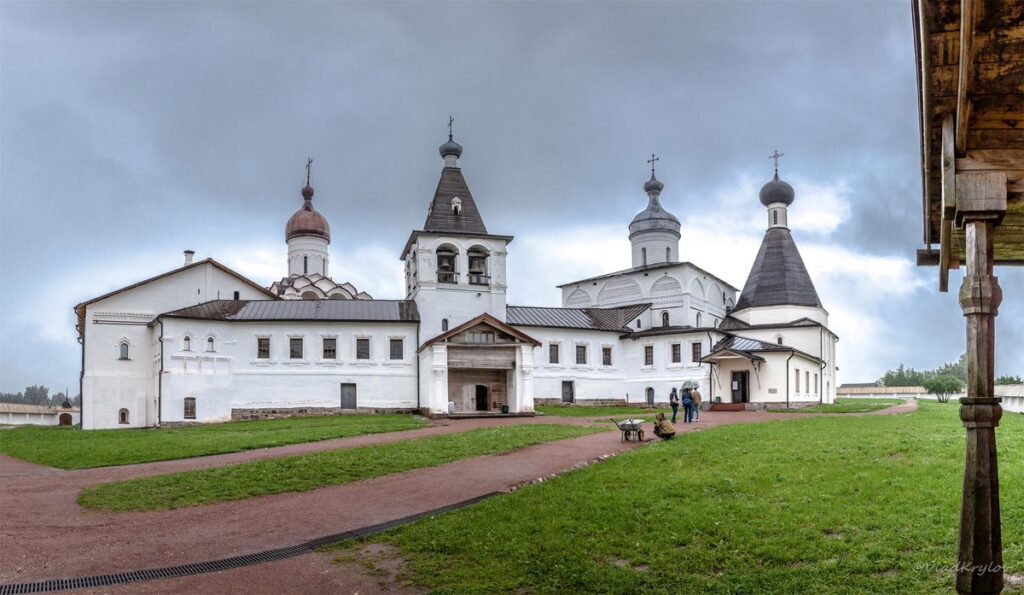
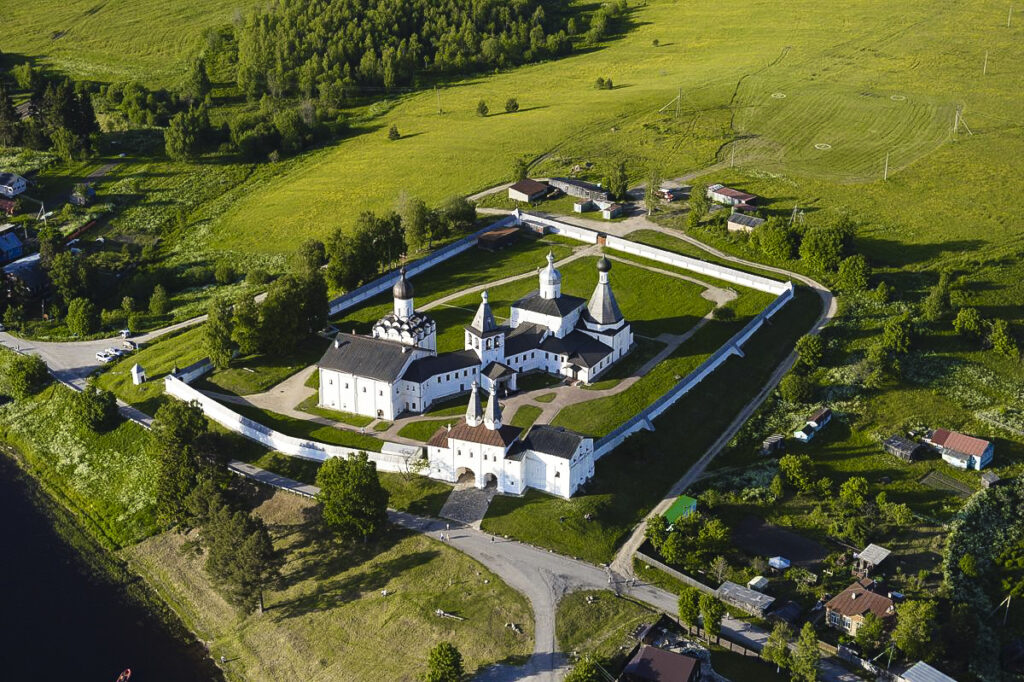
On the territory of the monastery there are 4 temples, refectory, bell tower, state chamber. The cells have not survived.
The Cathedral of the Nativity of the Virgin
It was built in 1490. In the Russian North it is the oldest preserved temple. In 1502, the icon painter Dionysius and his sons were invited to paint it. In addition to frescoes, Dionysius painted several icons for the iconostasis. It was the frescoes that made the Ferapontov monastery world famous. It is included in the UNESCO World Heritage List.
In 1930, the icons were taken from the temple. Some are in museums, others are lost forever.
Church of the Annunciation
Built in 1531 in honor of the birth of the heir to the throne, Prince Titus, who is better known to us as Ivan the Terrible. His refectory served as a bakery and cookhouse. The whole wall (now walled) was given under «vocals» — special jars that created a resonance to the bell ringing. Later, a bell tower was built, through which the transition from one temple to another passed.
The Treasury Chamber
An unusual structure for the monastery, which had no spiritual function. In the upper tier there was a bookshop, library, treasury, archive In the lower tier — economic premises.
The Church of the Monk Martinian (1641)
This is the tomb of one of the first founders of the monastery. There, his relics are stored under the bush, and next to him are the relics of his disciple Joasaph. Rica Martinian was richly decorated with gold and stones, it was carved texts from the life of the saint.
The Church of God with the Holy Spirit
feraponta
The gate church was built in 1649. It served as the home church of disgraced Patriarch Nikon. He had his cell attached to him until another was built nearby. The Church is small, but disposed to reflection and spiritual communion.
Antiquities and shrines
9 antimins of the 15th-17th centuries. This is a silk embroidered board, without which it is impossible to hold the Liturgy.
1 Icons of Ferapont and Martinian
2 Cancer Martinian
3 His robe
4 Nikon’s chair and table
Now the Dionysius Museum operates on the territory of the monastery, and the monastery itself is part of the Kirillo-Belozersk Museum-Reserve.
Charitable Foundation Holy Land
Russian Temples and Monasteries