When St. Stephen of Perm arrived at the end of the fourteenth century in the land of the Zyrians, he carried with him not only faith, but also the understanding that spiritual transformation requires physical embodiment. The result of his works – the Mikhailo-Arkhangelsk Monastery – has been standing here for six and a half centuries.
From Paganism to Stone: Architecture as Confession
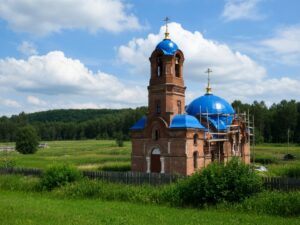
The monastery complex in Ust-Vymy tells its story in stone and wood. The main temple of the Stefanovsky Great Perm Monastery, built in 1761, is not just a building. This is evidence of change: on the site of a pagan sanctuary (birch idol) an icon of faith appeared.
The temple, designed by Vasily Belorukov and the Trenkin brothers, embodies the northern
Style: square volume without internal pillars, eight-lot vault, three faceted drums under the bulbous head. This is not a copy of Moscow architecture, but an original handwriting of the Great Ustyuzh school, adapted to the harsh climate. Semi-circular, like a shell, the altar contains an ark with twenty particles of the relics of saints — a tangible connection with Christendom.
The Land of the Saints: From the Cathedral to Forgetting
The first two centuries of the monastery’s existence coincided with the era when Ust-Vym was the cathedral center of the episcopate. Gerasimus (1416–1441), Pitirim (1444–1455), Jonah (1455–1470) – these names are preserved in memory thanks to the martyrdom of the first two. They were canonized late in 1607, but local veneration began much earlier. Their relics remained in the monastery, turning it into a reliquary.
Then came the eighteenth century. Catherine’s reforms of 1764 closed the monastery, as did hundreds of others.
Two and a half centuries is not just time, it is the oblivion, the destruction, the transformation of the saint.
places in the ruins of consciousness.
Return: 1996 and the Patriarchal Blessing
The miracle happened at the end of the twentieth century. Bishop Pitirim obtained the decision of the Holy Synod, and on 21 March 1996 the monastery was revived again. The restoration was led by Abbot Simeon. In the same year Patriarch Alexy II came here – it was an act of recognition that coincided with the anniversary of St. Stephen.
Today, monastic traditions are being revived in Ust-Vymy: liturgies, akathists, pilgrimage.
Three churches, three chapels, a refectory, a hotel – all the functionality of the spiritual center has been restored.
The hills of Vycheda keep the prayer again.
Charity FundHoly Land.
Russian Temples and Monasteries