Most monasteries are drawn to the sky — domes, bell towers, crosses. The Holkovo Monastery goes in the opposite direction. Deep down. In the chalk thickness of the hill above the Oskol River, where there is no noise, no light, no familiar sense of time.
To enter here is literally to cross the threshold of another world. Narrow corridor, low vault, smell of raw stone. There are eight degrees of heat all year round. Outside it could be August with its stuffiness — it doesn’t matter here.
When exactly these caves appeared is an open question. The chalk is soft, leaves no trace. One
Researchers tend to date the emergence of dungeons in the XIV century and associate them with
monks who came from the banks of the Dnieper. Others are more cautious in their conclusions. The first document in which the monastery is mentioned without any reservations is dated 1620 — and this is a fact, not an assumption.
The founder of the monastery is the priest Gelasius. With him, the brethren built cells right in the rock:
A bed and a table carved out of chalk – that’s all life. No extra furniture, no jewelry.
Asceticism in a literal, architectural sense.
The monastery was honored by the state. In the middle of the XVII century, Tsar Alexei Mikhailovich
He granted the monastery a mill on the river Holok — a rare mercy for a small cave community.
In 1764, it all ended with a decree. Catherine II in the framework of a large-scale church reform
It abolished hundreds of monasteries throughout the empire — the Holkovo Monastery was among them. The entrance to the caves fell asleep. The underground temple remained silent for decades.
Attempts to revive the monastery were made — in the XIX century, with the participation of Prince Golitsyn, the caves were cleared, the church briefly revived, but the monastery never officially opened. A local peasant Nikita Bychkov since 1890 alone dug a new tunnel — pickaxe, shovel, bucket.
Thirty years. Ninety-eight meters underground. The old cave was forty meters away when he died. The tunnel never connected to the monastery and now bears its name.
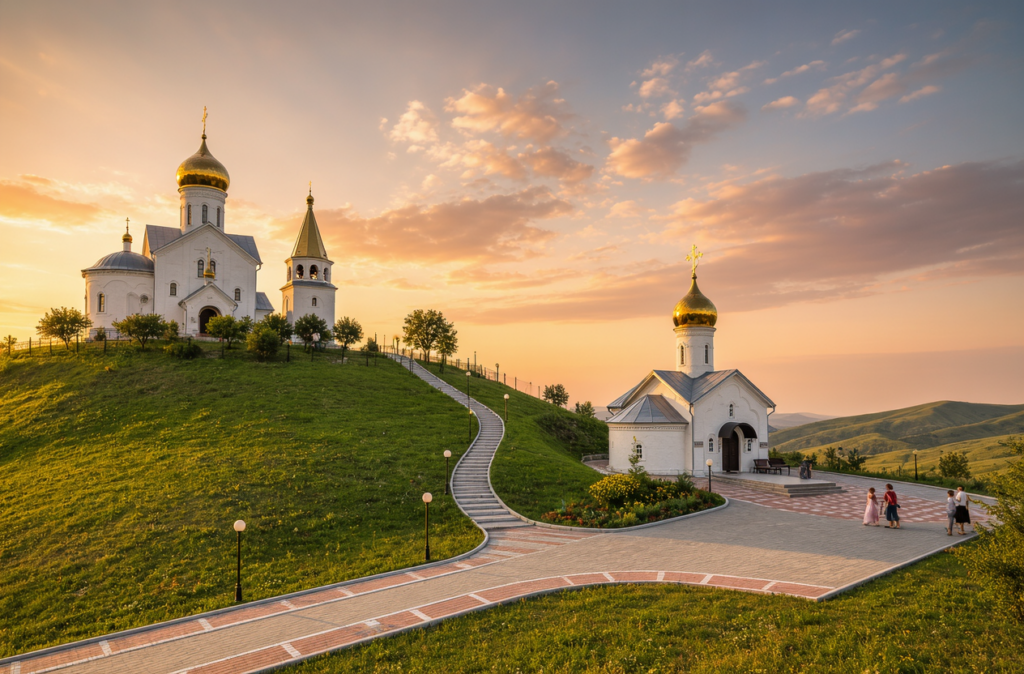
Today, the complex operates. The underground part occupies about 255 square meters, the corridors stretch for 126 meters. Above the entrance is a small gate temple. There’s a bell tower at the top of the hill. A little to the side stands the chapel above the grave of the architect Andrei Rodigin: he designed the monastery and died here without waiting for the completion of the work.
At the foot of the hill is an equestrian statue of Svyatoslav the Brave, the prince who defeated the Khazar Khaganate.
A harsh, deliberately unheroic face. The gaze is on the steppe.
This place is attracted not by pomp, but, on the contrary, by the silence, the cramped corridors, the feeling that nothing has changed here for four centuries. That is its main value.
Charity FundHoly Land.
Russian Temples and Monasteries