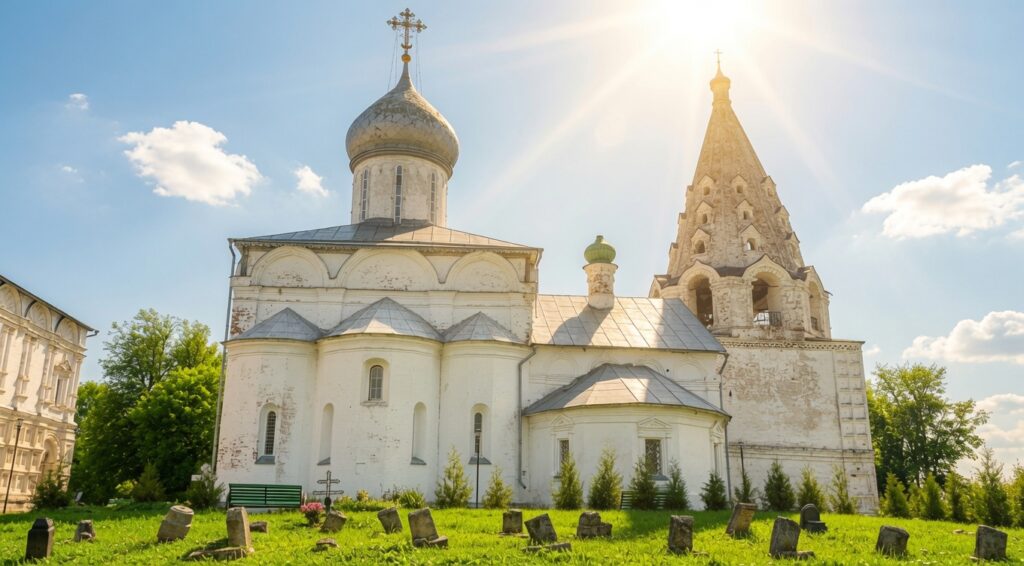
In the southern part of Pereslavl Zalessky, a little on the hill, for more than 500 years, the Holy Trinity Danilov Monastery rises. A place where you feel incredible spiritual power. The founder of the Holy Trinity monastery, which was later named after him, was the hieromonk of the Goritsky parish Daniel. The territory of the monastery used to be a barnyard, i.e. a cemetery. They say that even before the construction of the monastery, people heard church singing at this place and saw the light from the candles burning. The monk searched for lonely wanderers who were frozen and dead. He buried them and offered prayers there. It was important to him that the souls of the dead were healed.
In 1508, the first wooden church in the name of All Saints was built next to the cemetery. In time, the suffering began to flock there, seeking the salvation of their souls. They were healed by the prayers of St. Daniel. Cells were built, settled and gradually a monastery was formed here, which at first was called Vsekhsvyatskaya, after the name of the first temple built.
When the monastery was discovered in Moscow, Tsar Basil III visited it. He prayed for the birth of an heir. After the birth of Ivan IV in 1530, the tsar donated money to the Trinity Cathedral, which was built of stone.
Ivan the Terrible venerated the Monk Daniel and often made donations to the Holy Trinity Pereyaslav Monastery. Despite his close position with the royal family and friendship with the Metropolitan of Moscow, Daniel was always meek and humble. Thanks to God’s grace, he lived to a very old age and died in 1540.
In 1652 his relics were found. This was preceded by an amazing event. The monk himself appeared to one novice and said that he could no longer remain in the earth. Then the grave was excavated, the coffin was taken out and incorruptible relics were found. In 1653 he was made a saint. Cancer with the relics of St. Daniel is kept in the aisle of the Trinity Cathedral.
Amazing frescoes
Special attention inside the temple deserves beautiful and unusual frescoes. For more than 130 years the monastery stood without painting. Only in 1662, the famous icon painter Guri Nikitin and his artel were invited to work. Icon painters held fast throughout the work. They themselves made paints based on holy water and natural dyes. Thanks to this, the paintings are well preserved to our days.
On the upper rows are paintings from the Old Testament. The western wall shows scenes of the Last Judgment. The north shows the Flood and the Apocalypse. The apocalypse is the main theme, because according to the calculations of Russian scribes, in 1666 the demise of the World was to occur. The frescoes illustrate all the chapters of the revelation of John the Theologian and impress with the “liveliness” of the plot and scale.
Buildings and temples
The Church in honor of the Tikhvin Icon of the Mother of God is located above the main
gateway to the monastery.
The main temple is the Cathedral of the Most Holy Life-giving Trinity. In 1689 to him.
They built a bell tower with a tent top. On the second level was the sacristy.
The lower part was given for economic needs.
The Church of All Saints is located east of the Trinity Cathedral. It used to be.
hospital with treatment rooms. After the mid-18th century, the building was located
Pereyaslav Theological Seminary and Theological School.
The Church of Praise. On the background of other temples stands out unusual
eighteenth-century architecture.
● The large fraternal building stands south of the refectory. There were monastics there.
Cells and outbuildings.
Decline and rebirth
In the middle of the XVII century the monastery suffered from the Poles. It was restored, thanks to generous donations, by Prince I.P. Baryatinsky. At his expense, a refectory chamber was built with the Church of the Praise of the Virgin.
In the XVIII century the monastery flourished. But in 1764, she lost her lands by decree of Catherine II and came into decline. And only to the XX century, the former prosperity returned, but not for long.
After the revolution, the monastery was closed. During the war on its territory there was a camp for German prisoners of war, and then a military unit. Everything was destroyed, desolated. Monastic life was revived in 1993. Thanks to the prayers, the zeal of the monks and the help of the Lord, the holy place gradually returned to life.
On the day of remembrance of the Monk Daniel, April 20, 1996, his relics returned to his native monastery. Today there are daily worship services. The monastery lives under the heavenly protection of its patron. Visitors say that when you walk along the paths, touch a stone, which is more than four centuries, sit on a bench on the oldest linden alley, you do not want to escape from that silence and tranquility.
Charitable Foundation Holy Land
Russian Temples and Monasteries