The land near the northern capital is not rich in caves. Maybe that is why the hermits preferred to build dugouts, but huts. But near the village of Zaruchye, the terrain is hilly. Where there are hills and hills, there are caves. In one of them in the 18th century settled a holy hermit. He lived alone, prayed a lot. The locals brought him food, and he took water from a small reservoir, immediately in a cave. After the death of the hermit, the cave was empty, but the water in the spring had healing properties and pilgrimage to the cave did not stop. Especially near the shore.
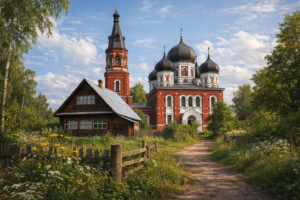
The long river, according to legend, left its mark the Virgin. In the 18th century, a small wooden church was built on the site, and in the late 19th century it was decided to build a stone temple. A small, but elegant, upward-looking church was consecrated in 1900 in memory of the Dormition of the Most Holy Mother of God.

The five-domed church with a two-tier bell tower was connected to the cave by a passage. The church survived the war, but what the fascists did not do, the chairman of the local kolkhoz succeeded. In 1955, the building was dismantled into a brick. The foundation remained of it, and the floor lined with tiles. In the place where the altar was not so long ago put a fence. Believers care about the cave. They laid out a path to her from brick, made steps. There was a small altar near the spring. There are also buckets for holy water.

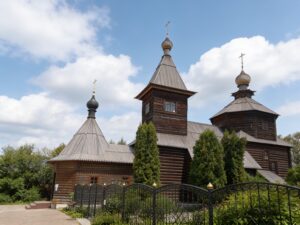
Recently, a small temple was built near the cave. It is wooden, very reminiscent of the home churches of Northern Russia.
They come to the cave for thought and worship. There are no crowds, as in tourist places, although the flow of pilgrims does not stop in winter or summer. The forest, the river, the remains of the church are set in a special way. In silence, nothing distracts from thoughts and prayers.
Charitable Foundation Holy Land
Russian Temples and Monasteries