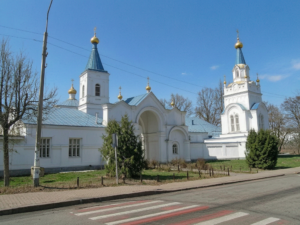
If you drive down the street of Karl Marx, the eye now and then clings to this unusual silhouette. Among the usual urban development and tramways, it seems an alien from another era — slender, directed upwards, as if composed of several snow-white volumes. It’s not just an old temple. It is an architectural challenge posed more than a century ago to modest budgets and provincial routine.
On June 4, 1911, here, at the then still new city cemetery, Bishop Benjamin performed the rite of consecration. But the history of this place began much earlier — in 1874, when the churchyard was just opened. For many decades there was only a small chapel, and money for a large temple was saved literally by the whole world: merchants donated thousands of rubles, philistines gave bells, and the city Duma established a special fee for burial. The project was entrusted to Fyodor Livchak, and he decided not to look for easy ways.
The architect created the only church in the city in the Russian-Byzantine style. And did it so that the masterpiece turned out at minimal cost. In terms of the church resembles a cross with four semicircular apses, but its main “trick” becomes clear only if you look from the bottom up. The inner space of the temple seems to breathe: it smoothly narrows from the base to the light drum. This reception, as the local historian Boris Arzhantsev later noted, creates an amazing sense of flight. It seems that the walls themselves stretch to the sky, and this architectural solution perfectly reflects the very idea of the Resurrection.
Livchak was a bold experimenter. He designed the building without the usual bell tower — the belfry was placed separately on wooden poles. And in the niches of the facades, according to the ancient Byzantine tradition, he placed picturesque panels, which was rare for Simbirsk. When in 1910 the cross was raised on the dome, the weather was sunny, and the people were rolling ramparts – everyone wanted to see the birth of this “cute”, as newspapers wrote then, temple of unusual beauty.
Fate has prepared this building the role of a saving ark. By the end of the 1930s, it was the only active temple in the city. But in 1941 it was closed, intending to turn into a granary. The story of the Resurrection Church seemed to come to an end. However, the war broke plans: the leadership of the Moscow Patriarchate was evacuated to Ulyanovsk. It was in these walls in the autumn of 1941 that Metropolitan Sergius (Stragorodsky), the future patriarch, began his service on the Ulyanovsk land. Not only did the temple survive, it became the spiritual center of the city during the most difficult time.
Now it is difficult to imagine that once this elegant temple was dark brown, and its domes cast silver. In the 1970s, it looked different: instead of the usual image of Seraphim of Sarov, the image of the Resurrection of Christ shone on the southern wall. Paints were changed, extensions were completed, arches were laid, but the inner core of the building remained indestructible. In many ways, this is the merit of the abbots — from father Boris Kryzhin, who in the 1980s held the defense, to today’s priest Anthony Zakurdaev.
For Father Antony, this temple is not just a place of service. He was baptized here in 1991. Then the baptism was dark and gloomy, but today he sees it very differently. Memorial plaques appear on the walls of the church, in 2016 it received the status of a monument of federal significance — the first and so far the only case among the religious buildings of the city. And here, in the Old Cemetery, the relatives of the abbot rest.
Is 110 years too much or too little for a temple? Walls, remembering and merchant donations, and military evacuation, and tramways, laid literally under the windows, continue to amaze with ease. You go inside, and the feeling of narrowing space, conceived by the genius Livchak, still pulls your eyes up to the dome, sparkling with gold. Where the sky begins.
Charity FundHoly Land.
Russian Temples and Monasteries