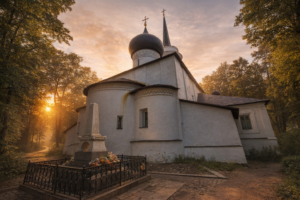
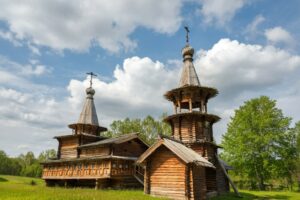
The temple building is part of the museum-reserve and is available for visiting only by excursion groups by prior arrangement.
The history of the temple began in the 17th century, when the Nazarev brothers, Ankindin and Gury, moved from the Time of Troubles to Yaroslavl.
In 1634, they decided to demolish the old Nativity wooden church and build a stone church in its place. Construction dragged on and was completed with the participation of the sons of Gury, Mikhail, Ivan and Andrey, whose last name was the Guryevs, not the Nazarevs.
The original temple was five-domed, with an unusual bell tower. The lower tier of the bell tower represented the holy gates. On the second level there was a gate temple, as well as 2 turrets, in one of which a clock was installed. Only on the third tier was a belfry installed. The bells for it were ordered from Holland.
In the temple itself, magnificent iron-forged doors were installed, and the floor was made of jasper. The stone was delivered from the Urals. The famous Yaroslavl tiles were used for the first time in this temple.
In the 80s of the 70th century, the walls of the church were painted. For this purpose, the surfaces were divided into 8 conventional tiers. The first five tiers display scenes from the Holy Scriptures, then there is a decorative frieze, a chronicle from the valance.
Unfortunately, in the 30s of the 19th century, the building was reconstructed. Instead of five chapters, they left one, the northern gallery was completely dismantled, and the western one was partially dismantled. The passages under the bell tower were blocked, some chapels were abolished. In the 60s, the paintings, iconostasis, and choirs were updated.
Despite the fact that the walls and bell tower were damaged during artillery shelling of the city in 1918, services in the church continued until 1921. Even after this, the temple was not destroyed because its historical value was recognized. However, this did not save it from being used as a warehouse, and in some rooms there was even a stable.
After the war, in the 50s, the authorities remembered the historical significance of the building and began to make attempts to restore it.
By the early 70s, the temple was more or less returned to its appearance before its closure, and made part of
historical museum of Yaroslavl.
Charity FundHoly Land
Temples and Monasteries of Russia