Imagine a wooden church built in the Arctic at the beginning of the 18th century. Not a single nail, not a single piece of iron, not a foundation. Larch logs, an ax, a saw — and nothing more. Now imagine that this church does not stand where it was built, but one and a half thousand kilometers to the south, near Novosibirsk, on the territory of an academic museum. And that the hometown around which she grew up disappeared from the face of the earth so completely that not even mounds in the tundra remained from it. This is the history of the Spaso-Zashiverskaya Church — the only surviving wooden tented church in Siberia.
Fort beyond the rapids
In 1639, a Russian winter hut arose on Indigirka, beyond the Arctic Circle. The place was not chosen by chance: higher up the river there were shivers — rapids and rifts that were dangerous for navigation. Zimovye turned out to be the last Russian settlement in this direction; further stretched the “Yukaghir land”. The settlement was called that way — Zashiversk.
By the end of the century, the winter hut turned into a prison: chopped walls, towers, residential huts, customs, and a state barn for yasak appeared. The garrison was small — about twenty Cossacks. But for these places that was enough. Zashiversk became a hub of trade routes: Yukaghirs, Yakuts, Evens, and Russian industrialists came here. By the beginning of the 18th century, there were several dozen courtyards in the fort.
Somewhere between 1700 and 1710, a church was erected in the fort. Who exactly built it is not known for certain. Legend names the tradesman Andrei Khabarov, who led an artel of local carpenters. Dendrochronology carried out in our time has shown that most of the logs were harvested in 1709–1711. Perhaps the temple was built a little later than is commonly believed, or part of the forest first went to an earlier chapel, which was then included in the new building.
The church was consecrated in the name of the Savior, the Image Not Made by Hands — hence the name Spaso-Zashiverskaya.
How the church works
The building was cut from larch — wood that does not so much rot over time as become woody, becoming harder than stone. This property saved the temple: in conditions of permafrost and the absence of wood-destroying insects, the larch survived for three centuries.
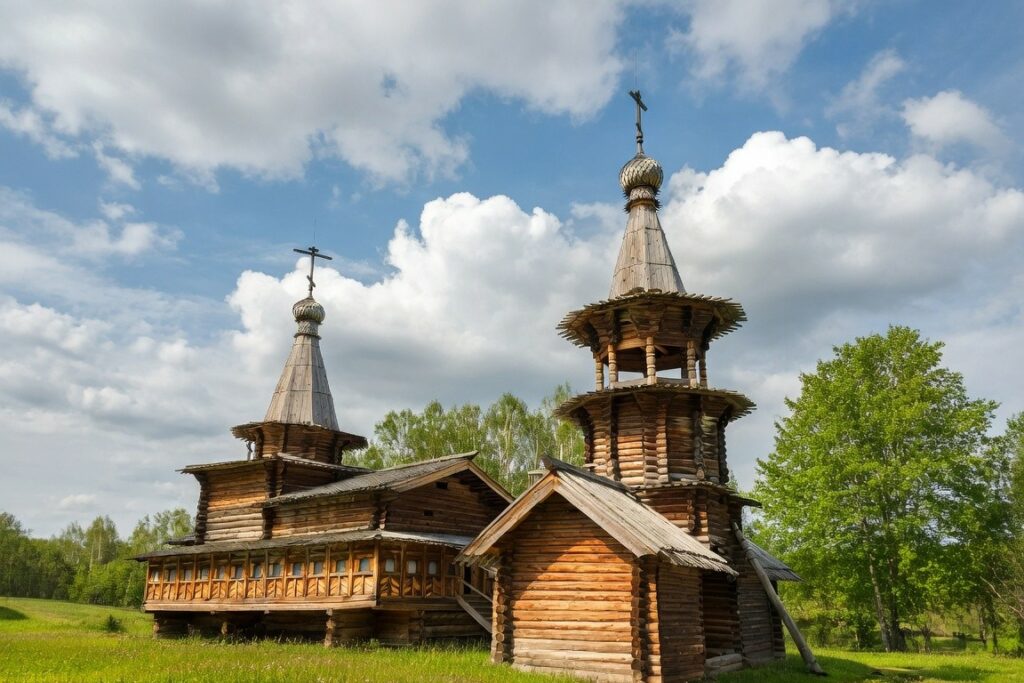
The type of construction is “octagonal on quadrangular”. At the bottom there is a rectangular frame — a quadrangle. An octagonal frame — an octagon — was placed on it. The structure is crowned by a tent — octagonal, with a bulbous dome on a thin drum. Adjacent to the east is a pentagonal altar apse, covered with a barrel. From the west there is a refectory under a gable roof. Nearby, eight meters from the main volume, there was a separate tented bell tower — twelve and a half meters high to the cross.
There is no foundation — the casings are buried thirty to forty centimeters into the frozen soil. On permafrost, this is not negligence, but an engineering decision: a solid foundation would lead to the walls at the slightest thawing. Larch logs work like piles — they support the building, preventing it from sagging.
Everything in the temple is subordinated to one task — to preserve heat. The ceilings are low, double, with an air gap between the layers. The floor is also double. The windows are tiny, covered with mica, cut only on the southern side to catch the meager polar sun. The ceiling height in the refectory barely exceeds three meters. The stove stood in the corner, and a stone was placed under it so that the heat would not melt the frozen earth under the floor. The church was heated, judging by the smoky vaults, black: the smoke went in, spread along the ceiling and came out through the fiberglass slits. No carving, no platbands, no painting. Only dark wood and clean log lines. Beauty is in severity.
Cities do not last forever
Zashiversk existed for a little over two hundred years — and it was life on the edge. The climate did not allow farming. Trade routes shifted. The garrison was melting. By the middle of the 19th century, several families remained in the prison. And then smallpox came.
There are no exact dates for the epidemic: some sources call the 1860s, others — the end of the 1850s. The last inhabitants either died out or moved down the Indigirka River to other settlements. The wooden walls of the fort began to rot and collapse. The Indigirka River was washing away the bank on which the city stood, and one by one the houses were sliding into the water. By the beginning of the 20th century, all that was left of Zashiversk was the church and the ruins of the bell tower, knocked down by the wind.
The temple stood in emptiness. Without parishioners, without a priest, without repairs. The floor fell through. The lower crowns have sank. The stove and internal partitions disappeared — maybe they were stolen for firewood, maybe they rotted. But the four, eight and tent held out. The larch did not give up.
Pilots, academician and expedition
In the mid-1960s, polar pilots, having lost their course over the Yakut tundra, saw a lonely tented temple in a gap in the clouds. It stands in the middle of nowhere — no roads, no villages, no traces of people. The pilots photographed it from the air and brought the pictures to the Novosibirsk Academgorodok.
Academician Alexey Pavlovich Okladnikov — archaeologist, historian, founder of the Institute of History, Philosophy and Philology of the Siberian Branch of the Academy of Sciences — realized: the unique monument must be saved. There were almost no wooden tent churches of the 17th–18th centuries left in Siberia by that time. Those that survived were rebuilt, covered with planks, and distorted by extensions. And the Zashiversky temple stood almost in its original form — three centuries in the polar permafrost preserved it better than any museum.
In the spring of 1969, Okladnikov organized an expedition to Indigirka. The composition included architects A.V. Opolovnikov and E.A. Ashchepkov — leading experts in Russian wooden architecture — as well as historians, photographers, and archaeologists. The expedition measured the building, made drawings and sketches, and conducted archaeological excavations around the foundation. Fragments of utensils, ceramics, and pectoral crosses were discovered — traces of the life of a fort that no longer existed.
In 1971, the second expedition returned — now with the task of dismantling and removing the temple. Each log was numbered, removed, and laid. The work took place in the most difficult conditions: tundra, mosquitoes, permafrost underfoot, short polar summer. The logs were floated down the Indigirka River, then transported by sea and along the Lena River, and from there by rail to Novosibirsk. The government of the Yakut Autonomous Soviet Socialist Republic donated the church to the Siberian Branch of the Academy of Sciences. Thus, the temple made a journey that probably no wooden monument in Russia has ever made.
Restoration and museum
The dismantled church was first kept in the Institute of History, Philosophy and Philology — in Akademgorodok. Okladnikov sought the creation of an open-air museum where the temple could be assembled and displayed. In 1981, the Council of Ministers of the RSFSR allocated a site — forty-six hectares, four and a half kilometers from Akademgorodok, near the village of Lozhok. Okladnikov, fearing that the land would be occupied by summer residents, immediately transported all the exhibits there. This is how the Historical and Architectural Museum-Reserve of the SB RAS began.
The restoration of the Spaso-Zashiverskaya Church with the reconstruction of lost elements was carried out in the 1980s, on the basis of measurement drawings and photographs of the expedition. The covered hanging gallery along the northern wall—the porch through which parishioners entered the temple—and the western porch were restored. The bell tower, of which only fourteen lower crowns survived in Zashiversk, was restored with a complete reconstruction of the tent and dome. Now it stands next to the temple, as it once stood — separate, at a distance of eight meters.
What else is there in the museum
The Spaso-Zashiverskaya Church is the main, but not the only exhibit of the museum. On the same territory there are two chopped towers of the Kazym (Yuilsky) fort — a 17th-century Russian fortress on the Lower Oba. The buildings of a peasant estate from Eastern Siberia were brought: a hut, a barn, a black bath — without a chimney, the smoke comes out through the door and cracks in the walls. There is a windmill. There is a large open-air archaeological exhibition: stone sculptures, slabs with petroglyphs — from the Paleolithic era to the Middle Ages. All this has been collected by expeditions of the Siberian Branch of the Academy of Sciences throughout Siberia over decades.
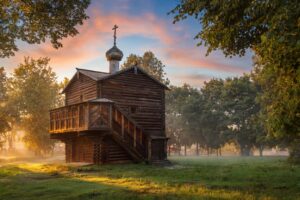
The museum is open only in the summer — from June to the end of September. In autumn, the territory becomes empty, the grass grows waist-deep, and the Church of the Savior Zashiverskaya stands in this sea of grass as lonely as it once stood in the tundra on the banks of the Indigirka River.
Double on Lena
In 1997, in the Sottintsy tract of the Ust-Aldan region of Yakutia, the Druzhba museum-reserve was created. An exact copy of the Spaso-Zashiverskaya Church was built there — with a bell tower, galleries, a porch — according to the drawings of the restorers. We tried to recreate fragments of the walls of the fort. It turned out to be a strange split: the original stands near Novosibirsk, the copy is on Yakut soil, two hundred kilometers from the place where the original stood. And Zashiversk itself — the place for which the church was built — is not even marked with a memorial sign. The shore of the Indigirka River has washed away and carried away the last traces.
Why is this important
There are only a few wooden tented churches of the 17th — early 18th centuries left in Russia. Most were burned: wood and fire are a predictable combination. Those that survived were almost all rebuilt — sheathed with planks, redesigned inside, expanded with extensions. The Spaso-Zashiverskaya Church is a rare case when a tented wooden church has been preserved in almost its original form. Not because they took care of him, but because they forgot about him. The polar climate, permafrost, larch, lack of people — everything that destroyed the city saved its church.
And then people were found who did not let it perish either.
The SB RAS Museum-Reserve is located at: Novosibirsk region, Novosibirsk district, Ionosfernaya street, 6, building 2. Works with June 1 to September 30, visits by appointment. A walk around the area takes about an hour and a half. The nearest landmark is Akademgorodok, stop «Lozhok».
Charitable FoundationHoly Land
Temples and Monasteries of Russia