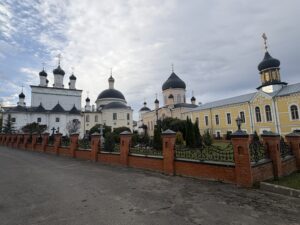
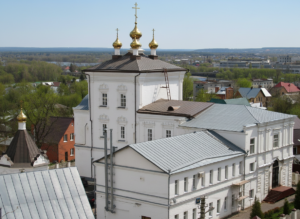
Among the pines and sand cliffs, where the Tuscar River makes a smooth bend, time flows differently. Here, in the village of Liberty, the air is like woven from history. Getting here, you find yourself not just in a monastery, but at the point where seven centuries ago the heavenly scenario unfolded. A random hunter lifted a board from the ground, and found the gate to a miracle. They say that at the same moment a spring hammered out of the earth, as if the earth itself confirmed that this place was marked from above.
The Kursk Root Desert was not built by the will of the kings and did not seek profit in trade routes. Its foundation is an act of gratitude and a desire to preserve the shrine. Tsar Fyodor Ioannovich in 1597 ordered to lay a monastery where once at the roots of the elm found the icon “Sign”. The first who assumed spiritual guardianship was the abbot Euthymius of Rylsk.
But from the very beginning, the fate of the monastery was closely intertwined with the dramatic events of Russian history. The desert has not yet had time to grow stronger, and the fever of the Time of Troubles has already reached its walls. The impostor False Dmitry, settling in Putivl, demanded a miraculous image for himself, the icon was taken to Moscow. Left without heavenly protection, the monastery fell under the onslaught of the Crimean Tatars. It seemed like the end. But history ordered otherwise: the shrine returned from the capital, having visited even the house of Prince Pozharsky, and the monastery began to revive from the ashes.
A new dawn came in the eighteenth century. Thanks to the diligence of Count Sheremetev, the first Russian field marshal, the Church of the Life-Bearing Spring was erected over the holy spring. The desert gained independence, and by the end of the century there was already a unique architectural ensemble. Looking at the slender stone gangways that lead from the upper square to the lower temple, it is hard to imagine that once in their place were steep trails. These stairs have become a real architectural theater: climbing them, the pilgrim seems to participate in the mystery, gradually opening a panorama of the church.
The main cathedral of the monastery, consecrated in honor of the Nativity of the Most Holy Mother of God, appeared already in the middle of the XIX century. Designed by the famous architect Konstantin Ton, master of monumental style. But the pearl of the interior decoration is rightly considered an iconostasis — the painstaking work of masters from Shchigrov, those very craftsmen of the Holy Trinity Brotherhood who filled the tree with heat and light.
Today, life here is subordinated to the age-old rhythm. The monastery bell convokes the brethren – and today the monastery ascetics 35 – for a prayer that has not been interrupted since its foundation. Metropolitan Herman is at the helm, and hegumen Seraphim is responsible for the economic part. Every day in front of the list of the miraculous “Sign” prayers sound, reminding of the very miracle on the roots of the age-old tree.
The monastery remembers not only saints, but also ascetics of enlightenment. Here spent his youth monk Sylvester Medvedev, who later became one of the largest bibliographers of his time. Within the walls of the desert he learned not only the prayer rule, but also the love of the book.
Kursk Root is a rare case when the place does not lose its strength after centuries. Seven hundred years of prayer did not cease here, neither under the tsar nor in the rush of war. Today, going down those stone steps to the source or entering the vaults of the Tonovsky Cathedral, you feel the same grace as the same hunter from Rylsk, who accidentally found his way among the dense forests.
Charity FundHoly Land.
Russian Temples and Monasteries