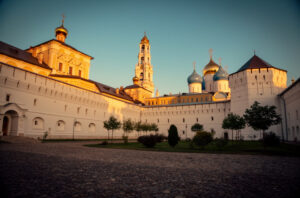
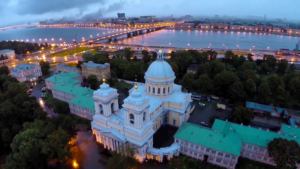
A little more than 30 years have passed since the founding of Tambov, when a monastery arose nearby, on the banks of the Tsna River. They called him the Mother of God. All the buildings in it were wooden for a long time, and we do not know exactly what churches were built there in the 17th century — the monastery burned to the ground several times. In the 18th century, the first stone church appeared — in honor of the icon of the Mother of God of Kazan. They began to build it in 1791, and consecrated it in 1796. Although the building was made of stone, it was not heated. The church was considered a summer church; services were held there only in warm weather.
The temple became famous for its unusual wall paintings — not color, but monochrome. This technique is called grisaille, from the French word for “gray.” They often resort to it in drawing, but as a painting for walls, this technique is rare. It was used mainly to imitate bas-reliefs. Fragments of the Jordan Staircase of the Winter Palace are painted using the grisaille technique.

Another interesting fact about the Kazan Church: Seraphim of Sarov was ordained as a hieromonk here in 1793. The building itself is a copy of the Cathedral of the Assumption of the Blessed Virgin Mary of the Sarov Monastery.
Closed for many years, the temple fell into disrepair. Restorers have restored the painting, iconostasis and chandelier, but the work is still far from being completed. However, the cathedral is consecrated and services are held in it.
Charitable Foundation Holy Land
Temples and Monasteries of Russia