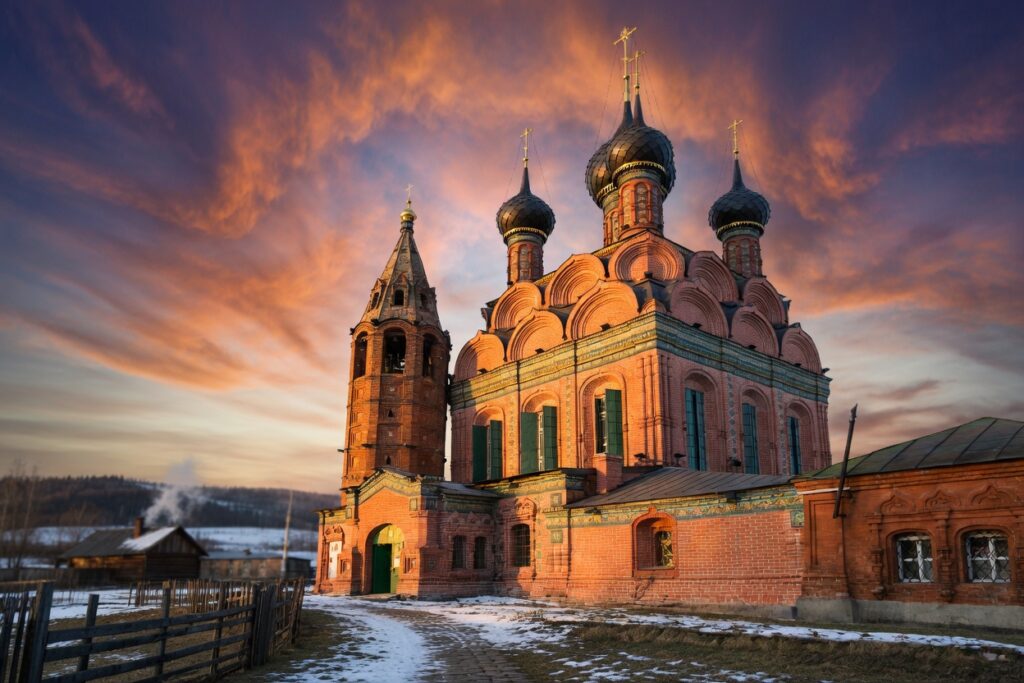
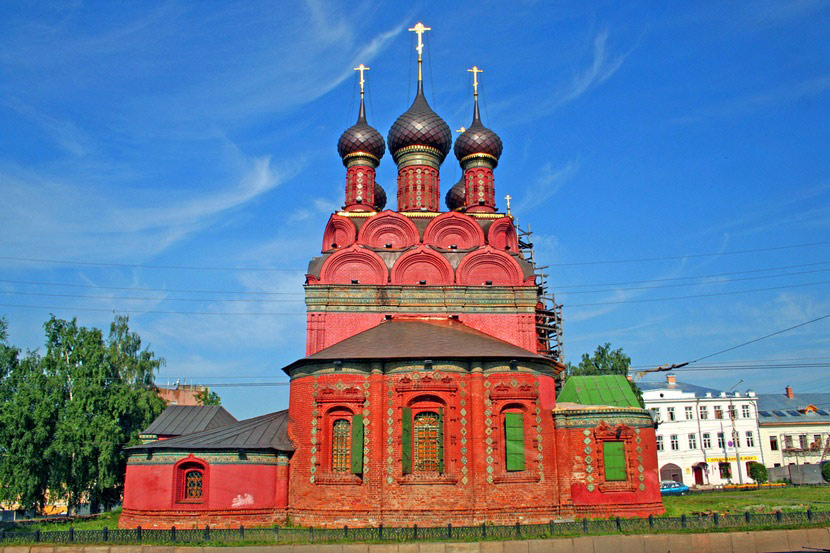
The church, which today is the decoration of the architectural ensemble of Yaroslavl, was an ordinary Posad temple. It was built on the donations of the merchant Zubchaninov. Construction lasted 9 years (1684-1693), but it was worth it. The temple is a sight. Red local brick, irrigated polychrome tiles, small architectural details made it a reason for the pride of the Posad people.
The place was chosen next to the Transfiguration Monastery, on the site of an old wooden church. In architecture, 2 styles are clearly traced: Moscow and Yaroslavl. The building without a subclete (in Moscow), but with galleries (in Yaroslavl). The original wooden heads were destroyed in a fire in the 18th century and replaced with the ones we see today.
The walls were painted before opening. It is believed that this was done by artels under the leadership of famous isographers Plekhanov and Ignatiev. We can say with accuracy that representatives of 2 different schools painted the walls.
Although the church was an ordinary Posad temple, there were many merchants among the parishioners, so it was regularly repaired and renewed. In the 19th century, a fence was built and overhauled. The money was allocated by another Yaroslavl merchant — Vasily Kuznetsov.
Under Soviet rule, the temple was closed. He suffered during the White Guard uprising in 1918, came under artillery fire. In the list of buildings for renovation, the church was in last place. The building continued to decay. In 1927, it was recognized as historical and handed over to the museum, but the money was not allocated, and it again remained without repair.

Only in the middle of the last century, large-scale restoration work was carried out here. They were continued in 2000.
Only a miracle can be considered that in the temple preserved carved iconostasis of the 17th century. It is gilded and shines in the sunlight that fills the temple through 9 huge windows.
Of the three shrines of the temple, one is preserved — a huge altar cross. The cross with the particles of the Cross of the Lord and the wooden head of John the Forerunner are lost.
The temple is active, services are held daily. At the same time, it is part of the Yaroslavl Museum of the reserve and is open to tourists.
Charitable Foundation Holy Land
Russian Temples and Monasteries