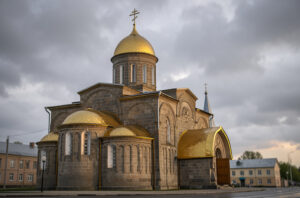
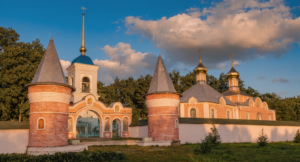
Imagine a stone lace frozen on the walls under the harsh Siberian sky. Patterns resembling either the eastern carpet, or the finest weaving, cover every centimeter of the facade. This is how the Church of the Exaltation of the Cross in Irkutsk looks like – the only temple beyond the Urals, where the spirit of the eighteenth century was preserved in intact originality. This place is not just prayed for centuries, it literally breathes history hidden in every detail of the decor.
The history of this architectural miracle did not begin from scratch. Back in 1717, the first wooden shrine appeared on the Cross Mountain, which served as a landmark for travelers. But the real masterpiece was born three decades later. In May 1747, the stone building was laid, and by the harsh winter of 1760, the construction was completed. It took more than ten years for the craftsmen to turn ordinary silicate material into a kind of precious fabric.
The facades of this temple are a real puzzle for art historians. Academician Igor Grabar noted that with rather modest means, the architects achieved a virtuoso effect: bricks were laid along and exquisitely, bizarre columns were carved out, and the intricacies of the cornices gave rise to the illusion of a rich tapestry. Art historian Georgy Lukomsky compared this decor with a gypure, running along the cornices and braiding window openings. In the strict geometric dance of local ornaments, echoes of Ancient Russia, Ukrainian Baroque and even Mongolian motifs are clearly heard. This “oriental taste” gives the temple a very special, slightly mysterious silhouette.
It’s no less authentic inside. This is the only church in Siberia where the interiors of the XVIII century have completely survived. Entering these vaults, you see the altar barrier and decoration as they saw parishioners centuries ago. The carved tree was not replaced with new-fangled decor, but carefully stored, like a page from the chronicle.
The walls also hold warm human memories. In April 1851, the famous researcher of the Far East Gennady Nevelskaya married here. In memory of this event, a memorial plaque shines on the wall. And at the end of the last century, the abbot here served as Metropolitan of Irkutsk and Angarsk Vadim. Interest in this place was shown in the XIX century: in 1887 it was included in the collection of monuments of domestic antiquity, and the motifs of stone carvings became an example to follow. Echoes of patterns from the Cross Mountain can still be seen on the walls of later cathedrals off the coast of Baikal.
Standing in front of this building, you feel the weightless weight of time. It seems that these brick threads are encrypted with a message from the masters of the past, who managed to draw eternity with a simple solution. This temple does not press with monumentality, but as if it embraces the eye, leaving on the soul the feeling of touching a real living miracle.
Charity FundHoly Land.
Russian Temples and Monasteries