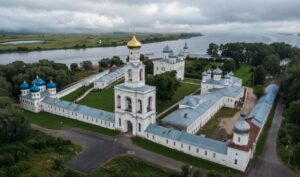
When you look at it for the first time, you don’t immediately realize that this is almost two centuries of history.
The cathedral does not scream about its age. He just stands — confidently, solidly, slightly towering over everything that surrounds him. Five domes, four tiers of bell tower, walls made of brick, which was burned in the field with firewood back under Nicholas I.
The city of Spassk was lucky: its main temple was built by people who knew how to finish the job.
Mid-19th century. Two local traders — Vasily Bundikov and Nikolai Makov — get down to business
which will last for eighteen years. They invest their own money and involve other merchants in the business.
Brick makers are brought from Krasnoslobodsk — they take on contracts for three hundred thousand pieces of a strictly specified format. A thousand bricks — six hundred silver rubles. The amount is not small, but they don’t save on it.
By 1859 the temple was ready. Five altars were consecrated in it: the main one — in honor of the Ascension of the Lord, the rest — in honor of John the Baptist, Nicholas the Wonderworker, Basil the Great and the Kazan Icon of the Mother of God. Bundikov and Makov did not live to see the cathedral become old. Their graves are right here, near the walls.
The outside of the building is designed in the Russian-Byzantine style — the very official style that was in fashion among provincial clients of that era. Massive attics with semicircular
finishes add density to the façade, and arched windows soften the overall heaviness. Inside there are four pillars supporting the vaults, and paintings from which it is impossible to take your eyes off: scenes of the Last Judgment, apocalyptic images, iconostases with metal frames. Not museum beauty — alive, prayed for.
In 1887, a school was built nearby — a one-story brick house with a hip roof and neat windows in the niches. The parish taught children to read and write.
At the end of the 1930s, the cathedral suffered the fate of all Soviet churches. It was closed. But not for long—a year later services resumed, and for many years it was the only functioning church in the entire region. What was behind this — whose persistence, whose decision — history is silent.
In 2013, the cathedral received cathedral status. For small Spassk this is a significant event.
The two merchants who started the construction wanted to leave behind something lasting. And they
it worked.
Charity FoundationHoly Land
Temples and Monasteries of Russia