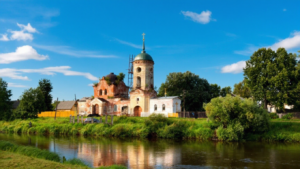
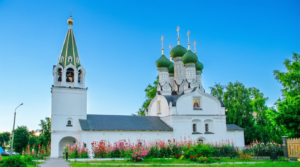
On the steep Oka shore, where the river has been sharpening limestone for centuries, a maiden monastery once offered prayers. It was founded in 1507 by the Ryazan princess Agrippina, a woman who left a noticeable mark on the spiritual life of these places. Three stone temples, which grew here by the XVIII century, seemed unshakable. But the Oka reasoned differently: the water mercilessly undermined the shore, threatening to swallow the shrine. In 1819, the monastery was saved — moved to the city of Mikhailov, and the former buildings were dismantled to the ground.
It seemed like a point. The village did not want to be without a temple. The stubbornness and faith of the local Archpriest Afanasy Arbekov breathed new life into this place. It was with his diligence that a new brick church was laid here in 1884, and by 1897 a new brick church was completed — this time in the name of Sergius of Radonezh. It was built on a grand scale. The building turned out to be squat, but impressive: a single dome was raised above the main volume, porches were attached from the sides, and the refectory was made so spacious that it still amazes the entered. Later, the ensemble was supplemented by a bell tower.
The architect did not pursue a strict style — he allowed himself eclecticism, mixing the details as required by the soul of provincial architecture. Inside, three thrones were installed: the main one was consecrated in honor of the Intercession of the Most Holy Mother of God, and the aisles were dedicated to Sergius of Radonezh and Nicholas the Wonderworker. The temple became the heart of the district: ministerial and zemstvo schools worked under it, where by 1915 almost four hundred children were gaining diplomas.
The twentieth century walked these walls harshly. In 1922, valuables were withdrawn from the church — officially «in favor of the starving.» Then the temple was closed, and in 1941, at the height of the war, demolished the bell tower. It seemed that a little more — and the memory of the former greatness will finally dissolve in the thickets of the weed. But it wasn’t.
Today the temple is experiencing a second birth. In the 2000s, restorers came here. They restored the dignity of the building, and now it again meets parishioners with a warm light in the windows of the refectory. Standing here, on the border of earth and sky, you feel especially keenly how the fates of the princess, the stubborn priest and ordinary people who did not allow this place to disappear are intertwined. The wind from the Oka still rattles the grass on the hill, but the temple is strong.
Charity FundHoly Land.
Russian Temples and Monasteries