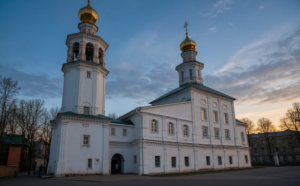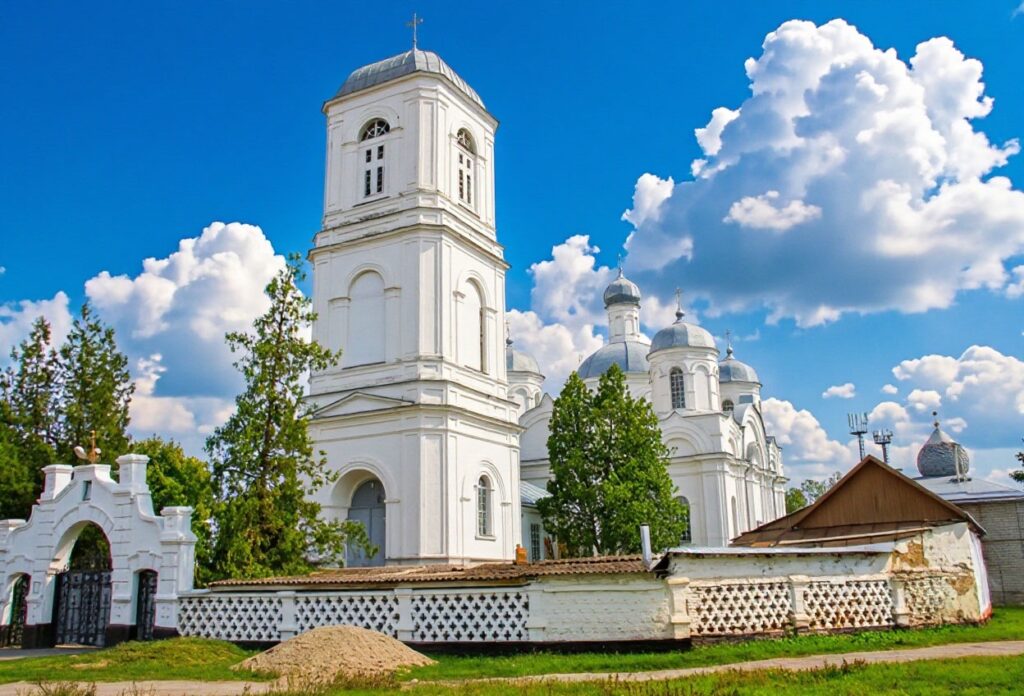
In the Prokhladnensky district of Kabardino-Balkaria, on the left bank of the Malki River, stands one of the oldest Orthodox churches in the North Caucasus. Its history is full of unexpected turns: it began as a project of Catherine II, was built from the stones of a dismantled palace, miraculously avoided demolition and served as a granary for decades — before returning to its purpose.
Empress’s foundation and the forgotten forty thousand
In 1781, the settlement on Malka received the status of a city — Ekaterinograd. On November 24, 1786, the ceremonial laying of the cathedral in the name of the Great Martyr Catherine took place: a silver plaque with an inscription intended to perpetuate “the beneficence of the Great Empress Catherine Alekseevna” was placed in the foundation. 40,000 rubles were allocated for construction.
But in 1790, Ekaterinograd was abolished — the institutions were transferred to Astrakhan, and in the place of the provincial city only a village remained. The construction of the cathedral was never started, and the money was lost in the Astrakhan Ecclesiastical Consistory.
The Emperor Who Was Surprised
In 1837, Nicholas I passed through the village. Instead of the promised magnificent cathedral, he saw a small wooden church. The emperor ordered to find the funds allocated by his grandmother, and all 40,000 rubles were soon found.
In 1845, construction began. Nicholas I donated the former palace of the commander-in-chief and the barracks of the fortress — they were dismantled, and the stones were used to build walls. The main altar was consecrated in the name of St. Euthymius of New Thessalonica, the northern aisle in honor of the Great Martyr Catherine, the southern aisle in the name of St. Nicholas. The consecration took place on July 1, 1850.
For many years, the blue silk banner of the Mountain Cossack Regiment with the gold inscription “For the Turkish War in 1828–1829” was kept in the cathedral.
Architecture
The cathedral was built in Russian-Byzantine style made of burnt brick, in plan it has the shape of a cross, five domes. The bell tower, about 30 meters high, is connected to the temple by a porch. The largest of the eight bells weighs 100 pounds — about 1,600 kg. Inside there is a three-tier wooden iconostasis, decoration in white and blue tones, bronze chandeliers.
Closing and rescue
On October 19, 1940, the temple was closed with permission to “disassemble the building with the use of building materials for the construction of a school.” But the village residents adapted the cathedral into a granary — so the walls, erected by the will of the emperor, survived.
Renaissance
In 1991, the temple was returned to believers. On October 6, 2001, Russian President Vladimir Putin visited him, at the end of the service he was presented with a list of the miraculous icon of the Mother of God «Mozdok».
Among the shrines — a list of the icon of St. Euthymius the New with particles of relics, a list of the icon of the Great Martyr Catherine, consecrated on the relics of the saint at Sinai, a list of the Trinity Rublev’s letter.
Charitable FoundationHoly Land
Temples and Monasteries of Russia