The ancient “Legend about the construction of the city of Yaroslavl” tells that Prince Yaroslav the Wise, having defeated a fierce beast in the forest thicket, ordered the foundation of the city in this very place. This happened, as the legend says, on the second of August — on the day of remembrance of the Prophet Elijah. In gratitude for the victory, the prince erected a wooden cross and founded a church in the name of Elijah the Prophet. So on the Volga hill, where the Chopped City — the ancient fortress of Yaroslavl — would later grow, the first temple appeared.
The wooden church stood in the most prominent place. Before the Assumption Cathedral was built on Strelka, it was the Elias Church that apparently served as the main cathedral of the young city. But the tree is short-lived: the temple burned down more than once, fell into disrepair and was rebuilt. In 1669, it was destroyed by a lightning strike — and this was not the first fire in his lifetime.
Two thrones — two names
By the 17th century, the church already had two altars. This is evidenced by the silver altar cross of 1681 — the contribution of the parishioners, on which images of Elijah the Prophet and Tikhon the Wonderworker are engraved. The inscription on the cross said that it was donated “in the Kremlin city to the church of the holy glorious prophet Elijah and St. Tikhon the Wonderworker, Bishop of Amathusia.”
Tikhon of Amathusia is an early Christian saint who lived in Cyprus. His memory was honored in Rus’, and the chapel in his honor made the Elias Church the only one in Yaroslavl dedicated to this saint. In order not to be confused with another Ilinskaya Church — the one that stood in Zemlyanoy Gorod, behind the moat — the residents of Yaroslavl began to call the temple Ilinsko-Tikhonovsky.
Stone structure and classicism
In 1694, at the expense of parishioners, a stone building was erected on the site of the old wooden church. A bell tower twenty meters high was erected above the entrance, and a warm chapel was built in the refectory in the name of Tikhon of Amafunt.
But this building was not destined to stand for long. By the beginning of the 19th century, Yaroslavl was being rebuilt: shopping and residential areas moved outside the Rubleny town, the population here was declining, and the parish was melting away. By 1824, the stone church had become so dilapidated that it had to be dismantled.
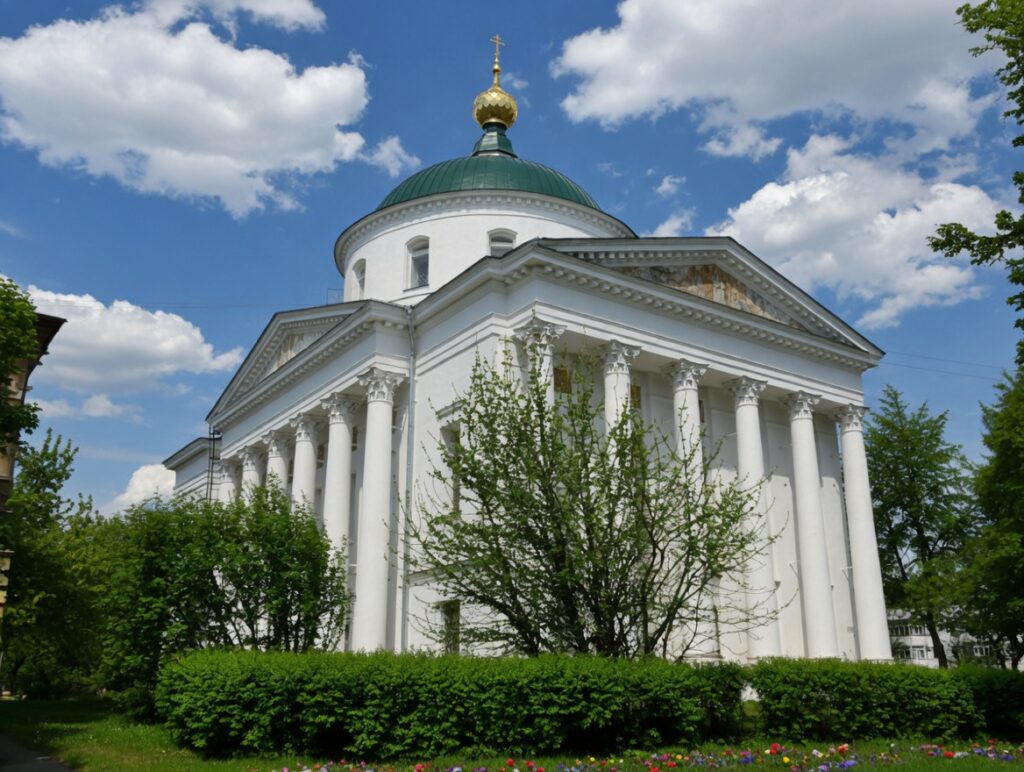
The temple was saved by State Councilor Mikhail Alekseevich Lenivtsev, a man who did not want the ancient place to disappear without a trace. Together with the St. Petersburg merchant A.I. Otryganev, he paid for the construction of a new building. The project was carried out by the architect P. Ya. Pankov, and in 1825–1831 a two-story temple in the style of classicism grew on the old foundation — strict, symmetrical, decorated on four sides with identical porticoes of six Corinthian columns with triangular pediments. Frescoes were added to the pediments. Two small towers were placed above the western façade: one for the bell tower, the other for the sacristy.
The upper, summer floor was consecrated in the name of the prophet Elijah — this happened on September 15, 1832. The lower one, heated, is in the name of the Yaroslavl Icon of the Mother of God, December 3, 1833. On the northern side there was a chapel of Tikhon of Amafuntsky, consecrated on October 16, 1837, and on the southern side there was a chapel of the Archangel Michael. Some of the icons, utensils and iconostasis were transferred from the Church of Boris and Gleb, abolished in 1828 — so the former holy place did not completely dissolve into oblivion.
Ruin and oblivion
Artillery shelling of Yaroslavl in 1918 damaged the building. The exact date of its closure is unknown, but by 1930 the temple was no longer in operation — it was transferred to the Labor Exchange. In 1931, the church was deregistered as an architectural monument, recognizing it as “not of historical value.” Inside, everything was rebuilt for economic needs.
During the war and post-war times, the dormitory of the Yaroslavl Medical Institute was located within the walls of the temple. One can imagine how students walked on the floors under which the liturgy had previously been celebrated, and slept in the rooms where the iconostasis stood.
In the 1950s, a fire destroyed the roof and interior spaces. The building was restored — but for restoration workshops: monuments rescued from other destroyed churches were repaired and stored here. It turned out to be a bitter irony: the temple, which itself was destroyed, became a haven for the saved shrines.
Our time
In 1998, the building was transferred to the Yaroslavl Art Museum. In 2010, the dome with a cross was restored — and the temple again acquired a recognizable silhouette, visible from the Volzhskaya embankment. Today it belongs to the Yaroslavl Museum-Reserve; no services are held here.
The building stands on Volzhskaya Embankment, building 5, a few steps from the place where, according to legend, Yaroslav the Wise put his cross. The two bell towers that once crowned the western façade have been dismantled. A light drum with a wide dome is all that remains from the previous completion. But the columns of the porticos still rise above the slope descending to the Volga, and the facade looks out onto the city on four sides the same way as one hundred and ninety years ago.
Why you should come
The Temple of Elijah the Prophet and Tikhon of Amafunt is not the most famous and not the most elegant of Yaroslavl churches. There are no frescoes by Gury Nikitin, no magnificent baroque, no crowds of sightseers. But it was here, according to legend, that Yaroslavl began. And when you stand at these walls and look at the Volga, it’s easy to imagine how nine centuries ago on this hill the first logs of the city, which was destined to become one of the most beautiful in Russia, were cut down.
Charitable FoundationHoly Land
Temples and Monasteries of Russia