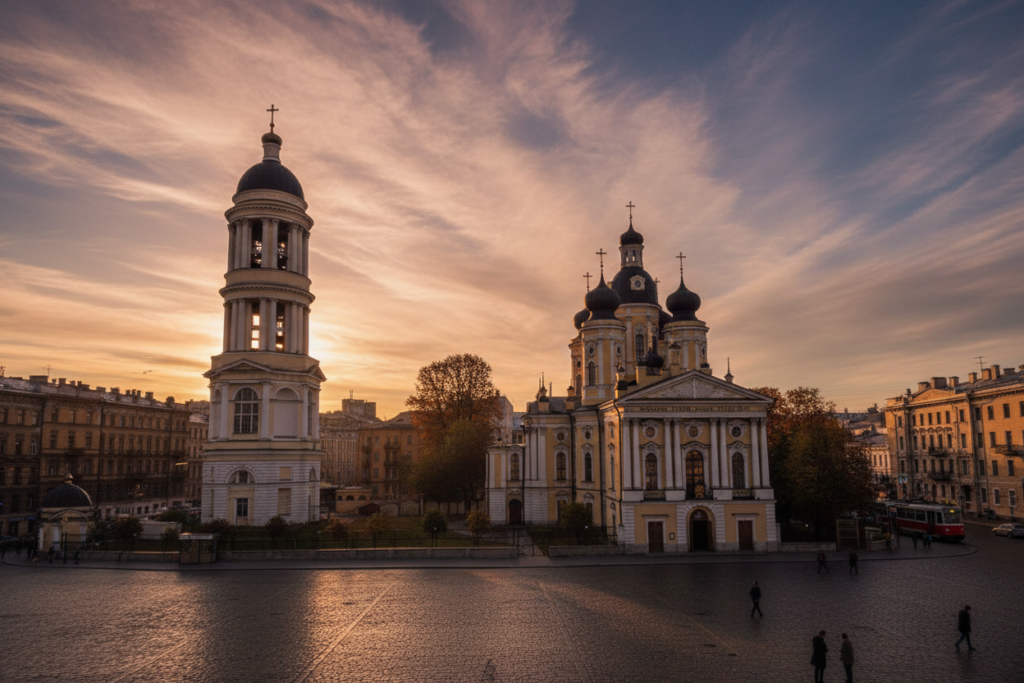
A small wooden church with a single dome appeared on the current Vladimir Square in 1747. The consecration was attended by Empress Elizabeth Petrovna. She donated 300 rubles to the temple, a huge amount of money at that time.
At the request of parishioners on the site of the dilapidated building, after 23 years began the construction of a stone temple. It was built for a long 15 years and completed under the reign of another Empress – Catherine II, in 1768.
Money for the interior decoration of the temple was not spared. He was amazing with his splendor. Eyewitnesses admired icons, utensils and numerous liturgical books. Alas, none of this has reached our days.
In 1810 the old iconostasis was replaced. Replaced not with a new, but with an iconostasis from the Resurrection Church of Anichkov Palace. It was made from Rastrelli’s drawings. Fortunately, this iconostasis is almost completely preserved. This is the only iconostasis of Rastrelli that has come down to us.
In this church, Arina Rodionovna, the nanny of Pushkin and his best friend, Anton Delvig, was buried. The parishioners of the temple were Dostoevsky, Nekrasov, Rimsky-Korsakov, Kuprin, Lev Gumelev. It is with the names of Lev Gumilev and Academician Likhachev that the restoration of the church is associated. It was closed in 1932. The room was used for book funds and even as a knitting factory. After the appeal of Gumilev and Likhachev, which was supported by many cultural figures, the church was transferred to the diocese and its restoration began. The first service was held in April 1990.
Shrines of the temple:
Icon of the Mother of God of Vladimir
Icon of the “Savior without hands”
The image of Seraphim of Sarov and a particle of his relics
At the church there is a Sunday school «Logos», a school of bell ringers, a youth Orthodox club.
Charitable Foundation Holy Land
Russian Temples and Monasteries